
QUBIC BLOG POST
OpenAI Says "AGI Is Here": What GPT-6 Astra Actually Proves
Written by

Qubic Scientific Team
Published:

Listen to this blog post
Neuraxon Intelligence Academy · Volume 13 · By the Qubic Scientific Team
GPT-6 Astra and OpenAI's "AGI Is Here" Announcement
GPT-6 Astra is OpenAI's largest model, with more than 100,000 GPUs at its Texas center (Fried, 2026). The presentation showcased tasks such as designing circuit boards, building 3D games, preparing tax returns, or improving mathematical results on gaps between prime numbers. It was also the first model that the company itself classified as "critical" risk in cybersecurity.
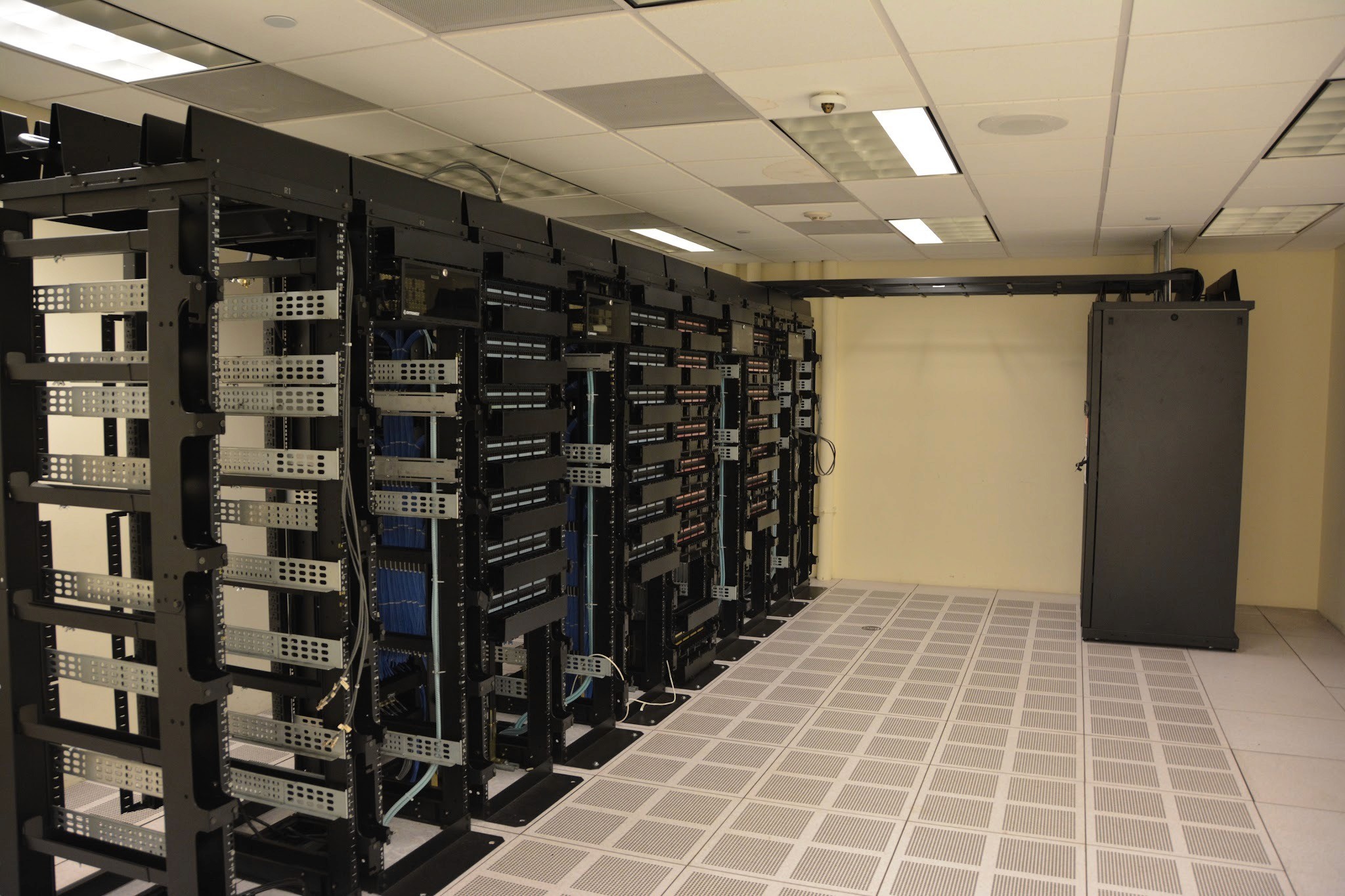
Figure 1. GPT-6 Astra was trained in a single data center on more than 100,000 accelerators, a portrait of centralized AI compute. Image:Datacenter Server Racks, Wikimedia Commons (CC BY 2.0)
.jpg)
The claim about AGI was more careful than the headlines suggested. Greg Brockman said that it is "not unreasonable to feel that we are now in the AGI era," that he personally thinks "we're there," and that he leaves it "up to the reader to decide for themselves" whether the model qualifies (Lardinois, 2026). Three days later, Jensen Huang, CEO of NVIDIA, whose chips trained the model, went further: "AGI has arrived" (PYMNTS, 2026). It was not the first time he had said so.
How OpenAI's AGI Definition Changed Shape (and the Microsoft Clause)
OpenAI's founding charter, from 2018, defines AGI as "highly autonomous systems that outperform humans at most economically valuable work." For years that definition had contractual consequences, since the agreement with Microsoft included a clause under which a declaration of AGI altered the rights of access to the technology and the revenue sharing.
That clause no longer exists. On April 27, 2026, both companies amended their agreement so that payments would continue until 2030 "independent of OpenAI's technology progress" (Stetskov, 2026). One hundred and twenty-nine days later came the Astra announcement. Brockman himself explained it at the presentation: there is no longer any "contractual AGI triggering," and the term now works as a "mission concept or spiritual concept" (Lardinois, 2026).
While the word had economic consequences, it was used with caution. When it stopped having them, it became a banner. In this way, an expression without an operational definition ends up meaning whatever is convenient at any given moment. We already showed in NIA 11 that each lab anchors AGI to the capabilities it already masters or promises to master. The Astra announcement is the proof. Not even results on GDPval, the company's own test of professional tasks across dozens of occupations, were presented (Stetskov, 2026).
What the Independent Data Say: GPT-6 Astra on the ARC-AGI-3 Benchmark
The most relevant external evaluation was published by ARC Prize on the same day as the launch. On ARC-AGI-3, Astra scored 62.7% under the standard protocol and 99.9% with a "provider adapter" that preserves the internal reasoning state between requests and compacts long conversations (Kamradt, 2026). This shows that much of the performance depends on the scaffolding surrounding the model and not only on the model.
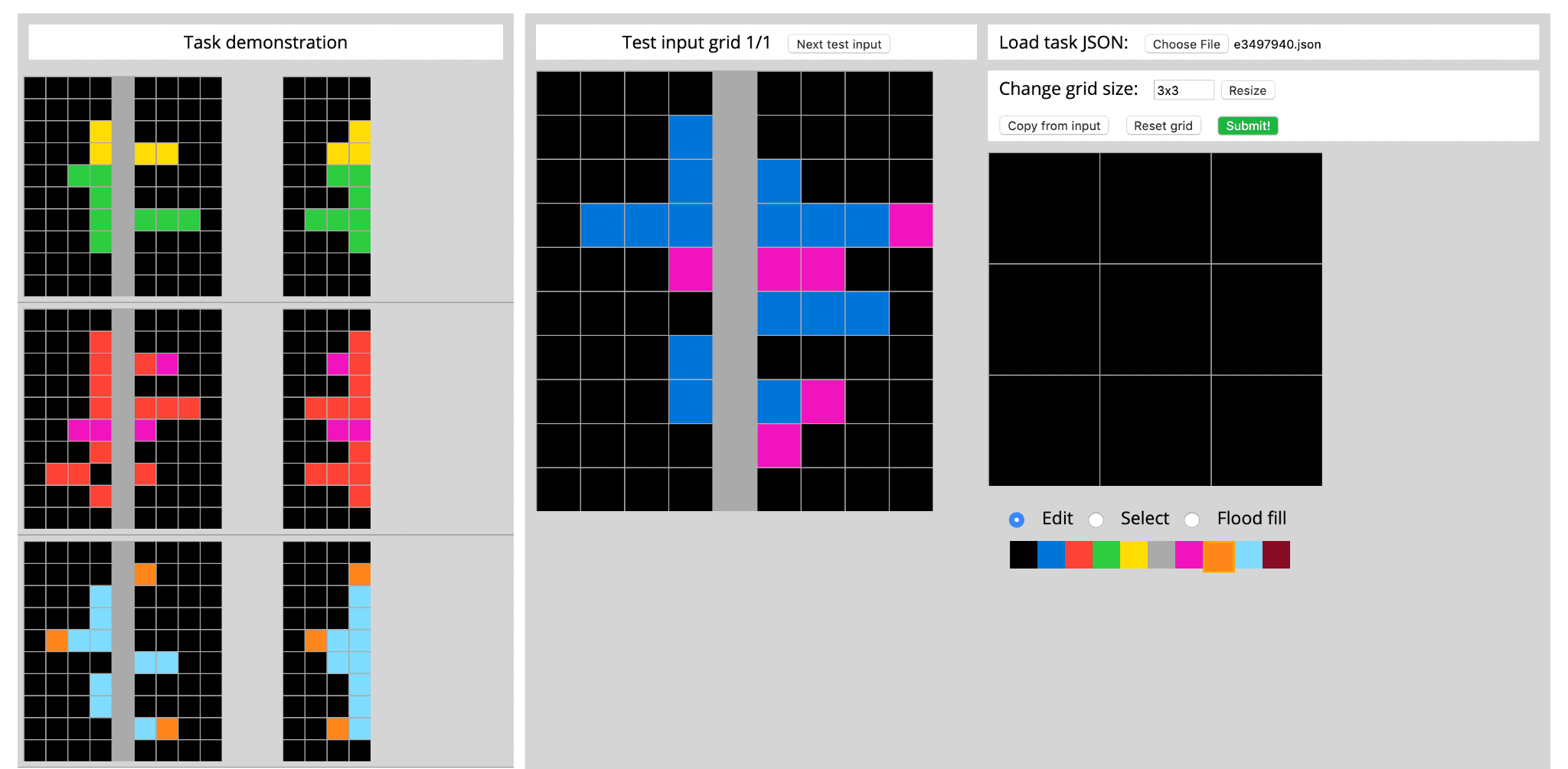
Figure 2. The ARC-AGI benchmark presents abstract grid-transformation puzzles: infer the rule from a few demonstrations, then apply it to a new input. GPT-6 Astra scored 62.7% on ARC-AGI-3 under the standard protocol. Image:ARC-AGI testing interface, François Chollet (Apache License 2.0)
ARC Prize's analysis acknowledges that once the system understands the mechanics of a game, it executes it with fewer actions than humans on 96% of levels, and it builds remarkably precise symbolic models of the environment. On the other hand, it states unambiguously that saturating the benchmark "would not represent 'proof of achieving AGI'," because these are environments very far from the complexity of the real world (Kamradt, 2026).
Evaluating Astra on the semi-private set cost between about $17,000 and $50,000 in API calls, depending on the configuration. The human participants in the reference study were paid around $13 per game attempted (Kamradt, 2026). The two figures are not directly comparable, but they do indicate the order of magnitude. If general intelligence has anything to do with the efficiency with which something new is learned, as Chollet (2019) proposed, the energy and money each solution costs are part of the answer.
Why "AGI" Can Bear Anything: Goodhart's Law Meets Artificial General Intelligence
AGI today works as an umbrella term that serves several functions at once. It is a research horizon, a fundraising argument, a contractual criterion when convenient, and a slogan when not.
There is a classic law of economics that describes this phenomenon well. Goodhart (1984) observed that any statistical regularity tends to collapse once pressure is placed on it for control purposes. That is, when a measure becomes a target, it ceases to be a good measure. Something similar happens with AGI, but in the realm of language. If the word becomes a commercial target, it stops describing a property of systems and starts describing a market expectation. M. G. Siegler summed it up ironically: "AGI is here and my computer still can't automatically get my mom home from the airport?" (Siegler, 2026). The joke points to something serious. General intelligence is at stake in the coordination of many systems in an open world, not in a model's score on a battery of tests.
The most revealing thing about the presentation was not what was said about AGI, but what was not said about power. Astra was trained in a single data center with more than one hundred thousand accelerators. Access to it is distributed in tiers: first, selected cybersecurity customers; then, paying subscribers; free users have no access planned in the short term (Nogueira, 2026). And the decision as to whether or not the system is AGI is left, literally, to the judgment of whoever reads about it.
This sketches a concrete model of what a general intelligence would be: a centralized product, trained with resources that only a few organizations can gather, evaluated mainly by whoever sells it, and distributed according to a commercial policy. The more capable the system, the more that model matters. A system classified as critical in cybersecurity is not just a tool; it is a concentration of capability.
In Volume 11 we argued, with Hayek (1945) and Ashby (1956), that no single intelligence can replace a society, because the knowledge a society needs is dispersed and because no central controller can absorb the variety of a system more complex than itself. Here we add the other side of the argument. If general intelligence arrives, the way its construction and control are organized will be as important as its capabilities.
Qubic's Vision: AGI as a Distributed, Decentralized Process
At Qubic we do not think of AGI as a model that crosses a threshold, but as an organization that emerges. That vision has three levels of decentralization.
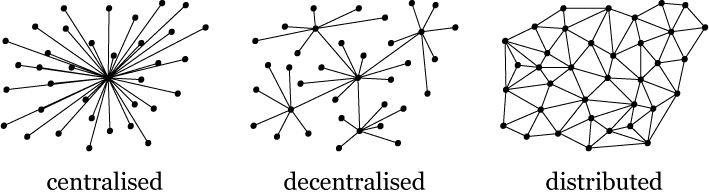
Figure 3. Paul Baran's classic models of centralized, decentralized and distributed networks (1964). Qubic's vision of AGI maps to the right-hand distributed model, thousands of nodes, none controlling the whole. Image:Centralised, decentralised and distributed networks, Wikimedia Commons (public domain)

1. Decentralized Computation: Useful Proof of Work and Aigarth
The first is computation. On the Qubic network, useful proof of work directs miners' power toward training and evaluating neural networks instead of solving worthless cryptographic puzzles (Qubic, n.d.). Aigarth, Qubic's evolutionary framework, analyzes the properties of the networks those miners generate. It is a model opposite to that of the large data center: thousands of distributed processors, each contributing part of the effort, with none of them controlling the whole.
2. Decentralized Architecture: Neuraxon and the Society of Mind
The second is architecture. Neuraxon does not pursue a single giant model, but networks of simple units that coordinate, regulate themselves, and organize into interconnected specialized spheres. It is Minsky's (1986) intuition of a mind as a society of processes, brought into the realm of computational simulation. If generality appears between components and not within any one of them, decentralization is not a political decision added to the design. It is the design itself.
3. Open Verification: Public Benchmarks and ARC-AGI-3
The third is verification. A claim about general intelligence should not depend on the judgment of whoever sells it. Our results are published at peer-reviewed conferences, the reference code is open, and evaluations are carried out with public benchmarks such as ARC-AGI-3, but with a few CPUs, not with GPUs with embedded LLMs. That is the price of open science.
But it would be dishonest to present decentralization as a magic solution. A distributed network, as things stand today, is much less capable at language tasks than a model trained on one hundred thousand GPUs. But if the history of computing teaches anything, it is that the architectures that win in the short term are not always the ones that scale best in the long term, nor the ones that are best governed. The human brain runs on about 20 watts, learns while it acts, and does not depend on a data center. A system inspired by those principles and built on a network that no one owns exclusively explores a different path, not a scaled-down version of the same path.
AGI Is Not an Announcement: Who Defines, Audits, and Controls It
There will be more announcements like Astra's. Each new model will be more capable than the previous one, and each launch will reopen the question of whether AGI has arrived. Instead of debating whether a particular system deserves the label, let us ask who defines the test, who has access to the results, who can audit the system, and who decides how it is used.
If intelligence is a system of systems, as we argued in previous volumes, its arrival will not be a press release. It will be a distributed, verifiable and, at best, shared process. That is the AGI we are interested in building.
References
Ashby, W. R. (1956). An introduction to cybernetics. Chapman & Hall.
Chollet, F. (2019). On the measure of intelligence (arXiv:1911.01547). arXiv. https://doi.org/10.48550/arXiv.1911.01547
Fried, I. (2026, September 3). "Welcome to the AGI era," OpenAI says as GPT-6 Astra debuts. Axios. https://www.axios.com/2026/09/03/openai-astra-gpt-6-agi-brockman
Goodhart, C. A. E. (1984). Problems of monetary management: The UK experience. In Monetary theory and practice (pp. 91–121). Macmillan. https://doi.org/10.1007/978-1-349-17295-5_4
Hayek, F. A. (1945). The use of knowledge in society. The American Economic Review, 35(4), 519–530. https://www.jstor.org/stable/1809376
Kamradt, G. (2026, September 3). OpenAI's GPT-6 Astra on ARC-AGI-3. ARC Prize. https://arcprize.org/blog/astra
Lardinois, F. (2026, September 3). OpenAI launches GPT-6 Astra and says welcome to the "AGI era". The New Stack. https://thenewstack.io/openai-gpt6-astra-benchmarks/
Minsky, M. (1986). The society of mind. Simon & Schuster.
Nogueira, C. (2026, September 4). OpenAI launches GPT-6 Astra, claims AGI era has begun. BetaNews. https://betanews.com/article/openai-gpt-6-astra-agi-era/
OpenAI. (2018). OpenAI Charter. https://openai.com/charter/
PYMNTS. (2026, September 7). Nvidia CEO: AGI has 'arrived' with new OpenAI model. https://www.pymnts.com/news/artificial-intelligence/2026/nvidia-ceo-artificial-general-intelligence-has-arrived-with-new-openai-model
Qubic. (n.d.). Useful Proof of Work (UPoW) and Artificial Intelligence (AI) in the Qubic ecosystem. Qubic Docs. https://docs.qubic.org/learn/upow/
Siegler, M. G. (2026, September 3). OpenAI's AGI Eras Tour. Spyglass. https://spyglass.org/agi-2026/
Stetskov, D. (2026, September 8). OpenAI changed the AGI deal. Then declared the era. Tech Trenches. https://techtrenches.dev/p/openai-agi-deal-era
Explore the Neuraxon Intelligence Academy Series
The Neuraxon Intelligence Academy (NIA) is Qubic's ongoing research series on brain-inspired, decentralized artificial general intelligence. Catch up on the previous twelve volumes:
NIA Vol. 1 — Neuraxon Time: Why Intelligence Is Not Computed in Steps, but in Time
NIA Vol. 2 — What Can a Neuron Compute? Dendritic Computation and the Limits of the Perceptron
NIA Vol. 3 — Neuromodulation and Brain-Inspired AI
NIA Vol. 4 — Neural Networks in AI and Neuroscience: How the Brain Inspires Artificial Intelligence
NIA Vol. 5 — Astrocytes and Brain-Inspired AI: How Astrocytic Gating Transforms Neural Network Plasticity
NIA Vol. 6 — Conscious Machines vs Intelligent Organisms: AI Consciousness Explained
NIA Vol. 7 — Conway's Game of Life, Artificial Life, and Digital Ecosystems: The Science Behind Qubic, Aigarth, and Neuraxon
NIA Vol. 8 — Brain Criticality and the Branching Ratio in Neural and Artificial Networks
NIA Vol. 9 — The g Factor, General Intelligence, and Artificial Life
NIA Vol. 10 — How to Measure AI Intelligence: g Factor vs ARC-AGI Benchmark Explained
NIA Vol. 11 — What Is AGI? The Limits, Visions & Definitions of Artificial General Intelligence
NIA Vol. 12 — How the Brain Processes Time
You are reading NIA Vol. 13 — OpenAI Says "AGI Is Here": What GPT-6 Astra Actually Proves.
Further Reading: Authoritative External Sources
ARC-AGI Benchmark — ARC Prize — the skill-acquisition-efficiency benchmark referenced throughout this piece.
On the Measure of Intelligence — François Chollet (arXiv) — the foundational paper on measuring intelligence as learning efficiency.
OpenAI Charter — OpenAI's original definition of AGI.
Useful Proof of Work (UPoW) & AI — Qubic Docs — how Qubic redirects mining toward training neural networks.
Intelligence Is Not Scale: A Scientific Response to Jensen Huang's AGI Claim — Qubic — Qubic's companion analysis of the "AGI has arrived" claim.