
QUBIC BLOG POST
How Does the Brain Handle Time: Distributed Clocks & AI Limits
Written by

Qubic Scientific Team
Published:
Listen to this blog post
Neuraxon Intelligence Academy · Volume 12 · By the Qubic Scientific Team
The brain does not have a central clock. It has many, distributed throughout the tissue and tuned to scales ranging from the microsecond to the seasons of the year.
We know that intelligence is not computed in steps but in time, in which the neuron acts as a dynamical system: a state that changes continuously and never resets. But it is not enough for each unit to live in continuous time. An organism has to measure intervals, anticipate what is coming, learn from causes that occurred seconds ago and, at the same time, remain stable for years. These are different temporal problems, and the brain does not solve them with the same mechanism.
For decades the psychology of time searched for a single internal clock, a kind of pacemaker that would emit pulses and a counter that would accumulate them. That idea had descriptive success, but neuroscience kept finding something else. The literature today distinguishes between dedicated models, which postulate a circuit specialized in measuring time, and intrinsic models, in which time is read from the very evolution of neural activity (Ivry & Schlerf, 2008). There is no single stopwatch. There are distributed mechanisms, specialized according to scale and function: the cerebellum for brief and precise intervals, cortico-striatal circuits for intervals of seconds, the cortex for the integration of long sequences (Merchant, Harrington & Meck, 2013; Paton & Buonomano, 2018).
From the Microsecond to the Seasons: The Time the Brain Already Knows How to Handle
The brain simultaneously manages events that last less than a blink and cycles that last months. No other machine covers such a wide range with the same tissue.
At the fastest end is the localization of sounds. A noise coming from the left reaches the left ear some tens or hundreds of microseconds before the right one. Brainstem circuits detect that difference and convert it into a direction in space (Grothe, Pecka & McAlpine, 2010). We are not aware of the calculation; we simply turn our head toward the sound. A little higher up, on the scale of tens of milliseconds, is speech. What distinguishes "ba" from "pa" is, to a large extent, how long it takes for the voice to begin vibrating after the lips open (voice onset time). A difference of a few tens of milliseconds changes the consonant we hear (Lisker & Abramson, 1964).
On the scale of seconds lies almost everything we do intentionally: catching a ball in flight, following the beat of a song, waiting our turn in a conversation, noticing that a traffic light is taking longer than usual. Here the brain does not only perceive, it also anticipates. It knows when the next thing should arrive and is surprised if it does not.
On the scale of minutes and hours slower changes appear, which we do not experience as events but as states. An intense smell stops being noticed after a while: this is habituation. Attention degrades after a period of sustained task. And the organism has ultradian rhythms, that is, cycles shorter than a day that repeat several times in twenty-four hours. The best known is that of sleep: during the night we alternate between non-REM and REM sleep phases in cycles of about ninety minutes. Stress hormones are not released continuously either, but in roughly hourly pulses, and that pulsatility serves a purpose: tissues respond differently to a hormone that arrives in pulses than to the same amount administered constantly (Lightman & Conway-Campbell, 2010).
Sleep deserves special mention, because it combines two clocks. One is a sleep pressure that accumulates with the hours of wakefulness and dissipates during sleep. The other is a rhythm of about twenty-four hours that opens and closes the sleep window regardless of how tired we are. During wakefulness synapses tend to strengthen overall, and during sleep they are readjusted downward, which preserves what is relevant and gives the brain back room to learn the next day (Tononi & Cirelli, 2014).
That twenty-four-hour rhythm is the circadian rhythm, from the Latin circa diem, "around a day." Its master clock is in the suprachiasmatic nucleus of the hypothalamus, a small group of neurons (about twenty thousand in rodents, counting both sides) located just above the crossing of the optic nerves (Abrahamson & Moore, 2001). Inside each of its cells, a loop of genes and proteins that activate and inhibit one another takes about twenty-four hours to complete a cycle (Takahashi, 2017). Light sets it to the correct time through cells in the retina that measure how much light there is in the environment (Hattar et al., 2002). Jet lag is the direct experience of this clock, in which the world changed time abruptly and the internal clock takes days to readjust.
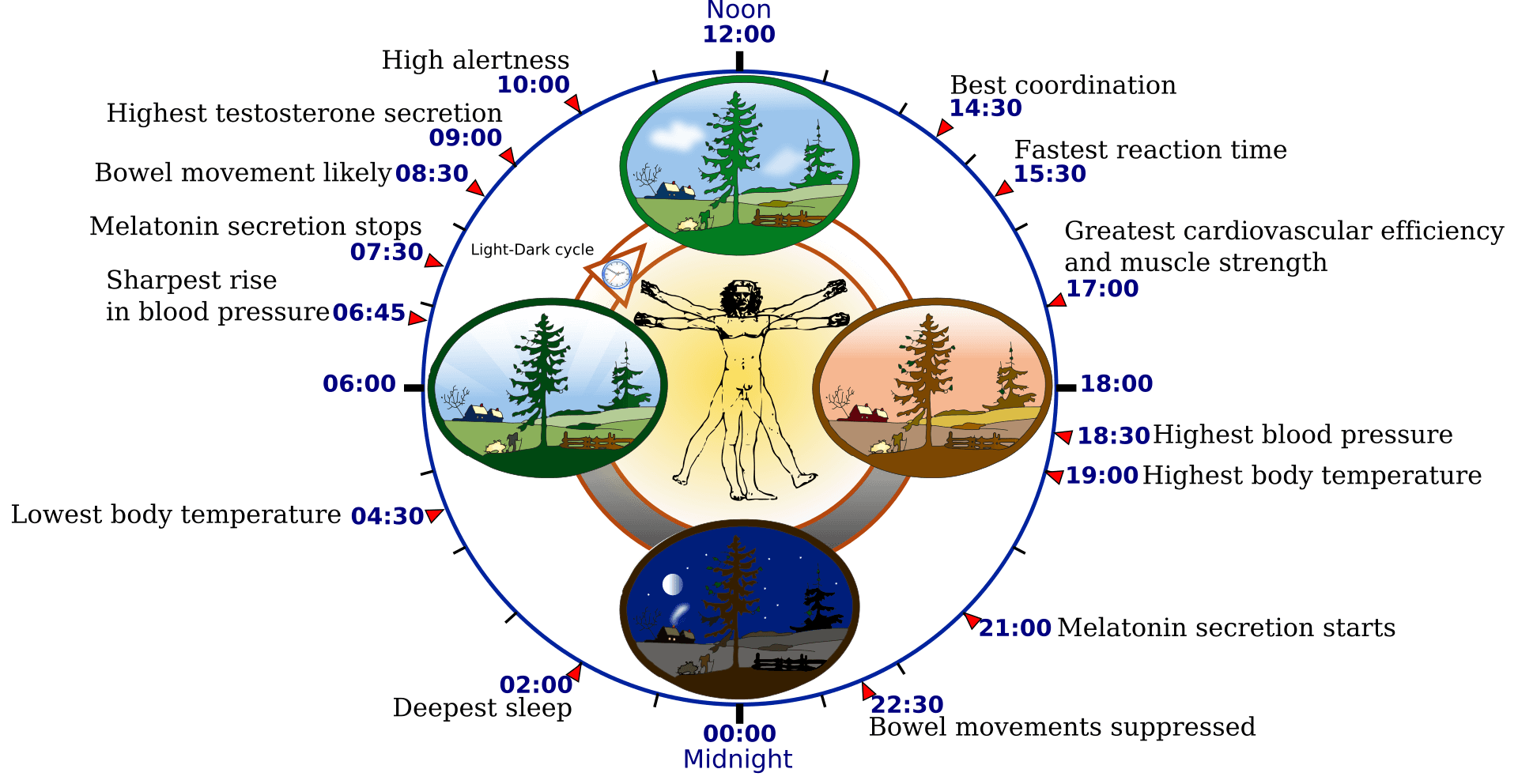
Figure 1. The circadian rhythm across a 24-hour day. A master clock in the suprachiasmatic nucleus synchronizes sleep, hormone release, and alertness to the light-dark cycle. Image: "Biological clock (human),"Wikimedia Commons (public domain).

Above the day are the infradian rhythms, longer than twenty-four hours. In the female rat, the density of dendritic spines in the hippocampus, the small protrusions where synapses form, drops by about 30% in just twenty-four hours within an estrous cycle of four or five days that follows estradiol levels (Woolley & McEwen, 1992). The wiring of a structure key to memory changes rhythmically.
Beyond that are the seasonal rhythms: the duration of nocturnal melatonin secretion encodes the length of the night, and thus many mammals know what time of year it is (Wehr, 2001).
There remains the scale of a lifetime. During development there are critical periods in which certain circuits can only be organized within a specific time window; if experience arrives late, the circuit does not form the same way (Hensch, 2005). The brain does not only measure time. It is built in time.
All these scales coexist in the same organ and influence one another. The circadian clock opens the sleep window, sleep readjusts the synapses, hormones modify the wiring, and all of this conditions what is learned in a given second. That coexistence is the phenomenon that we want, as far as possible, to simulate.
A Hierarchy of Temporal Windows in the Cortex
The first clue to that architecture is that different cortical regions do not "remember" for the same length of time. Murray and colleagues (2014) measured how long it takes for the autocorrelation of the spontaneous activity of neurons to fade in different areas of the macaque. Sensory areas have short time constants: they respond quickly and forget quickly. Prefrontal and association areas have much longer constants: they integrate information over a longer time. The cortex is ordered as a hierarchy of temporal windows.
In humans, something equivalent was observed with narrative stimuli. Hasson and colleagues (2008) presented films scrambled at different scales, from fragments of seconds to complete scenes. Primary sensory areas responded the same regardless of the scrambling. Higher-order areas responded reliably only when structure at long scales was preserved. Each region has its own "temporal integration window." Kiebel, Daunizeau and Friston (2008) gave this observation a computational reading: if the world generates causes that change at different speeds, a brain that wants to predict it needs a hierarchy of timescales that reflects that structure.
There is even a privileged scale for experience. Pöppel (1997) gathered evidence that we integrate events into windows of about two or three seconds, a functional "present" that groups what we perceive as simultaneous or continuous. It is not a magic number. It is the consequence of the nervous system working with several nested time constants.
Time as State: Population Clocks and Time Cells
If there is no central clock, how does a network know how much time has passed? The most elegant answer is that time is encoded in the very state of the network. Buonomano and Maass (2009) formulated it as state-dependent computation, where a recurrent network receives a stimulus that traverses a trajectory of activity that does not repeat. At each instant its configuration is different. A reader that learns to recognize that configuration is enough to know how much time has elapsed since the stimulus.
The hippocampus offers a striking version of this idea. During the empty intervals of a task, some neurons fire at specific moments of the interval, in sequence, as if marking successive seconds. They were called time cells (MacDonald et al., 2011; Eichenbaum, 2014). The lateral entorhinal cortex provides another piece: populations whose activity drifts gradually with experience, so that elapsed time can be decoded from the accumulated change of the population (Tsao et al., 2018). In both cases time is not measured with pulses, but with changes of state.
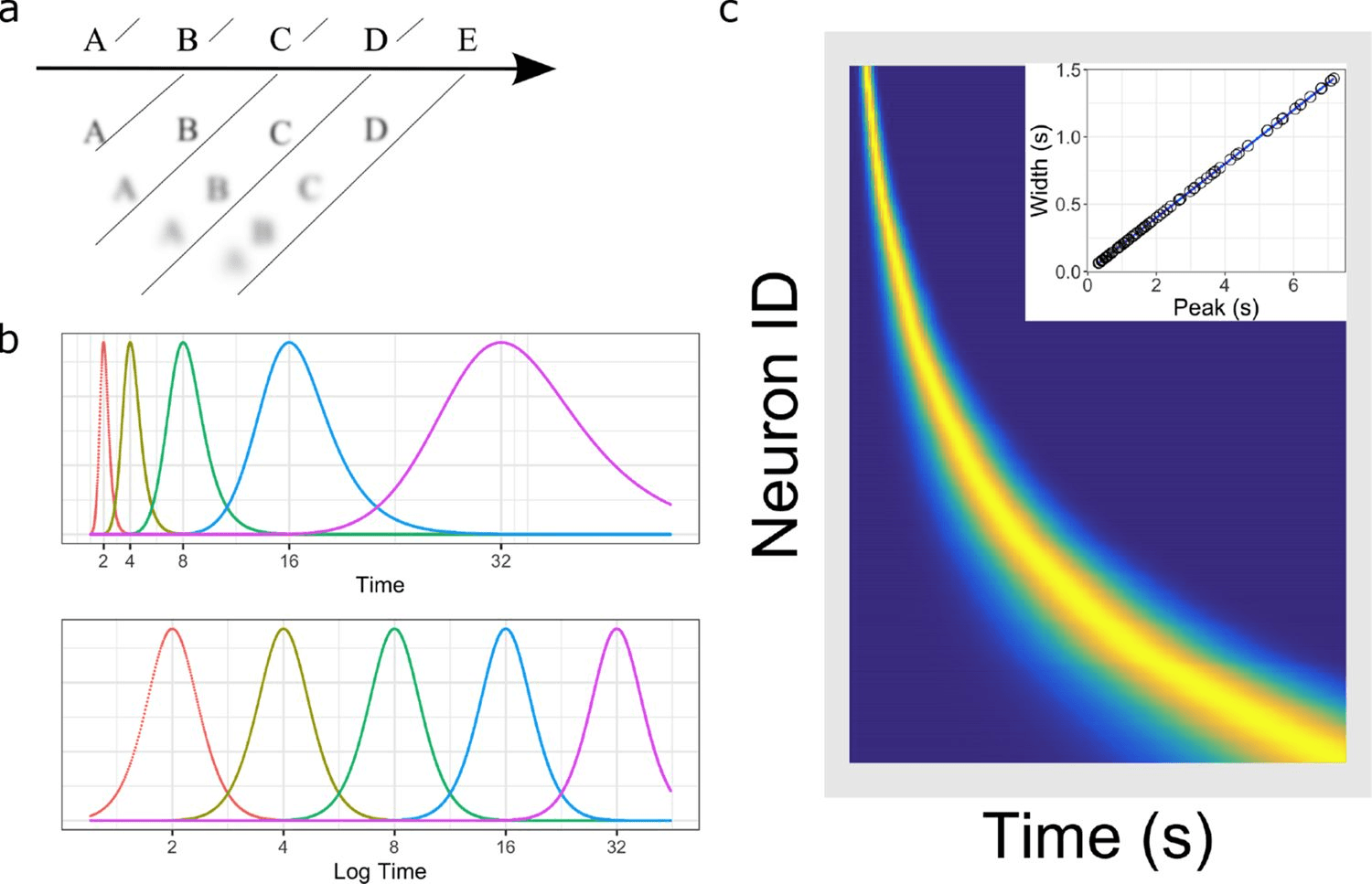
Figure 2. "Time cells" tile an interval: individual hippocampal neurons fire at successive moments, so elapsed time is read from the sequence of active cells rather than from a central clock. Image: Cao, Bladon et al. (2022),eLife 75353, Fig. 1,CC BY 4.0.
Learning in Time: Windows of Synaptic Plasticity
Representing time is one thing. Learning in time is another. The world rarely delivers the consequence in the same millisecond as the cause. The brain solves this problem with several overlapping windows of plasticity.
The briefest is spike-timing-dependent plasticity (STDP, one of Neuraxon's mechanisms). If a presynaptic neuron fires a few milliseconds before the postsynaptic one, the synapse is strengthened; if it fires after, it is weakened. The useful window is a few tens of milliseconds (Bi & Poo, 1998). It is a detector of local causality, very precise and very short.
That window is not enough to associate an action with a reward that arrives a second later. That is what eligibility traces are for: the coincidence of activity leaves a transient mark on the synapse, and that mark becomes a weight change if a neuromodulatory signal arrives while it persists. In dendritic spines of the striatum, dopamine strengthens synapses only if it arrives between about 0.3 and 2 seconds after the activity (Yagishita et al., 2014). The hippocampus adds behavioral timescale synaptic plasticity, capable of associating inputs separated by several seconds and of creating a place field in a single trial (Bittner et al., 2017).
Above these lie slower scales. Consolidation and structural plasticity operate over hours or days, and what is consolidated no longer depends on the activity of the moment.
Stability Without Freezing: Multi-Scale Homeostasis
A network that learns by Hebbian rules is unstable by nature. If what fires together is strengthened, what is strengthened fires more and is strengthened more. Without a counterweight, the network saturates or falls silent.
The brain has that counterweight. Turrigiano (2008) described synaptic scaling: when a neuron remains too active for hours, it proportionally reduces the strength of all its synapses, and increases it if it remains too silent. Intrinsic excitability adjusts in a similar way (Desai, Rutherford & Turrigiano, 1999). In vivo, this slow loop returns cortical activity to its set point over the course of days, and does so in a manner dependent on the states of wakefulness and sleep (Hengen et al., 2016).
But there is a difficulty. Hebbian plasticity acts in seconds and synaptic homeostasis in hours. Zenke, Gerstner and Ganguli (2017) showed that such a slow regulator cannot, by itself, curb such a fast instability. The conclusion is that there must be fast compensatory mechanisms, acting at almost the same speed as learning, and that slow homeostasis takes care of something else: correcting long-term drift. Stability is not provided by a thermostat, but by a cascade of regulators, each at its own scale.
Memory theory reaches a parallel conclusion. Benna and Fusi (2016) demonstrated that synapses with a single timescale, if they change quickly, learn well but forget soon; and if they change slowly, they retain but barely learn. Synapses with internal variables coupled to different scales escape that dilemma and multiply memory capacity. Multi-scale organization is the solution to a computational problem.
What Does a Transformer Do with Time?
With this whole framework we can look at the architecture that dominates current artificial intelligence. A Transformer processes a sequence of text fragments (tokens). So that the model knows in what order they appear, a positional encoding is added to each token, where a vector indicates whether it is the first, the second, or the thousandth (Vaswani et al., 2017). Then the attention mechanism compares all tokens with all tokens at once.
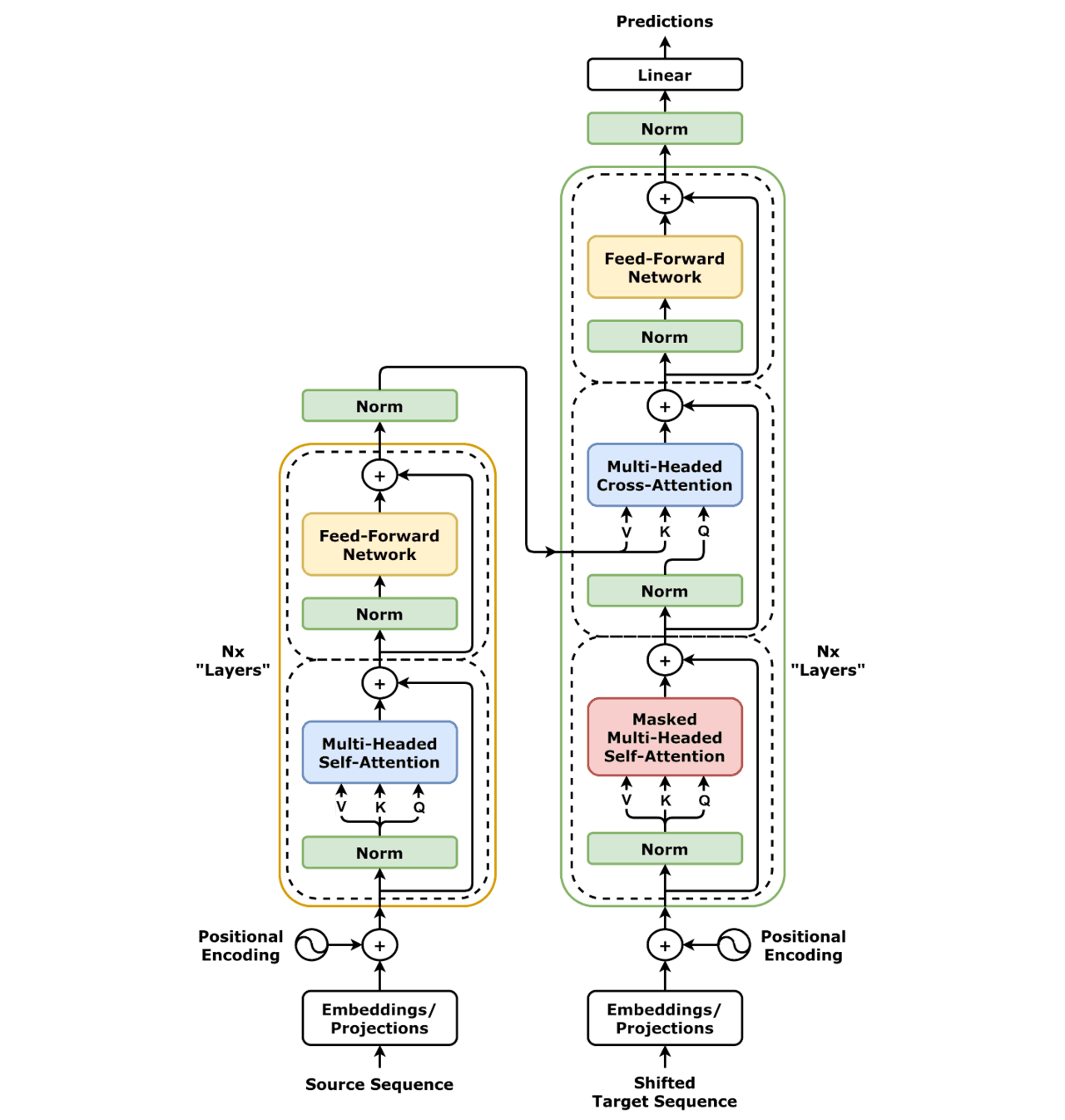
Figure 3. The Transformer architecture. Order is supplied once, as a positional encoding added to each token; self-attention then compares all tokens simultaneously, so the model treats sequence position as an index rather than living through time. Image: "Transformer, full architecture,"Wikimedia Commons (CC BY-SA 4.0).

The consequence is profound. For a Transformer, time is an index. There is no duration, only order. A silence of one second and one of an hour are indistinguishable if they do not generate different tokens. Moreover, the entire context is available simultaneously. The model does not live through the sequence; it contemplates it whole, like a map spread out on a table. In neuroscientific terms, it has turned time into space.
Nor are there learning timescales during use. The weights are fixed during training and remain frozen. What the model "remembers" within a conversation lives in its context window, which is an external and finite working memory. What it knows about the world stops at its cutoff date. Between the scale of the context window and the scale of retraining, which is measured in months, there is nothing.
Four Limitations of Transformers That Follow from That Choice
The first limitation is insensitivity to duration. Many phenomena of the physical and social world depend on how long something lasts, not only on what comes before. Transformers applied to time series illustrate the cost. A simple linear model outperformed several Transformer architectures specialized in long-series forecasting, partly because attention, being permutation-invariant, loses information about fine temporal order that positional encoding does not fully restore (Zeng et al., 2023).
The second is flat memory. The context window has no hierarchy of scales: everything that fits is equally present and whatever does not fit disappears. Not even within the window is access homogeneous. Models retrieve information located in the middle of long contexts worse than information at the beginning or the end (Liu et al., 2024). There is no equivalent to the nested windows described by Murray and Hasson.
The third is the rigid separation between learning and acting. A Transformer does not learn while it operates. If it is retrained with new data without precautions, it tends to overwrite what came before, a phenomenon known for decades as catastrophic interference (McCloskey & Cohen, 1989). It is exactly the single-scale dilemma, where without slow variables to protect what has been consolidated, the fast erases the old.
The fourth is imported stability. The network does not regulate itself. Its stability depends on fixed mathematical normalizations, on learning-rate schedules designed by engineers, and on a training process that ends. It works precisely because the system stops changing. An organism cannot afford that solution.
None of this denies the power of Transformers. It explains why they perform so well on tasks where the world fits into a text and so poorly when one has to act, wait, anticipate, and correct in an environment that keeps moving. There are alternatives within deep learning itself, such as liquid time-constant networks (Hasani et al., 2021) or state-space models. They are real advances, and they confirm that time has to be incorporated into the dynamics.
How Neuraxon 3.0 Attempts It: Multi-Scale Temporal Homeostasis (MSTH)
Neuraxon starts from the premise opposite to that of the Transformer. Time is not encoded as position; rather, it is the variable over which the state of each unit evolves. Neuraxon 2.0 already introduced continuous-time processing, synapses with fast and slow components, and a ChronoPlasticity mechanism that allows each synapse to adjust its memory horizon. Neuraxon 3.0, currently in development, reorganizes these pieces around the hierarchy of scales we have described.
The first decision is to separate what the brain separates. One thing is the synaptic current, which rises and dissipates in milliseconds according to receptor kinetics. Another is the weight, which persists. Conflating both variables makes memory depend on the noise of the instant (Destexhe, Mainen & Sejnowski, 1994; Tsodyks & Markram, 1997).
The second is to stack plasticity windows. On the millisecond scale, a rule dependent on spike order operates. On the scale of seconds, eligibility traces that wait for a neuromodulatory signal, in line with the experimentally described retroactive dopamine (Yagishita et al., 2014; Brzosko, Schultz & Paulsen, 2015), and a hippocampus-inspired behavioral-timescale plasticity. At slower scales, metaplastic gates and astrocytic domains that decide how much a group of synapses can change.
The third is multi-scale homeostasis, which in Neuraxon we call MSTH (Multi-Scale Temporal Homeostasis). Instead of a single thermostat, four coordinated regulatory loops, from an ultrafast one that damps bursts of activity to a slow one that corrects long-term drift. It is the computational translation of the argument by Zenke, Gerstner and Ganguli (2017): the fast regulators contain Hebbian instability and the slow ones preserve the set point without freezing learning. Criticality, the regime in which activity neither dies out nor runs away, is measured as an observable of the system (Wilting & Priesemann, 2018).
Neuraxon 3.0 is today an architecture in design, and the contribution of MSTH will be subjected to specific experiments in long-horizon regimes before claiming anything about its effectiveness. Nor does it yet incorporate an offline consolidation phase equivalent to sleep, which the preceding overview suggests is essential and which we consider one of the main pending tasks.
Why Time Matters for Qubic
The intelligence we seek does not answer closed questions. It acts in environments that change while it acts. The interactive games of ARC-AGI-3 show this well: they do not present a problem statement, but a world whose rules are discovered by playing, turn by turn. A system that does not distinguish between what just happened and what happened fifty moves ago, that cannot associate an action with its delayed consequence, and that does not learn while it plays, is at a structural disadvantage.
That is why time is not an implementation detail in Neuraxon. It is the ground on which it is decided whether an architecture can adapt. And that is why it makes sense for it to be developed on a network like Qubic, which operates continuously and with state, where a system can persist, change, and regulate itself without anyone resetting it. The brain took hundreds of millions of years to learn to manage time on many scales at once. We are trying to compute that unique characteristic.
References
Abrahamson, E. E., & Moore, R. Y. (2001). Suprachiasmatic nucleus in the mouse: Retinal innervation, intrinsic organization and efferent projections. Brain Research, 916(1–2), 172–191. https://doi.org/10.1016/S0006-8993(01)02890-6
Benna, M. K., & Fusi, S. (2016). Computational principles of synaptic memory consolidation. Nature Neuroscience, 19(12), 1697–1706. https://doi.org/10.1038/nn.4401
Bi, G. Q., & Poo, M. M. (1998). Synaptic modifications in cultured hippocampal neurons: Dependence on spike timing, synaptic strength, and postsynaptic cell type. Journal of Neuroscience, 18(24), 10464–10472. https://doi.org/10.1523/JNEUROSCI.18-24-10464.1998
Bittner, K. C., Milstein, A. D., Grienberger, C., Romani, S., & Magee, J. C. (2017). Behavioral time scale synaptic plasticity underlies CA1 place fields. Science, 357(6355), 1033–1036. https://doi.org/10.1126/science.aan3846
Borbély, A. A. (1982). A two process model of sleep regulation. Human Neurobiology, 1(3), 195–204.
Brzosko, Z., Schultz, W., & Paulsen, O. (2015). Retroactive modulation of spike timing-dependent plasticity by dopamine. eLife, 4, e09685. https://doi.org/10.7554/eLife.09685
Buonomano, D. V., & Maass, W. (2009). State-dependent computations: Spatiotemporal processing in cortical networks. Nature Reviews Neuroscience, 10(2), 113–125. https://doi.org/10.1038/nrn2558
Desai, N. S., Rutherford, L. C., & Turrigiano, G. G. (1999). Plasticity in the intrinsic excitability of cortical pyramidal neurons. Nature Neuroscience, 2(6), 515–520. https://doi.org/10.1038/9165
Destexhe, A., Mainen, Z. F., & Sejnowski, T. J. (1994). Synthesis of models for excitable membranes, synaptic transmission and neuromodulation using a common kinetic formalism. Journal of Computational Neuroscience, 1(3), 195–230. https://doi.org/10.1007/BF00961734
Eichenbaum, H. (2014). Time cells in the hippocampus: A new dimension for mapping memories. Nature Reviews Neuroscience, 15(11), 732–744. https://doi.org/10.1038/nrn3827
Grothe, B., Pecka, M., & McAlpine, D. (2010). Mechanisms of sound localization in mammals. Physiological Reviews, 90(3), 983–1012. https://doi.org/10.1152/physrev.00026.2009
Hasani, R., Lechner, M., Amini, A., Rus, D., & Grosu, R. (2021). Liquid time-constant networks. Proceedings of the AAAI Conference on Artificial Intelligence, 35(9), 7657–7666. https://doi.org/10.1609/aaai.v35i9.16936
Hasson, U., Yang, E., Vallines, I., Heeger, D. J., & Rubin, N. (2008). A hierarchy of temporal receptive windows in human cortex. Journal of Neuroscience, 28(10), 2539–2550. https://doi.org/10.1523/JNEUROSCI.5487-07.2008
Hattar, S., Liao, H.-W., Takao, M., Berson, D. M., & Yau, K.-W. (2002). Melanopsin-containing retinal ganglion cells: Architecture, projections, and intrinsic photosensitivity. Science, 295(5557), 1065–1070. https://doi.org/10.1126/science.1069609
Hengen, K. B., Torrado Pacheco, A., McGregor, J. N., Van Hooser, S. D., & Turrigiano, G. G. (2016). Neuronal firing rate homeostasis is inhibited by sleep and promoted by wake. Cell, 165(1), 180–191. https://doi.org/10.1016/j.cell.2016.01.046
Hensch, T. K. (2005). Critical period plasticity in local cortical circuits. Nature Reviews Neuroscience, 6(11), 877–888. https://doi.org/10.1038/nrn1787
Ivry, R. B., & Schlerf, J. E. (2008). Dedicated and intrinsic models of time perception. Trends in Cognitive Sciences, 12(7), 273–280. https://doi.org/10.1016/j.tics.2008.04.002
Kiebel, S. J., Daunizeau, J., & Friston, K. J. (2008). A hierarchy of time-scales and the brain. PLoS Computational Biology, 4(11), e1000209. https://doi.org/10.1371/journal.pcbi.1000209
Kleitman, N. (1982). Basic rest-activity cycle—22 years later. Sleep, 5(4), 311–317. https://doi.org/10.1093/sleep/5.4.311
Lightman, S. L., & Conway-Campbell, B. L. (2010). The crucial role of pulsatile activity of the HPA axis for continuous dynamic equilibration. Nature Reviews Neuroscience, 11(10), 710–718. https://doi.org/10.1038/nrn2914
Lisker, L., & Abramson, A. S. (1964). A cross-language study of voicing in initial stops: Acoustical measurements. Word, 20(3), 384–422. https://doi.org/10.1080/00437956.1964.11659830
Liu, N. F., Lin, K., Hewitt, J., Paranjape, A., Bevilacqua, M., Petroni, F., & Liang, P. (2024). Lost in the middle: How language models use long contexts. Transactions of the Association for Computational Linguistics, 12, 157–173. https://doi.org/10.1162/tacl_a_00638
MacDonald, C. J., Lepage, K. Q., Eden, U. T., & Eichenbaum, H. (2011). Hippocampal "time cells" bridge the gap in memory for discontiguous events. Neuron, 71(4), 737–749. https://doi.org/10.1016/j.neuron.2011.07.012
McCloskey, M., & Cohen, N. J. (1989). Catastrophic interference in connectionist networks: The sequential learning problem. Psychology of Learning and Motivation, 24, 109–165. https://doi.org/10.1016/S0079-7421(08)60536-8
Merchant, H., Harrington, D. L., & Meck, W. H. (2013). Neural basis of the perception and estimation of time. Annual Review of Neuroscience, 36, 313–336. https://doi.org/10.1146/annurev-neuro-062012-170349
Murray, J. D., Bernacchia, A., Freedman, D. J., Romo, R., Wallis, J. D., Cai, X., Padoa-Schioppa, C., Pasternak, T., Seo, H., Lee, D., & Wang, X.-J. (2014). A hierarchy of intrinsic timescales across primate cortex. Nature Neuroscience, 17(12), 1661–1663. https://doi.org/10.1038/nn.3862
Paton, J. J., & Buonomano, D. V. (2018). The neural basis of timing: Distributed mechanisms for diverse functions. Neuron, 98(4), 687–705. https://doi.org/10.1016/j.neuron.2018.03.045
Pöppel, E. (1997). A hierarchical model of temporal perception. Trends in Cognitive Sciences, 1(2), 56–61. https://doi.org/10.1016/S1364-6613(97)01008-5
Takahashi, J. S. (2017). Transcriptional architecture of the mammalian circadian clock. Nature Reviews Genetics, 18(3), 164–179. https://doi.org/10.1038/nrg.2016.150
Tononi, G., & Cirelli, C. (2014). Sleep and the price of plasticity: From synaptic and cellular homeostasis to memory consolidation and integration. Neuron, 81(1), 12–34. https://doi.org/10.1016/j.neuron.2013.12.025
Tsao, A., Sugar, J., Lu, L., Wang, C., Knierim, J. J., Moser, M.-B., & Moser, E. I. (2018). Integrating time from experience in the lateral entorhinal cortex. Nature, 561(7721), 57–62. https://doi.org/10.1038/s41586-018-0459-6
Tsodyks, M. V., & Markram, H. (1997). The neural code between neocortical pyramidal neurons depends on neurotransmitter release probability. Proceedings of the National Academy of Sciences, 94(2), 719–723. https://doi.org/10.1073/pnas.94.2.719
Turrigiano, G. G. (2008). The self-tuning neuron: Synaptic scaling of excitatory synapses. Cell, 135(3), 422–435. https://doi.org/10.1016/j.cell.2008.10.008
Vaswani, A., Shazeer, N., Parmar, N., Uszkoreit, J., Jones, L., Gomez, A. N., Kaiser, Ł., & Polosukhin, I. (2017). Attention is all you need. In Advances in Neural Information Processing Systems 30 (pp. 5998–6008). https://arxiv.org/abs/1706.03762
Wehr, T. A. (2001). Photoperiodism in humans and other primates: Evidence and implications. Journal of Biological Rhythms, 16(4), 348–364. https://doi.org/10.1177/074873001129002060
Wilting, J., & Priesemann, V. (2018). Inferring collective dynamical states from widely unobserved systems. Nature Communications, 9, 2325. https://doi.org/10.1038/s41467-018-04725-4
Woolley, C. S., & McEwen, B. S. (1992). Estradiol mediates fluctuation in hippocampal synapse density during the estrous cycle in the adult rat. Journal of Neuroscience, 12(7), 2549–2554. https://doi.org/10.1523/JNEUROSCI.12-07-02549.1992
Yagishita, S., Hayashi-Takagi, A., Ellis-Davies, G. C. R., Urakubo, H., Ishii, S., & Kasai, H. (2014). A critical time window for dopamine actions on the structural plasticity of dendritic spines. Science, 345(6204), 1616–1620. https://doi.org/10.1126/science.1255514
Zeng, A., Chen, M., Zhang, L., & Xu, Q. (2023). Are transformers effective for time series forecasting? Proceedings of the AAAI Conference on Artificial Intelligence, 37(9), 11121–11128. https://doi.org/10.1609/aaai.v37i9.26317
Zenke, F., Gerstner, W., & Ganguli, S. (2017). The temporal paradox of Hebbian learning and homeostatic plasticity. Current Opinion in Neurobiology, 43, 166–176. https://doi.org/10.1016/j.conb.2017.03.015
Neuraxon Intelligence Academy: The Complete Series
Continue exploring the science behind brain-inspired AI, Aigarth, and Neuraxon in the previous volumes of the Neuraxon Intelligence Academy:
Vol. 1 — Neuraxon Time: Why Intelligence Is Not Computed in Steps, but in Time
Vol. 2 — Beyond Binary: Ternary Dynamics as a Model of Living Intelligence
Vol. 3 — Neuromodulation: What the Brain Does, What Transformers Do Not, and What Neuraxon Attempts
Vol. 4 — Neural Networks in AI and Neuroscience: From Biological Brain Function to Neuraxon Aigarth
Vol. 5 — Astrocytes and Brain-Inspired AI: How Astrocytic Gating Transforms Neural Network Plasticity
Vol. 6 — Conscious Machines vs Intelligent Organisms: AI Consciousness Explained
Vol. 8 — Brain Criticality and the Branching Ratio in Neural and Artificial Networks
Vol. 9 — The g Factor in Artificial Life: From Spearman's 1904 Classroom to Evolved Artificial Brains
Vol. 10 — How Do We Measure the Intelligence of a Machine? g Factor vs the ARC-AGI Benchmark
Vol. 11 — What Is AGI? The Limits, Visions & Definitions of Artificial General Intelligence