
QUBIC BLOG POST
Neuromodulation: What the Brain Does, What Transformers Do Not, and What Neuraxon Attempts
Written by

Qubic Scientific Team
Published:

Listen to this blog post
Neuraxon Intelligence Academy — Volume 3
1. Neuromodulation in the Brain: The Foundation of Adaptive Intelligence
Neuromodulation refers to the set of mechanisms that regulate how the nervous system functions at any given moment, without changing its basic architecture. Thanks to neuromodulation, the brain can learn quickly or slowly, become exploratory or conservative, and remain open to novelty or focus on what is already known. The wiring does not change; what changes is the way that wiring is used. This concept is central to understanding brain-inspired AI and the architecture behind Qubic’s Neuraxon.
Ionotropic vs. Metabotropic Receptors: Two Timescales of Neural Signaling
To understand neuromodulation properly, it is essential to distinguish between two forms of chemical action in the brain. On the one hand, there are neurotransmitters that act on ionotropic receptors, such as glutamate and GABA. These receptors are ion channels: when they are activated, they produce immediate electrical changes in the neuron, on the scale of milliseconds. This corresponds to the fast level of neural computation: concrete information is transmitted, sensory signals are integrated, rapid decisions are made, and the neuronal activity that sustains perception, movement, and real-time thought is generated.
On the other hand, there are neurotransmitters such as dopamine, noradrenaline, serotonin, and acetylcholine, whose primary action is exerted through metabotropic receptors. These receptors do not directly generate an electrical signal. Instead, they activate intracellular signaling cascades that modify the internal properties of the neuron over longer periods of time, seconds, minutes, or more. This represents the slow dynamic level of neural processing, which is fundamental to how the brain adapts and learns.
An intuitive way to think about this difference is through the metaphor of a seaport. Ionotropic receptors are like swimmers, surfers, or small boats that enter and leave quickly. Metabotropic receptors, by contrast, are like large cargo ships. For them to dock, permits are needed, coordination is required, and the port’s logistics must be adjusted. These metabotropic receptors alter synaptic plasticity and the ease with which a neuron responds—this slow modulation does not transmit information, but instead modifies the internal rules of the system.
The Four Neuromodulators: Dopamine, Noradrenaline, Serotonin, and Acetylcholine
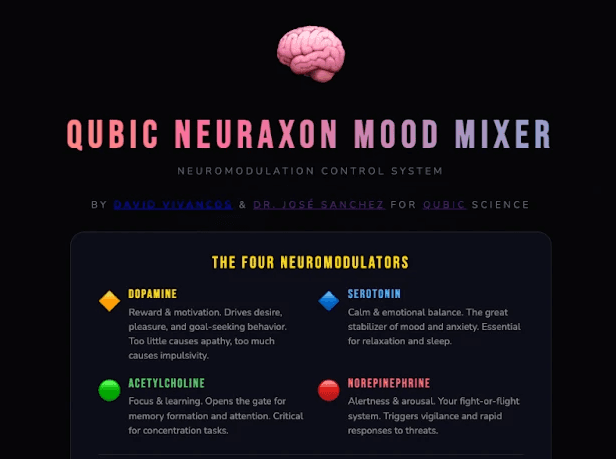
This is where the major neuromodulatory systems come into play. Each of these four neurotransmitters plays a distinct role in regulating how the brain processes information, learns, and adapts:
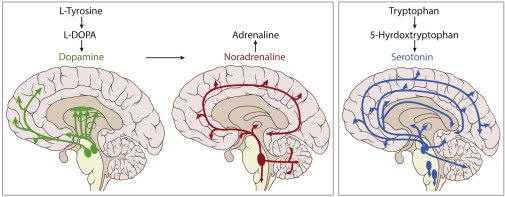
Dopamine, originating mainly from the ventral tegmental area and the substantia nigra, does not signal pleasure per se, but rather when something is relevant for learning. It adjusts the system’s sensitivity to errors and novelty. As Schultz (2016) demonstrated in his foundational work on dopamine reward prediction error coding, dopamine signals the difference between expected and actual outcomes, a mechanism critical for reinforcement learning in both biological and artificial systems.
Noradrenaline (Norepinephrine), released primarily from the locus coeruleus, regulates arousal and the balance between exploration and exploitation. When its tone is high, the brain becomes more sensitive to unexpected changes and less anchored to routines. This aligns with the integrative theory proposed by Aston-Jones & Cohen (2005), which links locus coeruleus–norepinephrine function to adaptive gain control and decision-making under uncertainty.
Serotonin, originating in the raphe nuclei, modulates mood, sleep, inhibition, and behavioral stability. As explored in Dayan & Huys (2009), serotonin does not push the system to learn rapidly, but rather to wait, to avoid impulsive reactions, and to maintain behavior when the environment is uncertain. It plays a critical role in patience and long-term planning.
Acetylcholine, released from basal forebrain nuclei in the brainstem, plays a central role in attention and context-dependent learning. It facilitates the opening of cortical networks to relevant sensory information and enables synaptic plasticity when the environment demands it. It is particularly important when something new must be learned, making it essential for adaptive neural computation.
Thanks to this combined action, the same stimulus can produce different responses depending on the neuromodulatory state. The circuit is the same, but the way it operates has changed. This is why the brain does not respond in the same way when it is attentive as when it is fatigued, nor does it learn in the same way in routine situations as it does in the face of novelty or surprise.
The Meta Level: Windows of Plasticity and Adaptive Learning
There is also a third, deeper level, which can be understood as a meta level of neural regulation. This level does not directly regulate neuronal activity or its speed, but rather the conditions under which the system can change in a lasting way. In the brain, coincident activity between neurons does not guarantee learning. For a connection to strengthen or weaken, the neuromodulatory state must permit it. It is as if there were a silent signal saying, “now yes,” or “now not.”
Neuromodulation thus acts as a system that opens or closes windows of plasticity, deciding when an error, an experience, or a coincidence deserves to be consolidated. This multiscale architecture, fast, slow, and meta, exists because an intelligent system cannot always apply the same rules. As Marder (2012) explained in her seminal review, neuromodulation of neuronal circuits is how the brain achieves behavioral flexibility without rebuilding its architecture.
The state of the body, energy levels, fatigue, or pain are part of the internal environment. Novelty, threat, opportunity, repetition, or predictability are part of the external environment. Neuromodulatory systems translate these conditions into functional states. Through dopamine, noradrenaline, serotonin, and acetylcholine, the brain evaluates whether a situation deserves learning, whether caution is required, whether exploration or conservation is preferable, and whether an error is informative or merely noise. The environment does not directly dictate the response, but it modulates the rules by which the brain responds. This principle is at the heart of what Friston (2010) described as the free-energy principle, a unified framework suggesting the brain continuously minimizes surprise through adaptive internal models.
2. Why Large Language Models and Transformer Architectures Lack Neuromodulation
Large language models (LLMs) and Transformer-based architectures do not possess neuromodulation. Although they process long sequences and have achieved remarkable performance in natural language processing, they lack a system that dynamically regulates the operating regime of the model during inference.
The Static Nature of Transformer-Based AI Systems
Learning in LLMs occurs during training phases that are entirely separate from use. Weights are adjusted through backpropagation of error, and once training is completed, the model enters a fixed state. During inference, there is no plasticity and no durable change as a function of context. The system does not decide when it is appropriate to learn and when it should stabilize, because it does not learn while it operates. This is the fundamental limitation that recent research has confirmed, LLMs lack true internal world models and the ability to adapt in real time.
Some neuromodulation-inspired approaches attempt to approximate certain effects by adjusting parameters such as the learning rate during training, activating or deactivating subnetworks, or modulating activation functions. However, these are merely external optimizations, not internal systems that regulate activity and plasticity in real time. As Mei, Müller & Ramaswamy (2022) argued in Trends in Neurosciences, informing deep neural networks by multiscale principles of neuromodulatory systems remains an open challenge, one that current LLM architectures have not addressed.
Although neuromodulation is sometimes mentioned in AI contexts, LLMs and Transformers remain partial approximations, not systems comparable to the brain. The gap between static matrix computations and the dynamic, state-dependent regulation found in biological neural networks is precisely what makes brain-inspired AI architectures like Neuraxon a necessary next step toward adaptive artificial intelligence.
3. How Neuraxon Computes Neuromodulation: Brain-Inspired AI Architecture
In Neuraxon, computation is a process that unfolds in continuous time. The code expresses a system that maintains internal states, s(t), which evolve even in the absence of clear external stimuli. These states influence future behavior, creating a living neural system that is always active, a concept explored in detail in the Neuraxon research paper.
Fast, Slow, and Meta Dynamics in Neural Computation
Neuraxon explicitly incorporates fast, slow, and meta dynamics, mirroring the multiscale temporal architecture found in the biological brain. Fast dynamics govern the immediate propagation of activity, analogous to rapid neuronal signaling through ionotropic receptors. Slow dynamics introduces accumulation, persistence, and stabilization of patterns, allowing the system to retain information beyond the instant, similar to how metabotropic receptors modulate neural function over seconds and minutes. Meta dynamics act on the rules of interaction between the former, modulating when the system becomes more sensitive to change and when it tends to preserve its state.
Neuromodulation in Neuraxon is not implemented as an external parameter adjustment. The system does not explicitly decide what to learn, but rather under which conditions it can change. This mirrors how biological neuromodulators like dopamine and serotonin create windows of plasticity rather than directly encoding information. You can explore these dynamics firsthand with the interactive Neuraxon 3D simulation on HuggingFace Spaces, where you can adjust dopamine, serotonin, acetylcholine, and norepinephrine levels in real time and observe how they affect network behavior.
From Biological Principles to Decentralized AI
This approach does not reproduce the molecular or anatomical complexity of the brain, which is currently impossible to replicate. There are no thousands of receptors or real biological networks. However, it preserves and computes an essential principle: intelligence is adaptive, and therefore requires internal dynamics, state, and modulation.
Neuraxon’s neuromodulation architecture is a core part of Qubic’s broader vision for decentralized AI. By integrating Neuraxon with the Aigarth Intelligent Tissue evolutionary framework, Qubic creates a system where millions of Neuraxon-based architectures can evolve, compete, and improve through distributed computation, powered by the Qubic network’s Useful Proof of Work (UPoW) consensus mechanism.
4. Explore Neuromodulators with the Interactive Neuraxon Demo
Want to experience how neuromodulation works in a brain-inspired AI system? The Neuraxon Mood Mixer demo lets you adjust dopamine, serotonin, acetylcholine, and norepinephrine levels in real time and observe how these neuromodulators influence neural network behavior. It’s a hands-on way to understand the principles discussed in this article and see the difference between static AI computation and dynamic, state-dependent processing.
5. The Mathematics Behind Neuraxon’s Multiscale Neuromodulation
The temporal dynamics in Neuraxon are governed by three differential equations that capture the fast, slow, and meta timescales of neural computation:
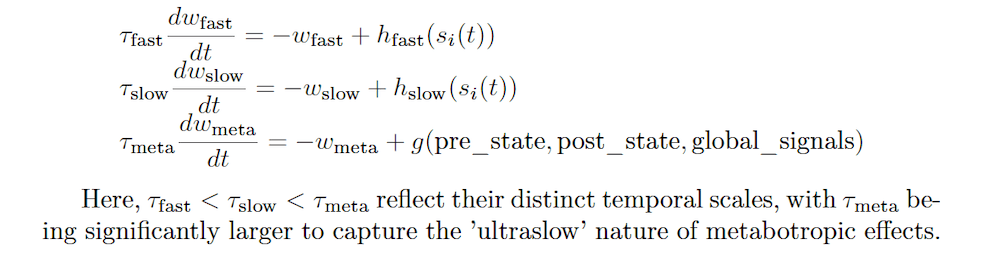
Here, τ_fast < τ_slow < τ_meta reflect their distinct temporal scales, with τ_meta being significantly larger to capture the ‘ultraslow’ nature of metabotropic effects. This mathematical framework directly implements the biological principle that neuromodulation operates on much slower timescales than fast synaptic transmission, as described by Northoff & Huang (2017) in their work on how the brain’s temporal dynamics mediate consciousness.
Scientific References
Dayan, P., & Huys, Q. J. M. (2009). Serotonin, inhibition, and negative mood. PLoS Computational Biology.
Marder, E. (2012). Neuromodulation of neuronal circuits: back to the future. Neuron.
Schultz, W. (2016). Dopamine reward prediction error coding. Dialogues in Clinical Neuroscience.
Aston-Jones, G., & Cohen, J. D. (2005). An integrative theory of locus coeruleus–norepinephrine function. Annual Review of Neuroscience.
Mei, L., Müller, E., & Ramaswamy, S. (2022). Informing deep neural networks by multiscale principles of neuromodulatory systems. Trends in Neurosciences.
Friston, K. (2010). The free-energy principle: a unified brain theory? Nature Reviews Neuroscience.
Northoff, G., & Huang, Z. (2017). How do the brain’s time and space mediate consciousness and its disorders? Consciousness and Cognition, 57, 1–10.