
QUBIC BLOG POST
Astrocytes and Brain-Inspired AI: How Biological Plasticity Regulation Shapes the Future of Neural Networks
Written by

Qubic Scientific Team
Published:
Listen to this blog post
Neuraxon Intelligence Academy - Volume 5
How Information Flows in Traditional Artificial Neural Networks
In the artificial intelligence models we know, information enters, is encoded, is transformed through algebraic matrices, and produces outputs. Even in the most advanced architectures such as transformers, the principle is the same: the signal passes through a series of well-defined operations within a structured system. The model functions as a directed processing circuit, from left to right, input-output, or from right to left, through backpropagation for adjustments and training.
The results, as we well know, are spectacular. By working over millions of language parameters, AI is capable of giving magnificent answers, along with some hallucinations, however. But if the goal is not to process inputs and produce outputs, but to build systems capable of maintaining an internal dynamics, adapting continuously, reorganizing themselves, regulating their learning, and sustaining intelligence as a property of the tissue, current AI falls short.
Although people sometimes speak of language models as imitations of the brain, in reality this is more of a comparative metaphor than a simulation of computational neuroscience. Biological systems do not handle information from left to right and vice versa. Information propagates through a network, feeds back on itself, and also oscillates, is dampened, or is reinforced depending on the context.
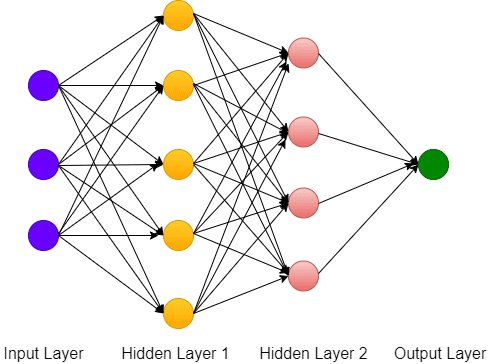
Fig 1. Left-right information flow in traditional artificial neural networks
Not Only Neurons: The Role of Astrocytes in Brain Function and Synaptic Plasticity
We usually associate cognition and intelligence with the functioning of neurons, their receptors, and neurotransmitters. But they are not the only cells in the nervous system. For a long time, astrocytes were considered nervous system cells devoted to support, cleaning, nutrition, and stability of the environment. Today we know that they actively participate in regulation; in fact, a term is used: tripartite synapse, in which they actively participate by detecting neurotransmitters, integrating signals from multiple synapses, modulating plasticity, and modifying the functional efficacy of the circuit.
A living network is not composed only of neurons that fire, but also of astrocytes that regulate how, when, and how much the system changes. In biology, computing is not only about emitting a signal but also about modulating the terrain where that signal will have an effect. Recent research has demonstrated that astrocytes can perform normalization operations analogous to self-attention mechanisms found in transformer architectures — linking astrocyte–neuron interactions directly to attention-like computation in artificial intelligence systems.
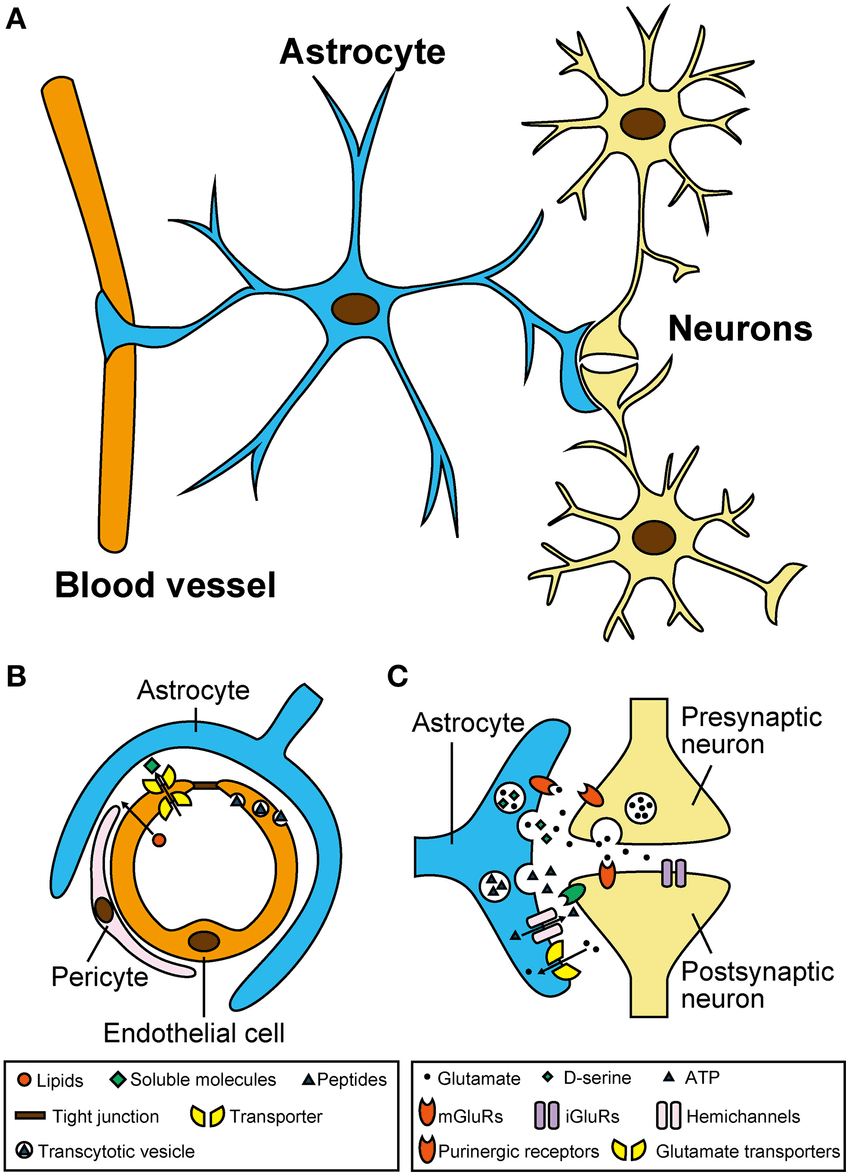
Fig. 2 Biological astrocytes and tripartite synapse
Astrocytic Gating in Neuraxon: Bio-Inspired Neural Network Architecture
Neuraxon is an architecture that tries to recover and emulate the functioning of the brain and to compute functional properties that classical artificial networks have oversimplified.
As we have explained in previous volumes of this academy, Neuraxon does not work only with input, output, and hidden neurons in the conventional sense. It introduces units with states that emulate excitatory, inhibitory, or neutral potentials (-1, 0, +1). In addition, it does so within a continuous TEMPORAL dynamics where we take into account context and the recent history of activation. The network is no longer a sum of layers but resembles more a system with internal physiology. For deeper context on how these foundational elements work, see NIA Volume 1: Why Intelligence Is Not Computed in Steps, but in Time and NIA Volume 2: Ternary Dynamics as a Model of Living Intelligence.
We have explained how Neuraxon models transmission through fast, slow, and neuromodulatory receptors — a mechanism explored in depth in NIA Volume 3: Neuromodulation and Brain-Inspired AI. But now we also model the regulation of plasticity through astrocytic gating.
How Astrocyte-Gated Multi-Timescale Plasticity (AGMP) Works
Astrocytic gating introduces a gate inspired by the role of astrocytes in the tripartite synapse. The idea is to introduce a local, slow, and contextual filter that determines when a synaptic modification should be opened, dampened, or blocked. It is as if the system can consider whether there is permission for a change. This approach directly addresses the stability-plasticity dilemma, one of the most fundamental challenges in continual learning for neural networks.
Eligibility Traces and Local Synaptic Memory
How does it work? Through a kind of eligibility trace. It is a local memory that says, "something relevant has happened at this synapse." It is updated with a decay over time and with a function between presynaptic and postsynaptic activity. That is: the synapse accumulates local evidence of temporal coincidence or causality. From there, there is a global broadcast-type signal, such as an error, a possible reward, or something dopamine-like. The astrocytic gate selects whether the neuron is in a learning state. In future versions, astrocytes could modulate thousands of synapses if this provides a computational advantage.
This approach is consistent with recent advances in neuromorphic computing, including the Astrocyte-Gated Multi-Timescale Plasticity (AGMP) framework proposed for spiking neural networks, which similarly augments eligibility-trace learning with a slow astrocyte state that gates synaptic updates — yielding a four-factor learning rule (eligibility × modulatory signal × astrocytic gate × stabilization).
Endogenous Regulation: Why Neuraxon Is More Than a Conventional Neural Network
Neuraxon within QUBIC does not compete in scale or task performance. It works through an architecture with endogenous regulation. By incorporating astrocytic principles, it begins to behave like a network with internal ecology. That is: a system where it matters not only which units are activated, but which domains of the tissue are plastic, which are stabilized, which areas are damping noise, which are consolidating regularities, and which are preparing to reorganize themselves. For a comprehensive overview of how biological and artificial neural networks compare, see NIA Volume 4: Neural Networks in AI and Neuroscience.
For Aigarth and QUBIC, the goal is not to accumulate more parameters, but to introduce more levels of functional organization within the system.
Why Astrocytic Gating Matters for Aigarth and Decentralized AI
Aigarth is not a static model but an evolutionary tissue through an architecture capable of growing, mutating, pruning, generating functional offspring, and reorganizing its topology under adaptive pressures. In that context, Neuraxon contributes something: a rich computational microphysiology for the units that inhabit that tissue.
This has implications for robustness, adaptability, and memory. Also for scalability. In large architectures, the problem is not only that there are many units, but how to coordinate which parts of the system are available for reconfiguration and which must maintain stability.
In roadmap terms for QUBIC, the goal is to build systems where intelligence emerges not only from neuronal computation, but also from the coupling between fast processing, slow modulation, and structural evolution. You can explore these dynamics firsthand with the interactive Neuraxon 3D simulation on HuggingFace Spaces, where you can build, configure, and simulate a Neuraxon 2.0 network from scratch.
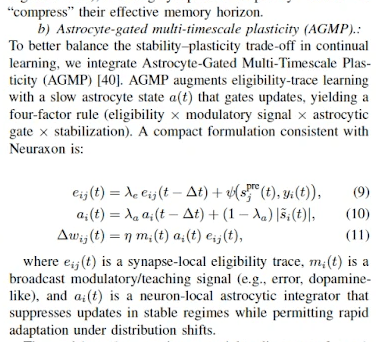
Fig 3. Neuraxon astrocytes gating - AGMP formulation
Scientific References
Allen, N. J., & Eroglu, C. (2017). Cell biology of astrocyte-synapse interactions. Neuron, 96(3), 697–708.
Halassa, M. M., Fellin, T., & Haydon, P. G. (2007). The tripartite synapse: Roles for gliotransmission in health and disease. Trends in Molecular Medicine, 13(2), 54–63.
Kofuji, P., & Araque, A. (2021). Astrocytes and behavior. Annual Review of Neuroscience, 44, 49–67.=
Perea, G., Navarrete, M., & Araque, A. (2009). Tripartite synapses: Astrocytes process and control synaptic information. Trends in Neurosciences, 32(8), 421–431.
Woodburn, R. L., Bollinger, J. A., & Wohleb, E. S. (2021). Synaptic and behavioral effects of astrocyte activation. Frontiers in Cellular Neuroscience, 15, 645267.=
Vivancos, D. & Sanchez, J. (2026). Neuraxon v2.0: A New Neural Growth & Computation Blueprint. ResearchGate Preprint.
Explore the Full Neuraxon Intelligence Academy
This is Volume 5 of the Neuraxon Intelligence Academy by the Qubic Scientific Team. If you are just joining us, explore the complete series to build a full understanding of the science behind Neuraxon and Qubic's approach to brain-inspired, decentralized artificial intelligence:
NIA Volume 1: Why Intelligence Is Not Computed in Steps, but in Time — Explores why biological intelligence operates in continuous time rather than discrete computational steps like traditional LLMs.
NIA Volume 2: Ternary Dynamics as a Model of Living Intelligence — Explains ternary dynamics and why three-state logic (excitatory, neutral, inhibitory) matters for modeling living systems.
NIA Volume 3: Neuromodulation and Brain-Inspired AI — Covers neuromodulation and how the brain's chemical signaling (dopamine, serotonin, acetylcholine, norepinephrine) inspires Neuraxon's architecture.
NIA Volume 4: Neural Networks in AI and Neuroscience — A deep comparison of biological neural networks, artificial neural networks, and Neuraxon's third-path approach.
Qubic is a decentralized, open-source network for experimental technology. To learn more, visit qubic.org. Join the discussion onX, Discord, andTelegram.