
QUBIC BLOG POST
Digital Ecosystems, Conway’s Game of Life, and Why Emergent Complexity Matters for Decentralized AI
Written by

Qubic Scientific Team
Published:
Listen to this blog post
Neuraxon Intelligence Academy — Volume 7
By the Qubic Scientific Team
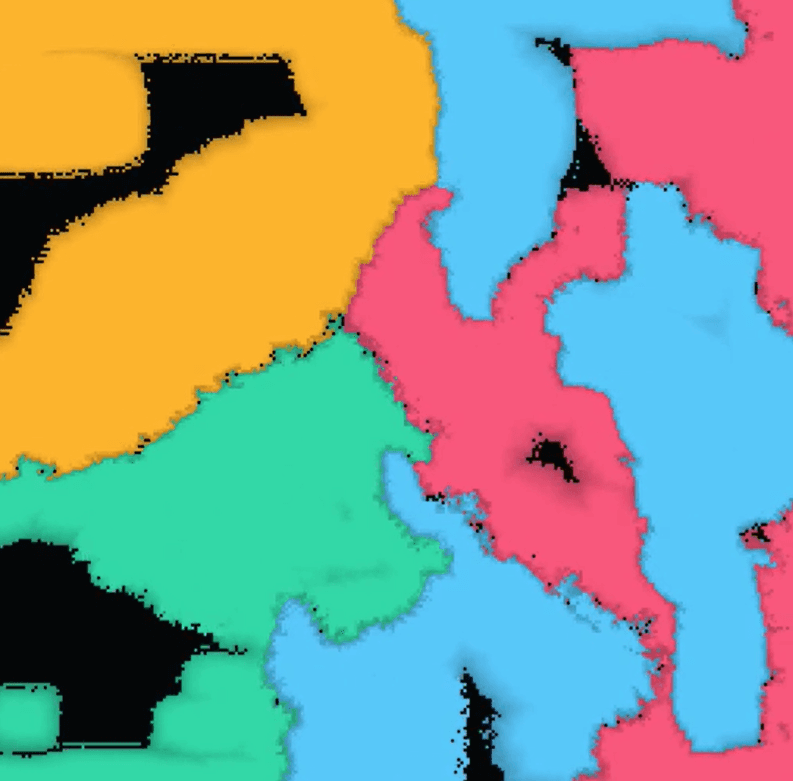
Five neural cellular automata species competing for territory on a shared grid. Each colour represents an independently learning species. Source: Sakana AI, Digital Ecosystems (2026).
In 1970, Martin Gardner published in Scientific American a recreational game invented by John Conway: the Game of Life. The rules fit on a postcard. A two-dimensional grid of cells in which each cell was alive or dead. At every step, a living cell stayed alive if it had two or three living neighbours, otherwise it died. A dead cell with exactly three living neighbours was born. Nothing else, as simple as that.
What no one expected was what emerged from those four lines of rules. Stable structures. Oscillators that pulse forever and gliders that travel across the grid. Cannons that fire gliders periodically. Constructions were complex enough that, eventually, someone would build a Turing machine inside the Game of Life. Inside Conway’s grid you can, in principle, run any computation that exists.
That game was the most accessible demonstration of a deep idea: emergent complexity does not need to be designed. Complexity emerges, given the right local rules, from interactions repeated thousands of times.
From Conway’s Game of Life to Artificial Life (Alife)
In the eighties, Christopher Langton and a group of researchers turned this idea into a discipline of its own: Artificial Life, or Alife. The proposal was simple. Biology has historically studied life as we know it, the carbon-based one, the one that emerged on this particular planet. But life is, perhaps, a more general phenomenon. If we can build artificial systems that show the properties we associate with the living, self-organisation, adaptation, evolution, reproduction, response to the environment, then we are studying life as it could be, not just as it happens to be.
Alife is not a search for digital pets. It is a science of fundamental dynamics. Its experimental tools are simulators where simple agents follow local rules, and where the researcher watches what emerges at the global scale.
Several findings have stayed as cornerstones. The first, already implicit in Conway, is that simple local rules can generate global complexity without anyone designing it. The second came from Langton himself: there is a critical regime, called the edge of chaos, where systems are neither rigidly ordered nor fully chaotic, and where almost everything interesting happens. Computation, learning, adaptation, all flourish in that thin band. Below it, the system freezes. Above it, it dissolves into noise.
A third finding, less famous but more uncomfortable, is that properties we usually associate with intention, like cooperation, specialisation, division of labour, can emerge in systems that have not been programmed to cooperate. They emerge as consequences of the dynamics, not as goals. This one is hard to digest for the self proclaimed superior species, because our intuition tells us that if we want X, we have to optimise for X. Alife shows, again and again, that this is not always true.
What Are Digital Ecosystems? From Cellular Automata to Multi-Agent Neural Systems
A digital ecosystem is the natural evolution of these artificial life ideas. Instead of a single rule shared by all cells, you have several agents, each with their own rules, sharing a common environment, competing or cooperating for resources, reproducing, and dying. The substrate may be a 2D grid as in Conway, a continuous fluid as in Lenia, a richer world with terrain and food as in Biomaker CA. The details vary. The principle does not.
What makes a digital ecosystem interesting is not the underlying technology, but what it lets you observe. Population dynamics. Boundaries that form between species. Niches that open and close. Strategies that appear, dominate for a while, are displaced, and come back. Cycles that look like those of real ecosystems, sometimes surprisingly so. And the question that runs underneath all of it: when can we say that something has emerged, that the system has discovered something we did not put into it.
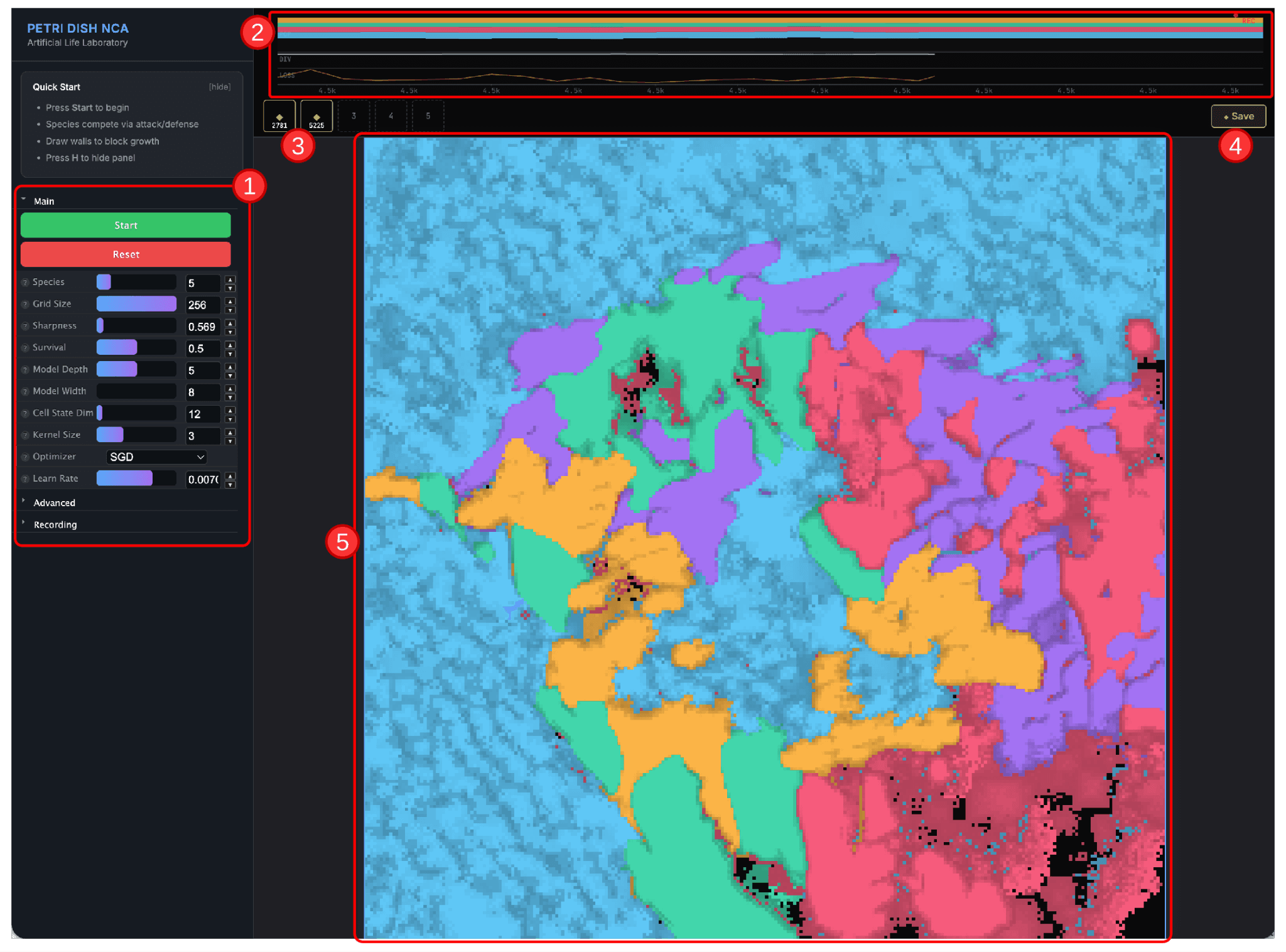
The Digital Ecosystems interactive platform by Sakana AI, showing real-time parameter sliders, population timeline, checkpoint tray, and simulation canvas. Users can steer the ecosystem and branch into alternative futures from any saved state.
There is recent work worth looking at. The team at Sakana AI, for instance, has just released Digital Ecosystems, an interactive platform where five neural cellular automata species compete on a shared grid in real time and where you can move the parameters with sliders, save states, and explore divergent futures from a single checkpoint. It is the latest and most accessible link in a chain that goes back to Conway, and it is worth playing with for an afternoon, just to feel how these dynamics behave when you can actually touch them.
Why Artificial Life and Emergent Complexity Matter for Qubic, Aigarth, and Neuraxon
The temptation, when reading about Conway, Langton, Lenia, or Sakana, is to file all this away as elegant intellectual entertainment. It is not. It is the conceptual scaffolding our project stands on.
Qubic: Self-Organising Decentralized Infrastructure
Qubic is, at the infrastructure level, a decentralised network of thousands of nodes competing and cooperating to validate computations and earn rewards. Without the right local rules, that network either centralises or falls apart. With the right rules, it self-organises into a stable, productive ecosystem. The validity of Qubic’s design rests on principles that come, in part, from artificial life research: how do you reach global stability without a central authority, and how do you make competition produce something useful for everyone.
Aigarth: Evolutionary AI at the Edge of Chaos
Aigarth goes further. It is not just a network, it is an evolving tissue. Networks of artificial neurons that mutate, prune, generate offspring, reorganise their topology under adaptive pressure. There are local rules, fitness criteria, or evolutionary dynamics. This is artificial life applied to AI architectures. And as with everything in Alife, what emerges depends on the regime the system operates in. Too rigid, no exploration. Too chaotic, no stability. The edge of chaos is, here too, where the interesting things happen.
Neuraxon: Trinary States and Self-Organized Criticality in Brain-Inspired AI
Neuraxon, the basic unit Aigarth is built on, was designed with this in mind. The trinary state (-1, 0, +1) is not a quantisation trick to save bits, even though it does also cut compute cost. It is a structural decision. The neutral state is a buffer that allows smooth transitions, that prevents the system from oscillating violently between extremes, and gives time for slow synapses and neuromodulators to act. As we have discussed in earlier volumes of the Neuraxon Intelligence Academy, this is what lets the system navigate the edge of chaos without collapsing.
In our experiments with NxonLife, the simulator we built to watch Neuraxon networks evolve in Game-of-Life-inspired environments, we have measured exactly the properties Alife predicts. A branching ratio close to 1, the classical signature of self-organised criticality. Long-range temporal correlations following 1/f dynamics. Activity that sustains itself for thousands of ticks without external resets, without imposed normalisation, without anyone telling the system what to do. The networks find that regime by themselves, because the architecture has been built for it to be possible.
From Artificial Life Simulations to Decentralized AI Infrastructure: An Old Idea, a New Substrate
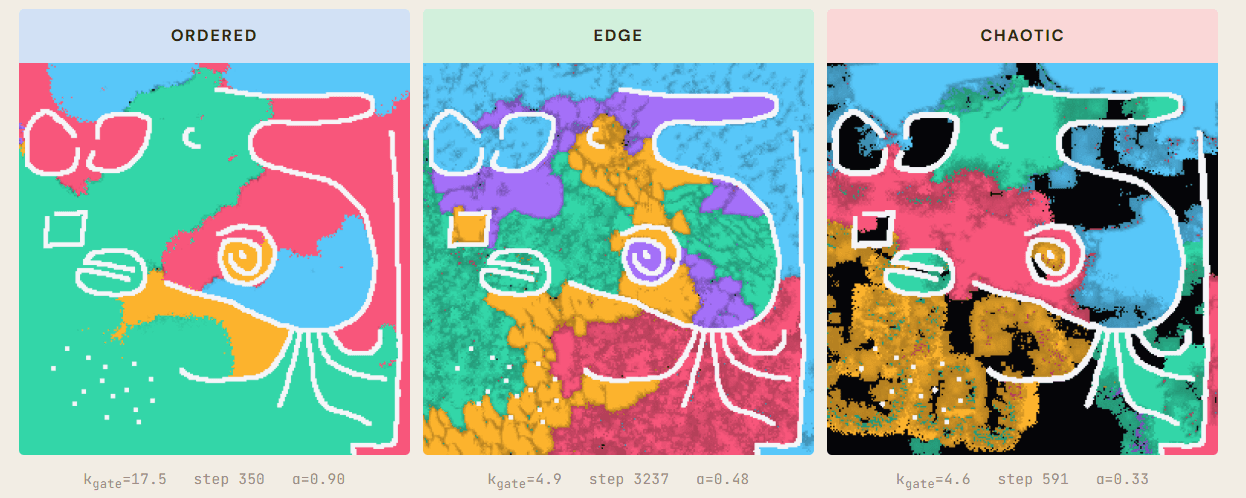
Growth-gate steepness sweep in Sakana AI's Digital Ecosystems. Lowering the gate steepness pushes species from rigid territorial boundaries into an excitable edge-of-chaos regime where emergent complexity and cooperation arise. Source: Sakana AI (2026)
What Conway showed in 1970, Langton in 1990, the Lenia team more recently, and Sakana AI a few weeks ago, is that complexity emerges from local rules and well-chosen parameters. What we are doing with Qubic, Aigarth and Neuraxon is taking that insight to its logical conclusion: not just observing simulated ecosystems, but building real distributed infrastructure on its principles.
The basic intuition does not change. Live systems live in time. They organise themselves between order and chaos. They cooperate without anyone instructing them to. They emerge, they do not design themselves.
Conway’s Game of Life was a postcard. Artificial life is a discipline. Digital ecosystems are a tool. Qubic, Aigarth and Neuraxon are an attempt to take all of this from the simulator and turn it into a working network. The ideas have been there for fifty years. The substrate to make them productive at scale is what we are building now.
References
Conway, J. H. (in Gardner, M.) (1970). Mathematical games: The fantastic combinations of John Conway’s new solitaire game “Life”. Scientific American, 223, 120–123. [Link]
Langton, C. G. (1990). Computation at the edge of chaos: Phase transitions and emergent computation. Physica D: Nonlinear Phenomena, 42, 12–37. [Link]
Bedau, M. A. (2003). Artificial life: organization, adaptation and complexity from the bottom up. Trends in Cognitive Sciences, 7(11), 505–512. [Link]
Chan, B. W.-C. (2019). Lenia: Biology of artificial life. Complex Systems, 28(3), 251–286. [Link]
Mordvintsev, A., Randazzo, E., Niklasson, E., & Levin, M. (2020). Growing neural cellular automata. Distill, 5(2), e23. [Link]
Darlow, L. (2026). Digital Ecosystems: Interactive Multi-Agent Neural Cellular Automata. Sakana AI. [Link]
Vivancos, D., & Sanchez, J. (2025). From Perceptrons to Neuraxons: A new neural growth and computation blueprint. Qubic Science. [Link]
Vivancos, D., & Sanchez, J. (2025). Time-embedded trinary state dynamics learning architecture. Preprint. [Link]
Explore the Complete Neuraxon Intelligence Academy Series
This is Volume 7 of the Neuraxon Intelligence Academy by the Qubic Scientific Team. If you are just joining us, explore the complete series to build a full understanding of the science behind Neuraxon, Aigarth, and Qubic’s approach to brain-inspired, decentralized artificial intelligence:
NIA Volume 1: Why Intelligence Is Not Computed in Steps, but in Time — Explores why biological intelligence operates in continuous time rather than discrete computational steps like traditional LLMs.
NIA Volume 2: Ternary Dynamics as a Model of Living Intelligence — Explains ternary dynamics and why three-state logic (excitatory, neutral, inhibitory) matters for modeling living systems.
NIA Volume 3: Neuromodulation and Brain-Inspired AI — Covers neuromodulation and how the brain’s chemical signaling (dopamine, serotonin, acetylcholine, norepinephrine) inspires Neuraxon’s architecture.
NIA Volume 4: Neural Networks in AI and Neuroscience — A deep comparison of biological neural networks, artificial neural networks, and Neuraxon’s third-path approach.
NIA Volume 5: Astrocytes and Brain-Inspired AI — How astrocytic gating transforms neural network plasticity through the AGMP framework in Neuraxon.
NIA Volume 6: Conscious Machines vs Intelligent Organisms: AI Consciousness Explained — Explores AI consciousness through the lens of Global Workspace Theory, Integrated Information Theory, and predictive coding.
Qubic is a decentralized, open-source network. To learn more, visit qubic.org. Join the discussion on X, Discord, and Telegram.