
QUBIC BLOG POST
The g Factor in Artificial Life: From Spearman's 1904 Classroom to Evolved Artificial Brains
Written by

Qubic Scientific Team
Published:
Listen to this blog post
Neuraxon Intelligence Academy, Volume 9 · By the Qubic Scientific Team
In one line: General intelligence, the g factor psychologists have measured for over a century, is the missing ingredient in today's language models, and Qubic's Neuraxon project is now selecting for it directly inside an artificial-life simulation.

Charles Spearman (1863–1945), who first identified the g factor of general intelligence while studying English schoolchildren's grades in 1904.
The g Factor: From a 1904 Classroom to Artificial Brains
In 1904, Charles Spearman stumbled upon a regularity that would forever change psychology. Examining the school grades of a group of English children, he noticed something seemingly trivial but strange: those who excelled in mathematics also tended to excel in French, in music, in language. Disciplines with no apparent connection correlated systematically with one another. Spearman proposed that beneath this tangle of disparate abilities there lay a single common factor, a general cognitive thread. He called it g (Spearman, 1904).
More than a century later, g remains one of the most replicated findings in the behavioral sciences (Carroll, 1993; Deary et al., 2010). It is neither a grade average nor an arbitrary construct: it is what emerges when factor analysis is applied to almost any battery of cognitive tests. It appears consistently when we measure working memory, fluid reasoning, processing speed, verbal comprehension, or novel problem solving. In psychometric terms, g is the shared variance that no single test measures on its own.
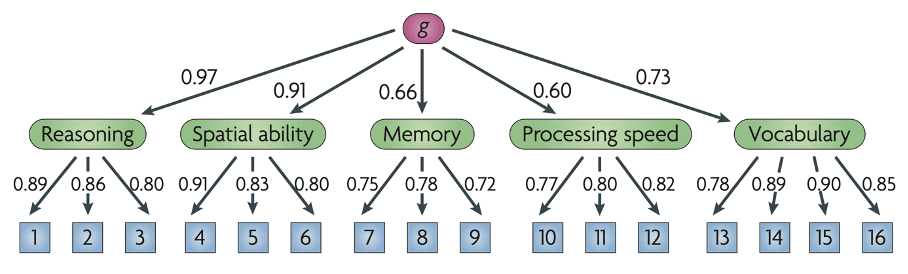
The g factor emerges from factor analysis: a single general factor loads onto broad cognitive domains (reasoning, spatial ability, memory, processing speed, vocabulary), which in turn load onto individual cognitive tests. g is the shared variance no single test captures alone.
What the g Factor Means in the Brain and in Behavior
P-FIT Theory and Brain Network Efficiency
From cognitive neuroscience, g has ceased to be a statistical abstraction and has become a property of brain architecture. The P-FIT theory (Parieto-Frontal Integration Theory) identifies a distributed network made up of dorsolateral prefrontal cortex, posterior parietal cortex, anterior cingulate, and temporal areas, whose connection efficiency predicts intelligence test scores (Jung & Haier, 2007). Functional connectivity studies show that g correlates with the brain's ability to dynamically reconfigure its networks (the executive control network, the default mode network, the salience network) according to task demands (Barbey, 2018; Cole et al., 2015). It is not about having "more" neurons in a specific place, but about better orchestrating the flow of information between functionally specialized regions.
The Predictive Brain and Free-Energy Minimization
This orchestration acquires an even deeper meaning in light of the predictive brain theory (Clark, 2013; Friston, 2010). Under this framework, the brain is not a passive receiver of stimuli but a hierarchical inference engine that continuously generates predictions about the world and adjusts its internal models based on prediction error. Here g fits naturally: the ability to predict well, to anticipate environmental contingencies, to learn quickly from error and, above all, to abstract regularities that transfer across domains, is precisely what intelligence tests capture indirectly. A brain with high g would be, on this reading, a system with more efficient generative models, capable of compressing experience into high-level abstractions and of minimizing free energy across heterogeneous contexts (Hohwy, 2013); that is, it reduces prediction error rapidly and therefore learns. Cognitive generality, then, would not be a static property of the neural hardware, but the quality of a deeply hierarchical predictive process. The research remains open. Other currents posit that g really has to do with the neurodevelopment of our brain, given that no matter what task we are performing or attempting, there is a huge common factor in any experience because it happens inside the same organ.
Behaviorally, g is the best predictor. Forget emotional intelligence; it is g that best forecasts what your academic performance, occupational success, longevity, and even certain health indicators may be (Deary et al., 2010; Gottfredson, 1997). Not because it is destiny, but because it captures something very basic: the capacity of a cognitive system to face problems it has not seen before, integrating heterogeneous information under time and resource constraints. g is, in a sense, a measure of generality.
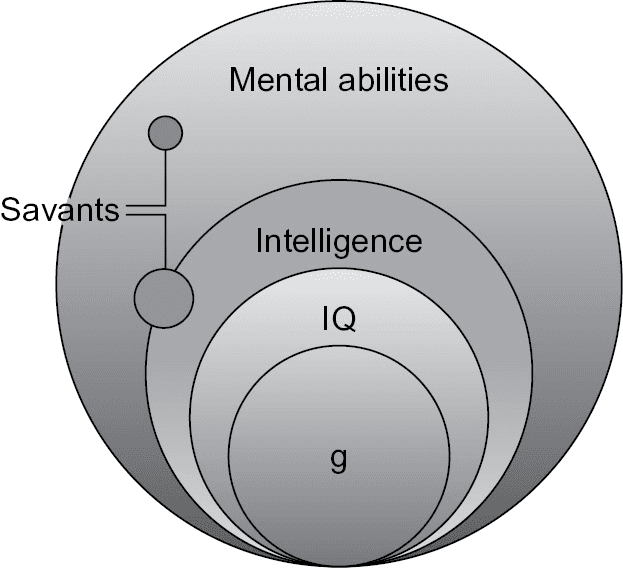
How the concepts nest: g sits at the core of IQ, which sits within intelligence, which is a subset of all mental abilities. Savant skills illustrate abilities that can fall outside the general-intelligence core.
The Problem of Measuring General Intelligence in Artificial Systems
For decades, artificial systems have shone in narrow tasks (playing chess, classifying images, translating) but failed to transfer that performance outside their domain (Chollet, 2019). The AGI debate revolves precisely around this: what does it mean, operationally, for a system to be "generally" intelligent?
If we take the parallel with human psychometrics seriously, the answer is uncomfortable but clear: to speak of generality we need to measure it, and measuring it requires diverse tests whose shared variance reveals something analogous to g. A system with high performance on a single task tells us nothing about its generality; a system with moderate and correlated performance across many structurally distinct tasks does. Spearman's logic, transferred to non-biological substrates, still holds: generality is not postulated, it is factored.
Why the g Factor Does Not Appear in Transformers (and What That Implies for AGI)
It is worth pausing here on the currently dominant paradigm. Large language models based on transformer architectures (Vaswani et al., 2017) deliver astonishing performance on linguistic tasks, but psychometric analyses applied to their outputs do not show the factor structure characteristic of g (Burnell et al., 2023; Ilić & Gignac, 2024). Their hits and misses across domains do not correlate as they would in humans; they depend rather on the density and quality of patterns present in their training data. A transformer can brilliantly solve one problem and fail on another that is structurally equivalent but phrased slightly differently, something a system with genuine g would not do (Mitchell, 2021).
This has serious implications. It suggests that the pursuit of cognitive generality exclusively through language may be a dead end, an architectural dead end. Language is the most visible output of human cognition, but not its substrate. To pretend that by scaling text one will arrive at g is like pretending that by scaling descriptions of chess games one will arrive at mastery: one obtains statistical mimicry, not the underlying cognitive structure. (We argued a closely related point in our analysis of why intelligence is not scale, and on why LLM predictions are not brain predictions.) Without genuine hierarchical prediction, without generative models of the world, without coordination between functionally specialized modules, behavior can look general without being so. The absence of g in transformers is not a failure of scale: it is a clue that generality requires other architectural ingredients (LeCun, 2022).
The g Factor Inside the Neuraxon Game of Life
We have taken this intuition to a different experimental terrain. In Multi-Neuraxon Game of Life Lite 5.0, the artificial creatures (the Nxons) grow their own brains and compete to survive. What is new in this version is that the selective pressure is applied to g. The Nxons are not selected for mastering a specific task, but for showing that common thread that allows them to face many.
The brains of the Nxons have been designed following a simplified model anchored in cognitive neuroscience, since they use six functional regions, inspired by the same kind of maps that psychologists use to describe the modular organization of the human brain. The bet is that generality does not emerge from a monolithic architecture, but from the coordination among specialized regions that share information flexibly. It is the P-FIT intuition translated into artificial life, and it connects directly with the predictive brain principle: each region contributes its own model, and the integration between them is what allows hierarchical prediction and, therefore, generality. (These dynamics build directly on the brain-criticality and branching-ratio principles we explored in Volume 8.)
Notably, the experiment is public and observable. Anyone can open their browser and watch how the Nxons evolve generation after generation, how their internal circuits reorganize under the pressure of a fitness function that rewards cognitive generality instead of specialization.
Implications for Artificial Life (Alife) and Applications for Qubic
For the field of artificial life, the explicit incorporation of g as a selection criterion opens a line of work that goes beyond academic exercise. Most Alife systems have evolved agents that solve very concrete niches: foraging, predator avoidance, navigation (Bedau, 2003; Lehman et al., 2020). But few have tried to select for something as abstract as the ability to generalize across heterogeneous cognitive domains. If we manage to get artificial organisms to show positive correlations between distinct tasks (the computational equivalent of Spearman's children) we will have an extraordinary test bench for questions that human psychometrics can only address correlationally: what evolutionary pressures favor the emergence of g? What neural architectures make it possible? Is g a convergent solution or a phylogenetic accident?
For Qubic, this line of research fits with a very concrete vision of the future of AI. While the industry invests massive resources in scaling transformers over text, Qubic is committed to exploring architecturally alternative paths: modular artificial brains, evolved, distributed, and subjected to real selective pressures. Qubic's decentralized useful-compute network offers the ideal substrate for this kind of experimentation at scale, where thousands of Nxon populations can coevolve in parallel, with fitness functions designed to favor the emergence of g. It is not only open research: it is the possibility of building, on decentralized infrastructure, an empirical alternative to the dominant paradigm of language-based AI, one that starts from the right question (how to measure and select generality) instead of assuming it. If genuine cognitive generality requires architectures inspired by brains and not by corpora, Qubic is one of the few environments where that hypothesis can be seriously put to the test.
A deeper analysis is in preparation, as it forms part of our recent papers and experiments. Spearman's old g, that thread which wove together children's school grades, we now use in digital creatures that learn to survive.
References
Barbey, A. K. (2018). Network neuroscience theory of human intelligence. Trends in Cognitive Sciences, 22(1), 8–20. https://doi.org/10.1016/j.tics.2017.10.001
Bedau, M. A. (2003). Artificial life: Organization, adaptation and complexity from the bottom up. Trends in Cognitive Sciences, 7(11), 505–512. https://doi.org/10.1016/j.tics.2003.09.012
Burnell, R., Schellaert, W., Burden, J., Ullman, T. D., Martínez-Plumed, F., Tenenbaum, J. B., et al. (2023). Rethink reporting of evaluation results in AI. Science, 380(6641), 136–138. https://doi.org/10.1126/science.adf6369
Carroll, J. B. (1993). Human cognitive abilities: A survey of factor-analytic studies. Cambridge University Press. https://doi.org/10.1017/CBO9780511571312
Chollet, F. (2019). On the measure of intelligence. arXiv preprint arXiv:1911.01547. https://arxiv.org/abs/1911.01547
Clark, A. (2013). Whatever next? Predictive brains, situated agents, and the future of cognitive science. Behavioral and Brain Sciences, 36(3), 181–204. https://doi.org/10.1017/S0140525X12000477
Cole, M. W., Ito, T., & Braver, T. S. (2015). Lateral prefrontal cortex contributes to fluid intelligence through multinetwork connectivity. Brain Connectivity, 5(8), 497–504. https://doi.org/10.1089/brain.2015.0357
Deary, I. J., Penke, L., & Johnson, W. (2010). The neuroscience of human intelligence differences. Nature Reviews Neuroscience, 11(3), 201–211. https://doi.org/10.1038/nrn2793
Friston, K. (2010). The free-energy principle: A unified brain theory? Nature Reviews Neuroscience, 11(2), 127–138. https://doi.org/10.1038/nrn2787
Gottfredson, L. S. (1997). Why g matters: The complexity of everyday life. Intelligence, 24(1), 79–132. https://doi.org/10.1016/S0160-2896(97)90014-3
Hohwy, J. (2013). The predictive mind. Oxford University Press. https://doi.org/10.1093/acprof:oso/9780199682737.001.0001
Ilić, D., & Gignac, G. E. (2024). Evidence of interrelated cognitive-like capabilities in large language models: Indications of artificial general intelligence or achievement? Intelligence, 106, 101858. https://doi.org/10.1016/j.intell.2024.101858
Jung, R. E., & Haier, R. J. (2007). The Parieto-Frontal Integration Theory (P-FIT) of intelligence: Converging neuroimaging evidence. Behavioral and Brain Sciences, 30(2), 135–154. https://doi.org/10.1017/S0140525X07001185
LeCun, Y. (2022). A path towards autonomous machine intelligence. OpenReview, version 0.9.2. https://openreview.net/forum?id=BZ5a1r-kVsf
Lehman, J., Clune, J., Misevic, D., Adami, C., Altenberg, L., Beaulieu, J., et al. (2020). The surprising creativity of digital evolution. Artificial Life, 26(2), 274–306. https://doi.org/10.1162/artl_a_00319
Mitchell, M. (2021). Why AI is harder than we think. arXiv preprint arXiv:2104.12871. https://arxiv.org/abs/2104.12871
Spearman, C. (1904). "General intelligence," objectively determined and measured. The American Journal of Psychology, 15(2), 201–292. https://doi.org/10.2307/1412107
Vaswani, A., Shazeer, N., Parmar, N., Uszkoreit, J., Jones, L., Gomez, A. N., Kaiser, Ł., & Polosukhin, I. (2017). Attention is all you need. Advances in Neural Information Processing Systems, 30. https://arxiv.org/abs/1706.03762
Explore the Complete Neuraxon Intelligence Academy Series
This is Volume 9 of the Neuraxon Intelligence Academy by the Qubic Scientific Team. If you are just joining us, explore the complete series to build a full understanding of the science behind Neuraxon, Aigarth, and Qubic's approach to brain-inspired, decentralized artificial intelligence:
NIA Volume 1: Why Intelligence Is Not Computed in Steps, but in Time. Explores why biological intelligence operates in continuous time rather than discrete computational steps like traditional LLMs.
NIA Volume 2: Ternary Dynamics as a Model of Living Intelligence. Explains ternary dynamics and why three-state logic (excitatory, neutral, inhibitory) matters for modeling living systems.
NIA Volume 3: Neuromodulation and Brain-Inspired AI. Covers neuromodulation and how the brain's chemical signaling (dopamine, serotonin, acetylcholine, norepinephrine) inspires Neuraxon's architecture.
NIA Volume 4: Neural Networks in AI and Neuroscience. A deep comparison of biological neural networks, artificial neural networks, and Neuraxon's third-path approach.
NIA Volume 5: Astrocytes and Brain-Inspired AI. How astrocytic gating transforms neural network plasticity through the AGMP framework in Neuraxon.
NIA Volume 6: Conscious Machines vs Intelligent Organisms: AI Consciousness Explained. Explores AI consciousness through the lens of Global Workspace Theory, Integrated Information Theory, and predictive coding.
NIA Volume 7: Conway's Game of Life, Artificial Life, and Digital Ecosystems. How emergent complexity and self-organized criticality move from simulators to decentralized AI infrastructure.
NIA Volume 8: Brain Criticality and the Branching Ratio in Neural and Artificial Networks. Why a branching ratio near 1 and self-organized criticality are bioinspired design principles in Neuraxon.
NIA Volume 9: The g Factor in Artificial Life. You are here.
Qubic is a decentralized, open-source network. To learn more, visit qubic.org or browse the full Academy and Blog. Join the discussion on X, Discord, and Telegram.
Qubic is a decentralized, open-source network for experimental technology. Nothing on this site should be construed as investment, legal, or financial advice.