
QUBIC BLOG POST
What Is AGI? The Limits, Visions, and Definitions of Artificial General Intelligence
Written by

Qubic Scientific Team
Published:

Listen to this blog post
Neuraxon Intelligence Academy — Volume 11
By the Qubic Scientific Team
In brief: There are few expressions repeated so much and defined so little as "artificial general intelligence." This volume examines why every AGI definition on offer says something different, why narrow AI that beats humans has never felt like general intelligence, and why the most useful clue we have is that intelligence is not a score but a viable system of systems, the principle that guides our work on Neuraxon and Aigarth.
There are few expressions repeated so much and defined so little as «artificial general intelligence». We use it as if it were a frontier that some system will cross on a specific day. When we try to pin down what exactly lies on the other side, however, the consensus evaporates.
Why Every Lab Has a Different Definition of AGI
Each laboratory and company offers its own definition, and each definition resembles the capabilities that the laboratory already masters or promises to master soon.
For some, general intelligence is to equal the human being in any task.
For others, to surpass the human in economically valuable work.
For still others, to reach the majority of cognitive tasks.
The three formulations sound reasonable. The three say different things, and none withstands much scrutiny.
This is not an abstract quibble. OpenAI's charter defines AGI as highly autonomous systems that outperform humans at most economically valuable work, while other leading labs anchor the same word to matching humans across most cognitive tasks. As independent analyses of these competing definitions have noted, when the same term is stretched to fit each organization's economic arrangements, disagreement about whether we have "reached AGI" becomes inevitable, the debaters are not looking at the same finish line.
Academic Attempts to Define Machine Intelligence Without Anthropocentrism
Academic research has tried to escape anthropocentrism. Legg and Hutter (2007) proposed understanding intelligence as an agent's capacity to achieve goals across a wide variety of environments, an elegant definition precisely because it does not tie intelligence to resembling a human.
Wang (2019) shifted the emphasis toward adaptation, and defined it as a system's capacity to cope with insufficient knowledge and resources.
Chollet (2019) turned the question around: what matters is not accumulated skill, but the efficiency with which a system acquires new skills. Each of these proposals is more rigorous than any corporate slogan, and each still leaves the underlying problem open. There is no accepted standard for saying when a machine has arrived.
Defining AGI by Elimination: What General Intelligence Is Not
Perhaps the problem is that we seek a positive definition when the only thing we are clear about is the negative one. We know, with considerable certainty, what is not general intelligence.
A pocket calculator surpasses any human mathematician in arithmetic and it occurs to no one to call it intelligent.
A chess engine effortlessly defeats the best player on the planet and we consider it, at most, an extraordinarily refined tool.
An automatic translator handles dozens of languages that no polyglot would master in several lifetimes.
In all these cases there is superhuman performance and, at the same time, a total absence of generality.
Narrow performance that surpasses the human has existed for decades and never seemed to us like intelligence. Defining by elimination turns out, paradoxically, to be more honest: general intelligence is not the sum of many narrow competences, however impressive each one of them may be.
The Economic Turing Test: Measuring What Intelligence Does
Faced with this conceptual fog, some voices from the industry itself have proposed a more down-to-earth criterion, an economic variant of the old Turing test (1950).
Instead of arguing about what intelligence is, let us propose measuring what it does.
The idea shifts the question from the philosophical terrain to the occupational one. A system would have reached a relevant milestone on the day it could perform a real job, be hired to do it and be paid for it without anyone around it discovering that it is not human. It would not matter then whether it «understands» or «reasons» in some deep sense. What would matter is whether it sustains the performance long enough to become indistinguishable from a professional. The proposal has the virtue of being verifiable. It also has the limitation of confusing, once again, economic capacity with intelligence, and of relying on a social verdict rather than on a property of the system. A machine could pass that test and still remain, in essence, fragile outside the script for which it was prepared.
What Science Fiction Taught Us About Machine Intelligence (and Why It Misleads)
A good part of our intuition about these machines does not come from science, but from fiction, and fiction has bequeathed to us incompatible assumptions.
In Minority Report intelligence is anticipation: a system that predicts what is going to happen before it happens, to the point of acting on futures that do not yet exist.
In I, Robot intelligence is obedience to rules: creatures governed by explicit laws that, precisely because of their rigidity, end up producing consequences that no one had foreseen.
In 2001 intelligence is opacity: a machine that reasons impeccably and whose true motives remain, until the end, indecipherable.
In more recent stories, such as Ex Machina, the decisive test is no longer to solve problems, but to manipulate the observer; and in Her intelligence is measured by the intimacy and affection it is capable of awakening.
Each story installs in our head a different definition of what it means to be intelligent, to predict, to obey, to conceal, to seduce, and we drag those definitions along, without noticing, when we judge real systems. Cinema did not give us a theory of intelligence. It gave us a repertoire of expectations that contradict one another.
Intelligence in Nature: A Gradient, Not a Switch
If we look at nature, the panorama becomes even less clear-cut, and for good reasons. Intelligence does not appear in the living world as a switch that turns on or off, but as a gradient with very diverse forms.
A New Caledonian crow manufactures tools with which it extracts food and chains together several steps to solve a problem it had never seen before (Hunt, 1996).

By Yi-Kai Tea - https://www.inaturalist.org/photos/212163787, CC BY-SA 4.0, https://commons.wikimedia.org/w/index.php?curid=139423401
An octopus distributes a good part of its nervous system through its arms and solves spatial problems with a bodily organization so different from ours that it is hard to find a common language to describe it (Godfrey-Smith, 2016).

By Anneli Salo - Self-photographed, CC BY-SA 3.0, https://commons.wikimedia.org/w/index.php?curid=4440100
A colony of bees chooses the location of a new nest through a collective process that no isolated individual could carry out, and it does so with notable reliability (Seeley, 2010).
None of these intelligences is reducible to the others, and none is «less» intelligence for not resembling the human one. What biology teaches us is that generality is not equivalent to a single scale where some stand higher than others, but to different ways of facing changing environments with limited resources.
Human Intelligence Is an Architecture, Not a Score
This lesson should make us cautious also with ourselves.
For more than a century we have tried to compress human intelligence into a number. Ever since Spearman (1904) described a general factor that seemed to influence almost all cognitive tests, the intelligence quotient became the convenient summary of something that does not let itself be summarized. And during that same century we have verified how little that number captures. Someone who obtains a high score is not necessarily the one who best negotiates a conflict, interprets an ambiguous situation or learns a new trade under pressure. The datum is stable; the life it claims to summarize is not. It would be a mistake, nonetheless, to go from excess to emptiness and conclude that intelligence lacks structure.
Decades of psychometric research, synthesized in the Cattell, Horn and Carroll model (Carroll, 1993; McGrew, 2009), point to something more interesting: human intelligence is organized hierarchically. At the apex there is a general factor that filters into almost everything we do. Below it, a handful of broad abilities, fluid reasoning, crystallized knowledge, working memory, processing speed. Further down still, dozens of specific abilities. It is neither a solitary number nor an archipelago of disconnected talents. It is an architecture. And it is worth retaining that word, architecture, because it will be the key to everything that follows.
(We traced the origins of that general factor across education, neuroscience, and AI in NIA Volume 9: The Origins of the g Factor, and examined how it breaks down when applied to machines in NIA Volume 10: How Do We Measure the Intelligence of a Machine?.)
Why AGI Benchmarks Fail: The Problem With Closed Worlds
If intelligence is architecture and not a score, then the tests with which we evaluate it matter enormously. Here lies one of the great self-deceptions of recent years.
We have celebrated that systems break record after record on standardized tests without noticing that almost all of them share the same flaw: they measure performance in closed worlds. Questions with a known answer, tasks with a fixed format, problems that someone already solved before. When a static test becomes popular, moreover, it becomes vulnerable: it is enough to generate thousands of attempts in parallel, or to train on similar tasks, to inflate the score without there being any true generalization.
But the intelligence that interests us manifests itself precisely where the world is open: when one must explore an unknown environment, build on the fly a model of how it works, infer what the goal is and chain actions toward it, correcting course when conditions change.
That is why the new generations of interactive tests, of the kind posed by ARC-AGI-3 (ARC Prize Foundation, 2026; Chollet, 2019), are so revealing. They do not present a puzzle and await an answer. They place the system inside an environment whose rules are discovered only by acting, turn by turn, without prior instructions. What they evaluate is not how much it knows, but how efficiently it learns something truly new. The contrast is telling: in its early versions, people solve almost all of these challenges while frontier models barely scratch a minimal fraction. It is a difference of nature, not of degree, and it reorients the entire conversation.
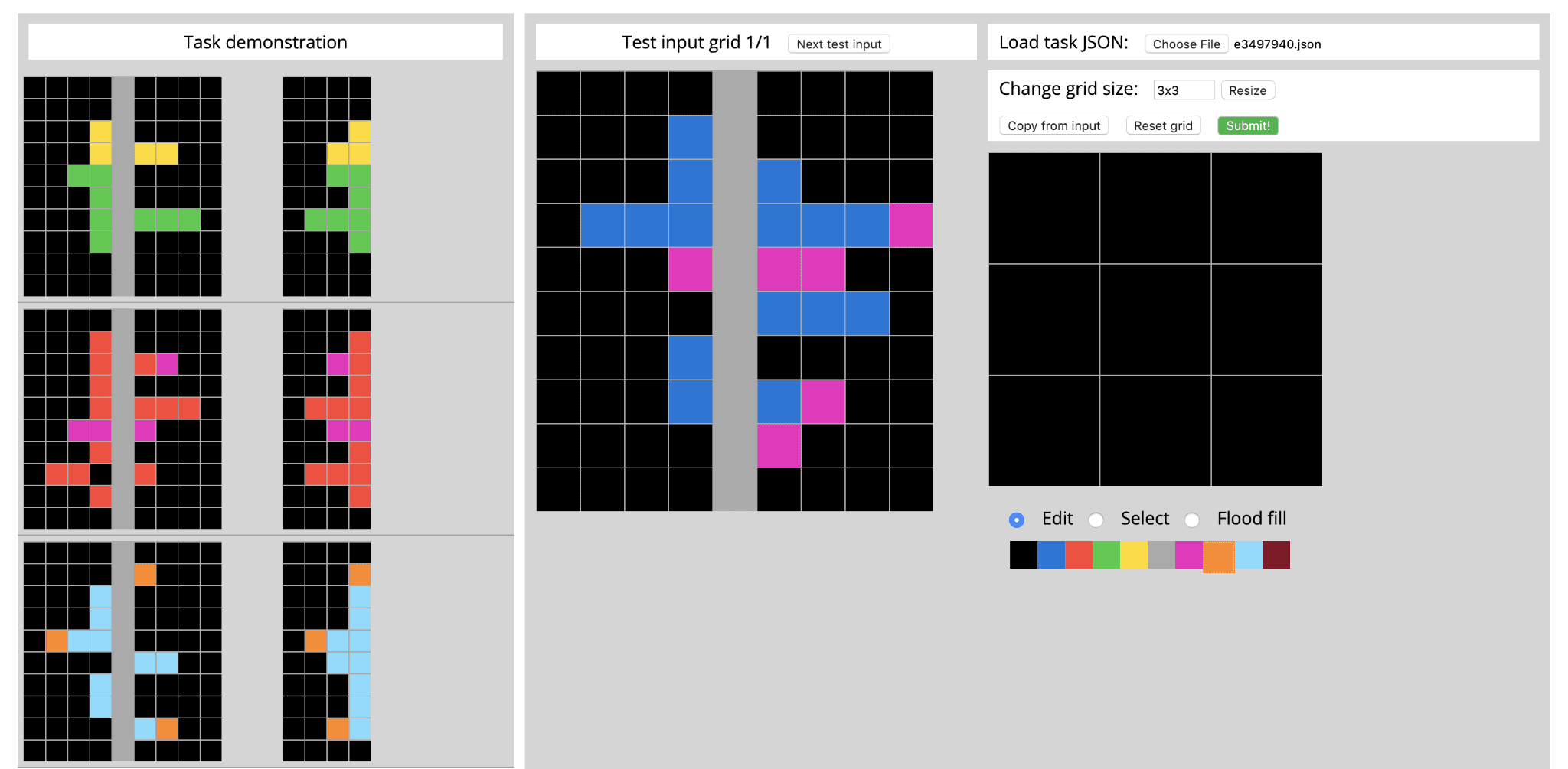
ARC Prize Foundation, 2026). Image: ARC Prize Foundation / François Chollet, ARC-AGI, Apache 2.0.
From "Is It Smart?" to "Is It Viable?": Stafford Beer's Better Question
Having reached this point, it is worth changing the question.
For too long we have asked whether a machine is «smart».
The cybernetician Stafford Beer, decades ago now, proposed a more fertile question for complex systems: not whether they are smart, but whether they are viable (Beer, 1981, 1985). A viable system is one capable of sustaining itself, preserving its identity and remaining governable while its environment changes ceaselessly. Beer maintained that any system that survives in a complex world, an organism, a company, a state, must house certain indispensable functions: units that carry out the task, mechanisms that coordinate them, instances that regulate internal resources, a capacity to scan the exterior and anticipate change, and a core that preserves the purpose of the whole. What is decisive about his model is that these functions repeat at different scales, like Russian dolls: each viable part contains viable parts and, at the same time, forms part of a viable whole. Read this way, intelligence ceases to be a property that an object possesses and becomes a property that a system sustains.
General Intelligence as a Network of Networks
This is, in our judgment, the most valuable clue we have.
If general intelligence is not the sum of narrow competences, nor a number, nor a record in a closed world, but the viability of a system that organizes itself at different scales, then it is improbable that it will arrive at the hand of a single gigantic model that one day crosses an invisible line. It is far more plausible that it will emerge from the interaction of many pieces: agents that specialize and coordinate, memories that persist, modules that evaluate and correct, networks that contain other networks. The idea is not new; Minsky (1986) already imagined the mind as a society of simple processes, none intelligent on its own, whose organization gave rise to something that was. Generality would then be a collective and not an individual phenomenon, something that appears between the components and not within any of them. The threshold we so eagerly seek does not exist as a line. It exists, if at all, as the moment when a network of networks begins to behave as a coherent whole.
How Neuraxon and Aigarth Pursue General Intelligence
It is precisely this intuition that guides our work. If intelligence is architecture, it is worth studying architectures; and if it emerges from networks that organize themselves at different scales, it is worth building, as a computational simulation, networks of simple units capable of coordinating, remembering, valuing and planning.
That is the logic we pursue with Aigarth and with the Neuraxons: not a model that imitates human language from the outside, but a system of systems inspired by the principles through which nervous tissue solves, in its own way, the problem of adapting to a world that never stops changing. We do not thereby claim to be approaching any form of consciousness or any ultimate mystery of the mind. We claim, more modestly and more ambitiously at once, that the path toward a truly general intelligence goes through understanding and simulating how many small pieces, suitably organized, come to sustain something that none of them contains on its own.
(This "third path" between biological and artificial networks is the subject of NIA Volume 4: Neural Networks in AI and Neuroscience, and the emergence of complexity from simple local rules runs through NIA Volume 7: Conway's Game of Life, Artificial Life, and Digital Ecosystems.)
Why a Single Superintelligence Cannot Replace a Society
It is worth, however, resisting one last temptation, the most seductive of all.
Suppose for a moment that this path succeeded and that we had a general, powerful and reliable system. It would be natural to imagine it then as a supreme instance, an oracle capable of taking for us the decisions that today overwhelm us. That image, attractive as it is, rests on an error that has nothing to do with the power of the machine, but with the nature of knowledge.
There is not, strictly speaking, a superior knowledge stored somewhere awaiting a sufficiently large processor. Hayek (1945) formulated it with a clarity that time has not belied: the knowledge that a society needs in order to function is not concentrated in any mind, but dispersed among millions of people, in large part tacit, tied to circumstances of place and moment that never come to be put in writing. That knowledge cannot be centralized because it does not exist in transferable form; it is created and revised in the very action of those who possess it.
Cybernetics arrived at the same conclusion by another route. Ashby's (1956) law of requisite variety, on which Beer built much of his thought, establishes that only variety can absorb variety: no single controller can match the diversity of states of a system more complex than itself. A society generates, at every instant, far more possible situations than any center could inspect and regulate. To place a single intelligence at the apex of that system would not be the height of viability, but its negation: a single point of control confronting a variety that exceeds it by definition, exactly the opposite of the recursive and distributed architecture that makes a whole viable.
There is, moreover, an obstacle that no increase in computation dissolves. Human systems are not closed mechanisms that can be solved from outside; they are adaptive orders in which agents learn, imitate, compete, err and react to what is said about them (Holland, 1995; Arthur, 2021). This reflexivity has an uncomfortable consequence: any prediction or any rule influential enough alters the behavior it meant to describe. A metric that becomes a target ceases to measure what it measured; a broadcast forecast becomes a prophecy that fulfills or belies itself. There is no stable, external observation point from which to compute the optimum, because the very act of intervening displaces the target. The uncertainty that surrounds these systems is not a lack of data that more information will remedy; it is structural. Their future is not computed: it is made.
And even if knowledge were complete and the system were not reflexive, the decisive thing would remain: the ends are in dispute. A plural society does not have a single correct objective function that an optimizer could maximize on its behalf. Disagreement, trial, error and correction are not defects of the social process, but the very mechanism by which a society discovers and readjusts its own answers. Under the right conditions, the diversity of perspectives solves problems better than any individual solver, however brilliant (Page, 2007). To replace that process with a single decision-maker would not perfect society: it would freeze precisely what allows it to adapt, and would eliminate the redundancy that makes it robust against error.
The Honest Role of Artificial Intelligence in a Viable Society
From all of this there follows an honest, and by no means modest, role for artificial intelligence, however general it may come to be.
It can help us see patterns that escape us, simulate scenarios before committing to them, refine concrete decisions and make them with less blindness. What it cannot do is take the place of the collective, fallible and self-correcting process through which we learn as a society.
If intelligence is a viable system of systems, so too is a society; and an artificial intelligence, however capable, is one more component within that system, never its apex.
References
ARC Prize Foundation. (2026). ARC-AGI-3: A new challenge for frontier agentic intelligence [Technical report]. arXiv. arcprize.org/arc-agi/3
Arthur, W. B. (2021). Foundations of complexity economics. Nature Reviews Physics, 3(2), 136–145.
Ashby, W. R. (1956). An introduction to cybernetics. Chapman & Hall.
Beer, S. (1981). Brain of the firm (2nd ed.). Wiley.
Beer, S. (1985). Diagnosing the system for organizations. Wiley.
Carroll, J. B. (1993). Human cognitive abilities: A survey of factor-analytic studies. Cambridge University Press.
Chollet, F. (2019). On the measure of intelligence (arXiv:1911.01547) [preprint]. arXiv.
Godfrey-Smith, P. (2016). Other minds: The octopus, the sea, and the deep origins of consciousness. Farrar, Straus and Giroux.
Hayek, F. A. (1945). The use of knowledge in society. The American Economic Review, 35(4), 519–530.
Holland, J. H. (1995). Hidden order: How adaptation builds complexity. Addison-Wesley.
Hunt, G. R. (1996). Manufacture and use of hook-tools by New Caledonian crows. Nature, 379(6562), 249–251.
Legg, S., & Hutter, M. (2007). Universal intelligence: A definition of machine intelligence. Minds and Machines, 17(4), 391–444.
McGrew, K. S. (2009). CHC theory and the human cognitive abilities project: Standing on the shoulders of the giants of psychometric intelligence research. Intelligence, 37(1), 1–10.
Minsky, M. (1986). The society of mind. Simon & Schuster.
Page, S. E. (2007). The difference: How the power of diversity creates better groups, firms, schools, and societies. Princeton University Press.
Seeley, T. D. (2010). Honeybee democracy. Princeton University Press.
Spearman, C. (1904). «General intelligence,» objectively determined and measured. The American Journal of Psychology, 15(2), 201–292.
Turing, A. M. (1950). Computing machinery and intelligence. Mind, 59(236), 433–460.
Wang, P. (2019). On defining artificial intelligence. Journal of Artificial General Intelligence, 10(2), 1–37.
Explore the Full Neuraxon Intelligence Academy Series
This is Volume 11 of the Neuraxon Intelligence Academy by the Qubic Scientific Team. If you are just joining us, explore the complete series to build a full understanding of the science behind Neuraxon, Aigarth, and Qubic's approach to brain-inspired, decentralized artificial intelligence:
NIA Volume 1: Why Intelligence Is Not Computed in Steps, but in Time — Explores why biological intelligence operates in continuous time rather than discrete computational steps like traditional LLMs.
NIA Volume 2: Ternary Dynamics as a Model of Living Intelligence — Explains ternary dynamics and why three-state logic (excitatory, neutral, inhibitory) matters for modeling living systems.
NIA Volume 3: Neuromodulation and Brain-Inspired AI — Covers neuromodulation and how the brain's chemical signaling (dopamine, serotonin, acetylcholine, norepinephrine) inspires Neuraxon's architecture.
NIA Volume 4: Neural Networks in AI and Neuroscience — A deep comparison of biological neural networks, artificial neural networks, and Neuraxon's third-path approach.
NIA Volume 5: Astrocytes and Brain-Inspired AI — How astrocytic gating transforms neural network plasticity through the AGMP framework in Neuraxon.
NIA Volume 6: Conscious Machines vs Intelligent Organisms: AI Consciousness Explained — Explores AI consciousness through the lens of Global Workspace Theory, Integrated Information Theory, and predictive coding.
NIA Volume 7: Conway's Game of Life, Artificial Life, and Digital Ecosystems — The science behind Qubic, Aigarth, and Neuraxon's emergent complexity and self-organized criticality.
NIA Volume 8: Brain Criticality and the Branching Ratio in Neural and Artificial Networks — Why a branching ratio near 1 and self-organized criticality are bioinspired design principles in Neuraxon.
NIA Volume 9: The Origins of the g Factor: From Education and Neuroscience to Artificial Intelligence — Explores the origins of the g factor across education, neuroscience, and AI.
NIA Volume 10: How Do We Measure the Intelligence of a Machine? The g Factor, ARC-AGI, and the Future of AI Evaluation — The g factor, François Chollet's ARC-AGI benchmark, data contamination in LLM evaluation, and why skill-acquisition efficiency is the real test of intelligence.
Qubic is a decentralized, open-source network. To learn more, visit qubic.org. Join the discussion on X, Discord, and Telegram. Nothing on this site should be construed as investment, legal, or financial advice.