
QUBIC BLOG POST
Mine Dogecoin on Qubic: How ASIC Miners Are Earning Up to 111% More Than Traditional Pools
Written by

The Qubic Team
Published:
Listen to this blog post
If you're running a Scrypt ASIC pointed at a traditional Dogecoin mining pool right now, you're earning less than you could be. Not by a little. Over a 14-day window, a single 13 GH/s rig earned 111% more revenue mining DOGE through Qubic than it would have on a conventional pool, even one running LTC+DOGE merge mining simultaneously.
This is measured data from two full epochs on a real ASIC by the QMine project, benchmarked against WhatToMine figures for the same period.
This article breaks down the numbers from six epochs of live DOGE mining on Qubic, explains how the buyback mechanism works, and gives you everything you need to decide whether it's worth making the switch.
Why Dogecoin Mining Profitability Is Shrinking on Traditional Pools
Most Scrypt miners set up their rigs, point them at a pool, and leave them running. That's the appeal of ASIC mining: low maintenance, steady output. But "steady" has quietly become "shrinking." DOGE difficulty keeps climbing, LTC block rewards are thinning after the last halving, and electricity costs haven't gone down for anyone. The margins on traditional DOGE mining pools are getting compressed, and a lot of older hardware (L3+ rigs especially) has been sitting idle because the math stopped working.
The instinct is to wait it out. But there's a different option that doesn't require new hardware, new algorithms, or any change to your physical setup.
How Dogecoin Mining on Qubic Works
Your ASIC mines Dogecoin the same way it always has: Scrypt algorithm, Stratum protocol, same difficulty. Nothing changes on the hardware side. The difference is what happens with the DOGE after it's mined.
In a traditional pool, you receive your share of the block reward in DOGE. On Qubic, 100% of the mined DOGE is sold on the open market for stablecoins, and those proceeds are used to buy back QUBIC tokens. The QUBIC is then distributed to miners based on their contributed hashrate. Right now, 100% of the buybacks go directly to miners. Burn thresholds will be reviewed as the pool scales.
Every share is verified on-chain by Qubic's Oracle Machines, removing the need to trust a centralized pool operator with your earnings. Pools like QLI already offer daily payouts, making it easy to track and verify your returns from day one.
Your ASIC handles the DOGE hashing while Qubic's CPU/GPU layer continues training AI neural networks through Useful Proof of Work (UPoW) with zero impact on your ASIC's performance. The two workloads run in parallel on separate hardware, so your mining output stays fully dedicated to DOGE. The full technical architecture explains how ASIC mining and AI training coexist without conflict.
DOGE Mining Profitability: Six Epochs of Verified Data
Over a six-week period from April 1 to May 13, 2026 (Epochs 207–212), Qubic's DOGE mining pool found 97 blocks, mined over 970K DOGE, and generated $111,000 in total earnings across 8 million pool shares.
Here's how Qubic DOGE mining profitability compared against traditional pools across each epoch where verified data is available:
Epoch | Profitability vs. Traditional Pools |
209 | +111% |
210 | +111% |
211 | +79% |
212 | +48% |
These aren't cherry-picked snapshots. The two-epoch report for Epochs 209 and 210 covers a full 14-day window using a qMine DG1+ ASIC at 13 GH/s. Over that period, the rig earned $1.23 per GH/s per day on Qubic versus $0.58 per GH/s per day on traditional pools running LTC+DOGE merge mining, which is the strongest setup those pools can offer. That gap added up to +$8.39 per day, or +$117.46 over the two-week stretch. From a single rig.
Epoch 211 told the same story on different hardware. A QDOGE Fluminer L1 at 5.7 GH/s earned $1.04 per GH/s per day on Qubic versus $0.58 on traditional pools, a 79% advantage that added up to +$18.41 over the epoch.
Epoch 212 confirmed the trend on the same Fluminer L1 at 5.7 GH/s. Mining through Qubic returned $4.67 per day compared to $3.15 on LTC+DOGE merge mining, a 48% advantage that totaled +$10.62 over the week.
The per-GH/s metric matters here because it normalizes across different rigs. Whether you're running a DG1+ or a Fluminer, the revenue-per-hashrate consistently lands between $1.04 and $1.23 on Qubic, roughly double the $0.58 benchmark on conventional pools.
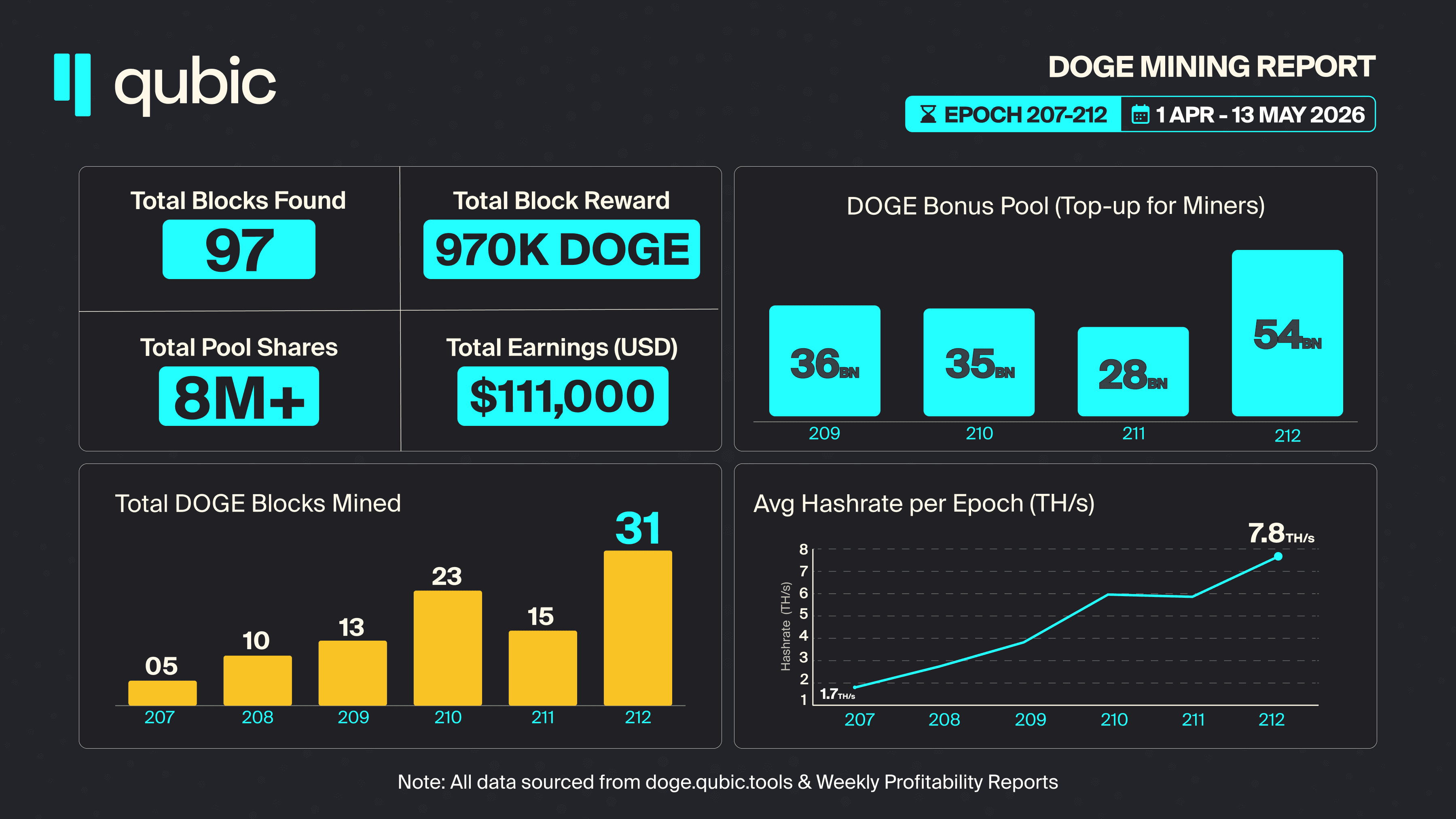
Note: All profitability comparisons use revenue figures. Actual take-home depends on your electricity costs. Qubic data is sourced from the QLI pool; traditional pool benchmarks come fromWhatToMine with ±5% variance possible. DOGE and QUBIC prices are averaged across each reporting window.
Qubic's DOGE Pool Is Growing, and Still Early
The hashrate growth tells a story of its own. Average hashrate per epoch climbed from roughly 1.7 TH/s in Epoch 207 to around 7.8 TH/s by Epoch 212, with an all-time high of 119.71 TH/s reached during Epoch 213. Blocks found per epoch have followed the same curve: 5, 10, 13, 23, 15, and 31 across Epochs 207 through 212.
The pool currently ranks #20 on the Dogecoin network, with a best ranking of #7 reached during Epoch 213. Total blocks found has reached 149 (DOGE + LTC), with the pool maintaining consistent uptime throughout.
For context, the total Dogecoin network hashrate is measured in petahashes. Qubic's DOGE pool is still in the low terahash range, which means there's significant room for the pool to grow. As more miners join, the pool's block-finding rate increases, the buyback volume scales with it, and the overall ecosystem strengthens. Miners who get in now are positioned to benefit from that growth as it unfolds.
Compatible Scrypt ASIC Mining Hardware
The following Scrypt ASICs have been tested and confirmed working on Qubic's DOGE mining pool:
ASIC Model | Notes |
Antminer L3+ | Older rigs that were unprofitable on traditional pools are earning again |
Antminer L7 | Confirmed compatible |
Antminer L9 | Confirmed compatible |
Goldshell Mini-DOGE | Confirmed compatible |
qMine DG1+ | Used in Epoch 209–210 profitability benchmarks (13 GH/s) |
QDOGE Fluminer L1 | Used in Epoch 211–212 profitability benchmarks (5.7 GH/s) |
If your rig mines Scrypt, you're good to go. The setup takes a couple of minutes: point your ASIC at Qubic's pool using the Stratum details, and you can monitor performance live at doge.qubic.tools.
What's Coming Next for Qubic DOGE Mining
LTC merge mining is currently live on the pool in a testing phase. Miners are already capturing LTC rewards on top of the existing DOGE+QUBIC model, stacking three revenue streams from the same hardware. This is a temporary configuration while the team evaluates performance, and will be reassessed as the pool's network share grows.
Mining scripts are also being actively optimized by the development team, which should improve efficiency and reduce setup friction going forward. For a closer look at Qubic's broader mining roadmap, see the April 30 All-Hands Recap.
Start Mining DOGE on Qubic
Six epochs of data across multiple rigs and hardware configurations all point in the same direction: mining DOGE through Qubic earns more than traditional pools. The margin has ranged from 48% to 111% depending on the epoch, and the revenue-per-GH/s has consistently landed at roughly double the conventional benchmark.
The pools are live, payouts are daily, the data is on-chain, and the setup takes minutes. If you want a step-by-step walkthrough, the full guide is here:
Mine DOGE, Earn More: Setup Guide
Track live pool stats: doge.qubic.tools
Full setup and dashboard guide: Qubic DOGE Mining Pool Setup & Dashboard Guide