
QUBIC BLOG POST
Dogecoin Mining on Qubic: How It Works and Why It Matters
Written by

The Qubic Team
Published:
Listen to this blog post
Qubic is bringing Dogecoin mining into its network. Not as a side feature or an afterthought, but as a fundamental expansion of what the protocol can do. The architecture is finalized. Testing begins in March. Mainnet launch target is April 1, 2026.
This is the full picture of how Dogecoin mining will work on Qubic, what it means for the network, and why existing miners should be paying attention.
What Is Qubic’s Mining Model?
Qubic doesn’t mine for the sake of mining. The network runs on a concept called Useful Proof of Work, where computational power serves a real purpose: training Aigarth, Qubic’s AI research initiative. Miners contribute processing power to advance AI models, and the network rewards them with QUs for that work.
Until now, the network has also mined Monero (XMR) during idle cycles, alternating between AI training tasks and XMR hashing. That model worked well as a proof of concept. It demonstrated that a blockchain could extract real-world value from its mining infrastructure beyond just securing a ledger.
Dogecoin changes the equation entirely.
Parallel Mining, Not Alternating: How Dogecoin and AI Training Coexist
The single biggest technical shift with Dogecoin integration is this: Doge mining will run parallel to AI training. Not in alternating blocks. Not in time-sliced cycles. Simultaneously.
Here’s why that’s possible. Dogecoin uses the Scrypt algorithm, which requires ASIC hardware. Qubic’s AI training runs on CPUs and GPUs. These are fundamentally different pieces of hardware doing fundamentally different jobs. So, instead of competing for the same resources, they operate simultaneously.
ASIC miners handle Dogecoin. CPUs and GPUs continue training Aigarth. Both contribute to the network. Neither displaces the other.
This is a departure from the XMR model, where CPU time had to be split between AI work and Monero hashing. With Dogecoin, that tradeoff disappears. The network’s full computational resources stay dedicated to AI training while a new class of hardware contributes Doge hashrate on top.
Qubic’s Dogecoin Mining Architecture: A Technical Breakdown
The Qubic team, led by tech lead Joetom, walked through the full architecture during the February 19, 2026 All Hands AMA (Watch the full replay here). The system consists of four main components working together.
Think of it like a postal system with built-in fraud detection.
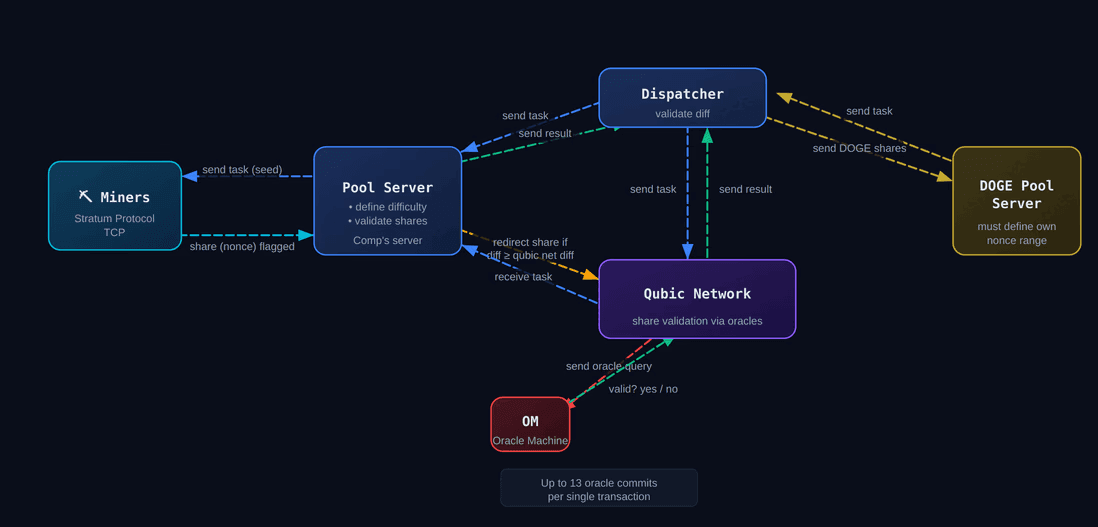
Miners connect through the Stratum protocol (TCP) to a Pool Server. This server acts like a local post office: it hands out work assignments, sets the difficulty bar for what counts as a valid “stamp,” and checks incoming mail. The Pool Server then talks to a Dispatcher, a custom-built bridge that sits between the Qubic network and the Doge network. The Dispatcher is the sorting facility. It takes tasks from an external Doge Pool Server, translates them for Qubic miners, and routes completed work back to the Doge mining pool for share submission.
When a miner finds a valid share that clears the Qubic network’s difficulty threshold, the Pool Server forwards that share through the Dispatcher into the Qubic network. This is where the process diverges from traditional mining pools.
Instead of trusting a single pool operator to confirm that a share is legitimate, the Qubic network runs that verification through Oracle Machines. The network sends an oracle query asking a simple question: is this Doge share valid? Oracle Machines, operated independently by computors across the network, respond with a yes or no. Up to 13 of these oracle commits can be bundled into a single transaction, which keeps the validation pipeline fast enough for high-throughput mining.
Picture a room full of independent auditors each checking the same receipt. If the majority agree it’s real, it passes. No single auditor can rubber-stamp a fake.
This is the first real-world external use case for Qubic’s Oracle Machines, which went live on mainnet February 11, 2026. As of the last AMA, over 11,000 successful oracle queries had already been processed with zero unresolvable requests.
Breathing Life Into Retired ASIC Mining Hardware
One of the more practical aspects of this integration is what it means for older Scrypt ASICs. Machines like the Antminer L3+ that have been collecting dust on a shelf because they can’t turn a profit on standard Doge pools get a second life here.
Qubic’s founder, Come-from-Beyond (CFB), explained the logic: these ASICs can contribute hashrate to the network, with all mined Dogecoin flowing through the dispatcher. The ASIC layer is entirely additive. It generates new revenue that didn’t exist before without cutting into existing CPU/GPU miner rewards.
How that revenue gets distributed is still being shaped. A dedicated group of community pools and computors is actively designing the economic framework: reward splits, fund allocation, and the relationship between ASIC-generated value and the broader QU economy. The goal is to create a model where QU incentives make otherwise unprofitable mining hardware worthwhile again. Computor documentation with technical specs for pool participation is scheduled for release by mid-March.
Oracle Machines: The Decentralized Validation Backbone
It is worth zooming in on why Oracle Machines matter here. In most mining setups, share validation is handled off-chain by the pool operator. You trust the pool and that’s the model.
Qubic takes a different approach. By routing Doge share validation through Oracle Machines, the network creates a decentralized verification layer. Computors running Oracle nodes independently confirm whether submitted shares are legitimate. This removes single points of failure from the validation process and ties Dogecoin mining directly into Qubic’s on-chain infrastructure.
It also generates real transaction volume. Every validation cycle creates on-chain network activity. Dogecoin mining doesn’t just introduce a new revenue source; it drives protocol usage in a way that strengthens the network’s fundamentals.
Starting in late March, Oracle Machine participation will directly affect computor revenue calculations. Running an Oracle node becomes a contributor to a computor’s earning potential rather than just a voluntary service.
The Community-Driven Business Model
The technical architecture is locked. The business model is where the community is stepping in.
A community-driven business consolidation group is defining the economic framework: how Doge mining revenue gets distributed, what percentage flows to ASIC miners versus the broader network, and how the model scales as more hardware comes online. This work runs as a parallel workstream alongside the technical implementation.
The approach reflects Qubic’s broader governance philosophy. The Governance & Funding Framework was approved by computor vote at Epoch 200 on February 14, 2026, with 614 yes votes and zero no votes. Decisions about how new revenue streams integrate into the network are made through community participation, not top-down mandates.
Dogecoin Mining on Qubic: Timeline and What Comes Next
The project has moved past design into active implementation. Here’s where things stand:
The main architecture and share validation logic are complete. The Dispatcher is currently in development. Testing begins early March. Computor documentation will be published by mid-March. The mainnet launch target date is April 1, 2026, with full production by April 30. That said, the team has been clear: network stability takes priority over hitting dates. If testing reveals issues, the timeline will be extended.
Why Dogecoin Mining Matters Beyond the Hashrate
Dogecoin integration is a milestone, but the significance runs deeper than adding another coin to mine.
It proves that Qubic’s infrastructure, Oracle Machines, smart contracts, and the computor network, can support external use cases at scale. Doge mining is the first application built on top of Oracle Machines. It won’t be the last. The same validation framework can serve price feeds, cross-chain data, and any external information that smart contracts need to act on.
It also demonstrates that Useful Proof of Work can expand horizontally. CPU/GPU resources train AI. ASIC resources mine Dogecoin. Future hardware categories could plug into additional workstreams. The network grows by absorbing more types of useful computation, not by requiring existing participants to do less.
Qubic set out to build a decentralized AI infrastructure where computation serves a purpose. Dogecoin mining is the next proof point that the model works, and that the network can scale the concept into entirely new territory.
Stay in the Loop
Dogecoin mining is one piece of a much bigger picture. Oracle Machines, Neuraxon 2.0, the new Governance Framework, core optimizations, March and April are packed with milestones.
For the full breakdown of everything the team covered in the latest session, read the Qubic All-Hands Recap: February 19, 2026.
New to Qubic? Start with What is Qubic to understand the network from the ground up, or dive into the technical documentation to explore Oracle Machines, smart contracts, and the mining architecture firsthand.
Got questions? The community is active on Discord and X. Jump in.