
QUBIC BLOG POST
That Static AI Is a Dead End. Google Confirms.
Written by

Qubic Scientific Team
Published:
Listen to this blog post
The End of Affair: Why Google’s "Nested Learning" Confirms That Static AI Is a Dead End
The premise of modern AI feels like a bait-and-switch. We were promised genuine intelligence, but what we got was a brilliant flipbook.
A flipbook, stacked with enough pages (layers) and cycled quickly enough, creates a powerful illusion of life. It seems to move, to think, to evolve. But pause the action, and you realize every single page is a static drawing, frozen in the past.
This is the state of today’s Large Language Models (LLMs). And now, the research giants are finally admitting it.
A significant new paper from Google Research, Nested Learning, confirms what Qubic has argued since the start: LLMs are not truly learning. They suffer from a form of digital amnesia, unable to form genuine new memories or integrate fresh experiences into their core being. They are—to use the most precise neuroscientific term—frozen artifacts.
The honesty is commendable. But their proposed solution, the "Nested Learning" (NL) paradigm, still clings to the very system that created the problem.
Here’s why NL is merely an improved map of a failed territory, and why Qubic’s Neuraxon is the only path forward into living computation.
The Mathematical Trap: Why "Nesting" Doesn't Solve "Static"
Google’s researchers recognize that true intelligence requires multiple time scales—some parts of the mind must focus on the immediate present, while others dedicate themselves to accumulating long-term wisdom.
Their solution? To create complex optimization loops (or "nests") within the existing deep learning framework. This means setting up elaborate rules for when, and how fast, different parts of the network update their weights.
But this remains a mathematical trick. It’s an algorithmic hunch designed to make a stack of static matrices simulate memory. It's like rigging a grandfather clock to tick at five different speeds. It sounds impressive, but it’s still fundamentally a discrete system, moving in fixed, separate jumps. It never achieves the seamless, messy, moment-to-moment flow of a living brain.
The True Difference: The Physics of Continuous Time
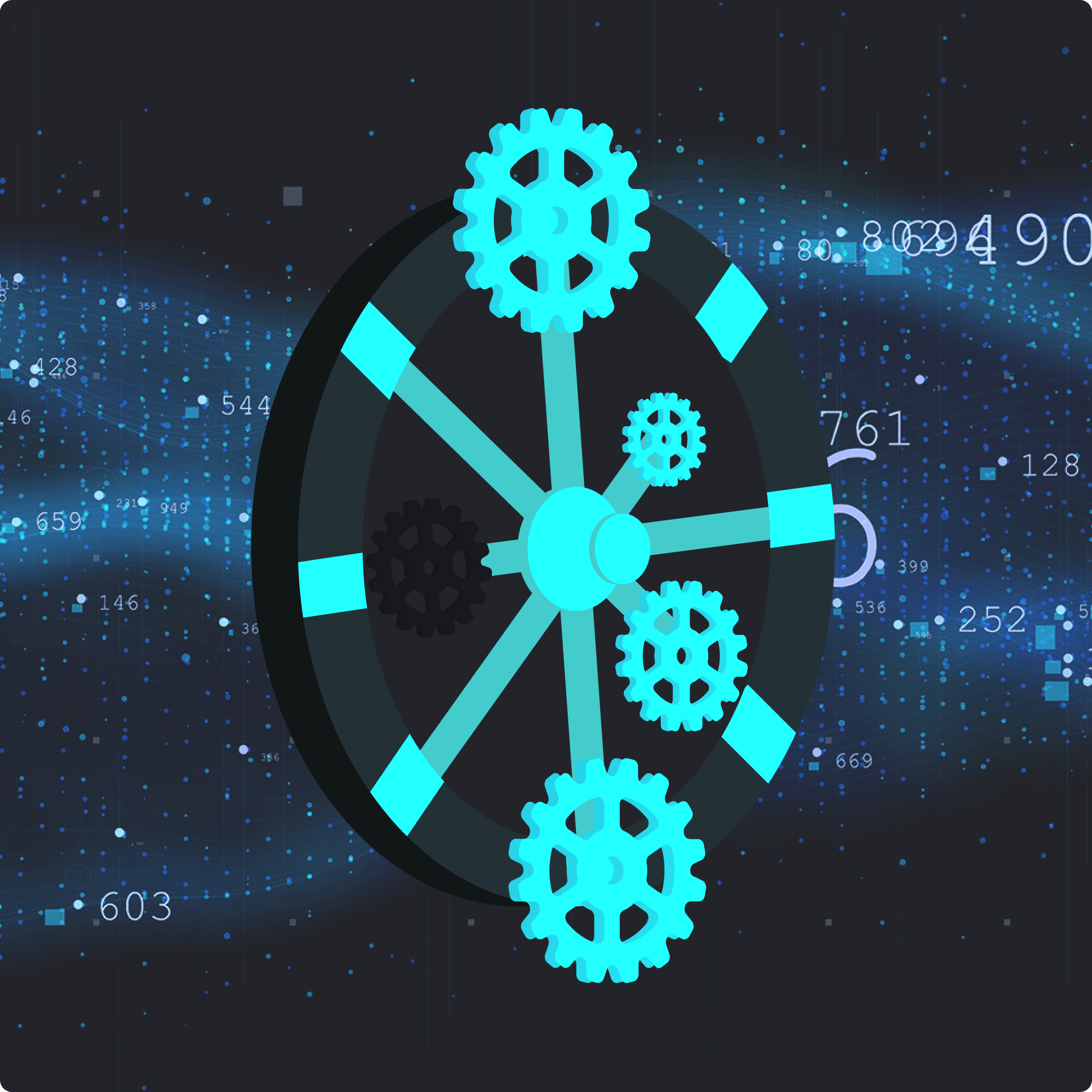
This is where Qubic leaves the old paradigm behind. The core flaw of Nested Learning is that it fails to introduce the physics of time. It is still constrained by the digital clock cycle.
In the real world, your brain doesn't wait for a tick-tock. Your neurons exist in a state of continuous flow. Their internal voltage, their "state," is always changing—second by second, millisecond by millisecond.
The Neuraxon unit is built on this biological imperative. Instead of just calculating the "next step" in a sequence, we model the instantaneous rate of change—the same differential equation that governs the biological neuron.
This simple, foundational shift means that a Neuraxon neuron can have spontaneous activity and genuine recovery periods (refractoriness). It allows the system to be alive in the most literal computational sense, evolving even when it’s not actively processing a task. This is impossible in any architecture—including NL—that relies on static matrix calculations.
Wisdom is a Mood, Not a Calculation
But the defining feature of Neuraxon is how it solves the long-term memory problem without resorting to Google's complex optimization schemes.
Real intelligence is not just about fast and slow connections; it’s about modulation. Think about how your mood or stress level changes your ability to remember things.
These are not simple electrical impulses. They are processes driven by neuromodulators released over time, which gradually reconfigure your neural circuitry. This is the foundation of true learning, where noradrenaline, dopamine, acetylcholine, and serotonin orchestrate reinforcement, goals, attention, and states.
We call this the Third Synaptic State.
In Neuraxon, we model the Metabotropic Weight. This weight doesn't contribute to the immediate signal itself; instead, it slowly and continuously alters the neuron's firing threshold. It changes how sensitive the neuron is to incoming information. This is the computational equivalent of a neuromodulatory system acting upon the neuron like those governed by dopamine or serotonin. It doesn't carry the message, but it influences how the message is received and processed, therefore enabling long-term adaptation.
This mechanism is our antidote to digital amnesia. It allows a part of the network to achieve wisdom: a long-term, ultra-slow change in the system's "personality" that governs all future decisions. It is the architectural foundation for genuine, continuous learning that lasts long after the immediate experience is over.
The Verdict: They Are Still Simulating. We Are Emulating.
The Nested Learning paper is a necessary moment of intellectual honesty for the industry. It confirms the failure of the static Deep Learning paradigm and the need for multi-time scale integration.
But while Google attempts to patch the problem with better math, Qubic has modeled the physics of the solution.
We are not adjusting the learning speed of a frozen matrix. We are giving life to a system where time is a physical variable, not a sequential list of steps.
The difference is profound: They simulate the brain. We emulate the physics that makes the brain possible.
The illusion is over. Welcome to the reality of Living Computation.
Read the full Neuraxon whitepaper to see the math behind the trinary logic and metabotropic weighting.
—-
🌐 Join the Revolution
Be early. Be active. Be recognized.
Join the discussion on X, Discord, and Telegram.
Visit the Qubic.org network to become a Computor, miner, or innovator.