
QUBIC BLOG POST
The three pillars of Qubic: How Smart Contracts See, Think & Act
Written by

The Qubic Team
Published:

Listen to this blog post
A smart contract is a strange kind of program. It can hold money, enforce rules, and run exactly as written, with no one able to interfere once it's deployed. But left on its own, it knows almost nothing about the outside world and can touch nothing beyond its own ledger. Ask a contract who won last night's match or what Bitcoin costs right now, and it has no way of knowing. Ask it to move funds on another chain or unlock a physical door, and it has no way to reach. Engineers call the first half of this the oracle problem, and it has limited what smart contracts can do since the technology began.
Qubic closes both gaps with three pieces of infrastructure that work together, as one system: smart contracts, Oracle Machines, and Outsourced Computations. Smart contracts and Oracle machines are already live. The third, Outsourced Computations, is the final piece, and it reaches completion in 2026. Together, these three pillars turn isolated on-chain code into something closer to an autonomous agent, one that can sense the world, reason about it, and act on it.
The three pillars of Qubic, in plain terms
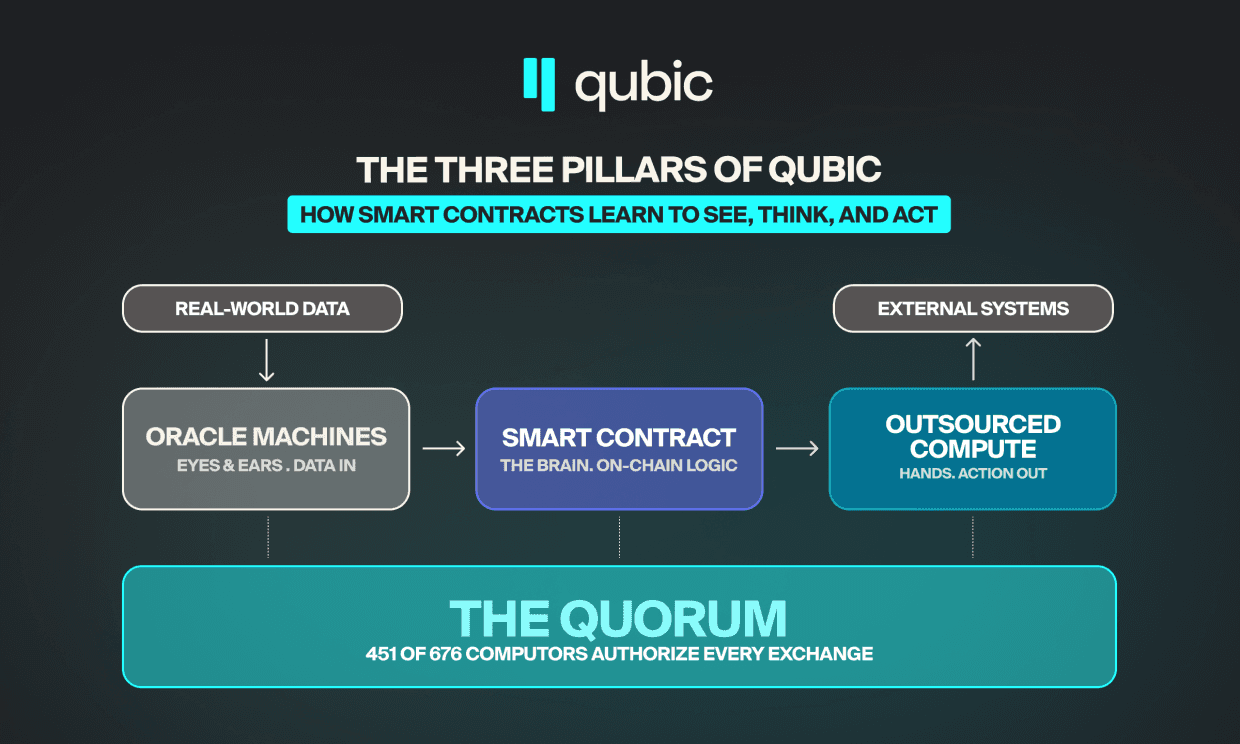
Think of a Qubic smart contract as a brain. It holds the logic and makes the decisions, but a brain in a jar can't do much by itself. Oracle Machines are its eyes and ears, feeding it verified real-world data. Outsourced Computations are its hands, carrying authorized instructions back out so the contract can affect things beyond Qubic in the real world.
Underneath all three sits the Quorum, Qubic's consensus layer of 676 Computors. Nothing moves in or out without 451 of them agreeing, and that is what makes the incoming data trustworthy and the outgoing actions verifiable.
Pillar one: Qubic smart contracts, the brain
Most blockchains run smart contracts inside a virtual machine, which puts a layer of overhead between the code and the hardware. Qubic skips that entirely. Its smart contracts run directly on bare metal, which is a big reason the network can finalize them in well under a second.
A few things make them stand out for the people actually using them. Execution is feeless for the end user, because each contract finances itself when it launches and covers its own running costs in QU, Qubic's native unit. Any QU spent on execution is burned, in turn permanently reducing supply. And before a contract ever goes live, the Quorum has to approve it by vote, so nothing reaches the network without consensus agreement.
On their own, these contracts are fast, cheap to use, and secure. They are also sealed off from anything that isn't already on the chain. That is the limitation the next two pillars exist to solve.
Pillar two: Oracle Machines, the eyes and ears
Oracle Machines give contracts a reliable way to pull in real-world data, and they have been live on Qubic mainnet since February 2026. When a contract needs to know something, whether it's the price of a currency pair, the result of an event, or a sensor reading, it sends a request to an Oracle Machine. The machine fetches the answer from an outside source and returns it to the chain.
The important part is how that answer earns trust. Most blockchain oracles rely on outside intermediaries, which reintroduces a weak point. Qubic's are built into consensus itself. The Computors independently confirm the oracle's reply, and only once the Quorum agrees does the verified result get written to the chain. A contract can ask for a one-time answer or subscribe to a steady feed, which is what a lending protocol would use to watch prices around the clock.
This one capability opens the door to applications that weren't possible on Qubic before. Prediction markets can settle themselves the moment a real outcome is known. DeFi lending platforms can track collateral and trigger liquidations on live price feeds. Insurance contracts can pay out automatically when a verified condition is met, like a flight delay or a storm. Every oracle request carries a small fee that is burned, so heavier use of the network quietly tightens QU supply along the way. If you want to try one yourself, Qubic has a step-by-step guide to querying Oracle Machines.
Pillar three: Outsourced Computations, the hands
If Oracle Machines let a contract listen, Outsourced Computations let it act. This pillar is still being finalized, and once it is the picture is complete.
First, a clarification, because the name throws people off. Outsourced Computations have nothing to do with renting out compute power. It is the mechanism that allows a Qubic smart contract send an authorized instruction outward, to a system that then carries it out. Oracle Machines bring information in. Outsourced Computations push commands out.
How Outsourced Computations work
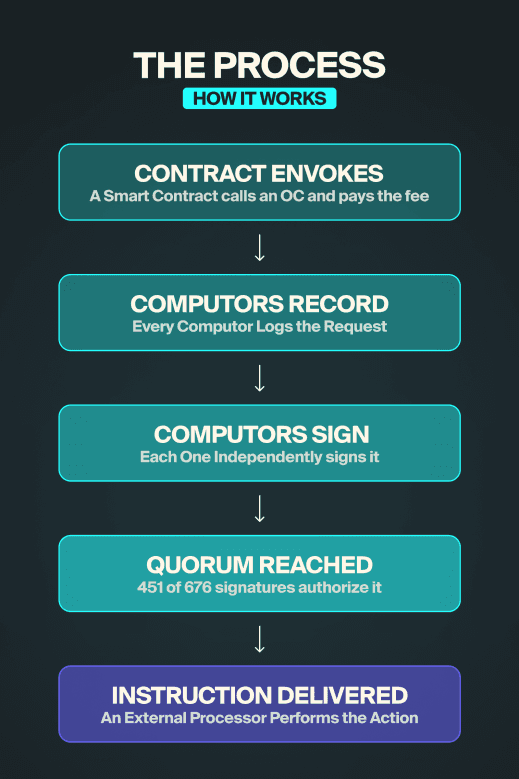
There is one design choice worth understanding. Outsourced Computations are "fire and forget." The contract issues its instruction, the network authorizes and delivers it, and the job is done. There is no automatic receipt. If a contract needs to confirm that the action actually happened, it asks an Oracle Machine. The two pillars hand off to each other, which is the whole idea.
So what can the hands actually do? The instruction is delivered to a processor built by the contract's own developer, so the range is wide. A contract could trigger a cross-chain transaction on Bitcoin or Ethereum. It could rotate the signers on a wallet held on another chain. It could respond to an on-chain payment by releasing escrow or unlocking a physical device. One of the most practical near-term uses is trustless cross-chain bridges that no longer rely on third-party middleware watching the network in the background.
Outsourced Computations roadmap: mainnet by July 1, developers by July 29
The rollout is staged and already underway. A mock version that exercises the full invocation and authorization path, without performing real-world actions yet, is moving through testnet and reaches mainnet around July 1. The production release that opens the protocol for developers to build on is set for July 29. If the system stabilizes sooner, the team has said the date could move up.
How Qubic's three pillars work together
Each pillar is useful by itself. It gets far more interesting when a single contract puts all three to work together.
Picture a parametric crop insurance product running on Qubic. A farmer's policy is a smart contract. Through an Oracle Machine, it watches verified rainfall data for the farmer's region. When rainfall drops below the agreed threshold, the contract's logic recognizes that a payout is owed. It then uses Outsourced Computations to release the funds, settling on another chain if that's where the farmer holds their assets. To be sure the transfer landed, the contract checks back through an Oracle Machine.
Sense, decide, act, confirm. The whole thing settles without a claims adjuster, a review queue, or a middleman sitting on the money. The same loop applies to automated trading, supply-chain triggers, on-chain games that react to real events, and a long list of applications nobody has built yet.
Holding it all together is the Quorum. The same 451-of-676 agreement that verifies an incoming oracle reply also authorizes an outgoing instruction. One trust model covers both directions, so a contract that reads from and writes to the outside world stays as secure as the chain itself.
The bigger vision: decentralized AI and world-aware smart contracts
Qubic has never described itself as just a place to settle transactions. The longer goal is decentralized AI, through its Aigarth project and the network's Useful Proof of Work, where mining power trains an AI model instead of solving throwaway puzzles.
The three pillars complete the vision. Oracle Machines let the network observe reality. Outsourced Computations let it act on reality. A smart contract that can see, think, and do becomes the building block for software that operates on its own in the real world, not only inside a ledger. Qubic's first live experiment in outsourcing real work, using its compute to mine Monero, already showed the model holds up under genuine conditions.
What to watch next
Qubic smart contracts have run since the network launched, and Oracle Machines have been live on mainnet since February 2026. Outsourced Computations are the last piece, reaching mainnet around July 1 and opening to developers on July 29. Once it lands, Qubic smart contracts will be able to communicate with the outside world in both directions, at the protocol level, with consensus behind every message.
For anyone following the project, builders and investors alike, this is the milestone worth following. It is the point where Qubic's contracts stop being clever isolated programs and start behaving like agents that take part in the world.
To go deeper, browse the Qubic blog for the latest updates, start with Qubic Academy if you're new, or read the smart contract documentation and the oracle-machine repository if you're ready to build.