
QUBIC BLOG POST
Qubic's Second Halving: What Epoch 227 Means for QUBIC Tokenomics
Written by

The Qubic Team
Published:
Listen to this blog post
On June 3, 2026, Qubic's Computors approved the network's second halving. It is now scheduled for Epoch 227, which begins around August 19, 2026. This follows the first Qubic halving at Epoch 175 in August 2025, and it keeps the network on the emission schedule that was mapped out back in 2024.
If you are new to Qubic, the short version is this: every week the network creates the same fixed amount of new tokens, but a growing share of those tokens get destroyed before they ever reach the market. A halving is the moment that the share of tokens removed from circulation jumps. The Epoch 227 halving is the next jump.
Here is what changes, why the Qubic tokenomics model was designed this way, and what it means for the QUBIC supply.
What is a Qubic halving?
Most people first meet the idea of a halving through Bitcoin, where the block reward itself gets cut in half. Qubic works differently.
Qubic emits exactly 1 trillion QUBIC every week, and that raw number never changes. What changes is the burn rate, the percentage of those emissions that gets permanently destroyed at the protocol level before distribution. A halving raises the burn rate so that the net amount of new QUBIC entering circulation drops by roughly half. For background on why projects remove tokens from circulation in the first place, The Motley Fool has a clear primer on what coin burning is and how it works.
Bitcoin shrinks the faucet. Qubic widens the drain. The outcome is similar, less new supply over time, but the mechanism is the part that needs to be understood, and it sits at the center of how the Qubic deflationary model operates.
What changes at the Epoch 227 halving
At Epoch 227 the burn rate rises from 55% to 77.5%. Out of the 1 trillion QUBIC emitted each week, 775 billion will now be burned, leaving just 225 billion as effective new supply. That is down from 450 billion today, a cut of about half.
The table below lays out the full picture, drawn from the official Computor proposal.
Category | Current (Epoch 175 to 226) | After Halving (Epoch 227+) |
Weekly Emissions | 1,000B | 1,000B (same) |
Maximum Weekly Burn | 550B | 775B |
Effective Emissions | 450B | 225B |
CCF Share (8%) | 36B | 18B |
QEarn Share (12.25%) | 50.7B | 25.35B |
Minimum Mineable Supply | 363.3B | 181.64B |
Every downstream allocation scales with the cut. The Computor Controlled Fund (CCF), the QEarn share, and the minimum mineable supply all drop by half, because they all draw from the same shrinking pool of effective emissions. That last line, the minimum mineable supply, is simply the amount of QUBIC left for mining rewards each epoch once the burn and the other allocations are accounted for. After Epoch 227 that number falls from 363.3 billion to 181.64 billion.
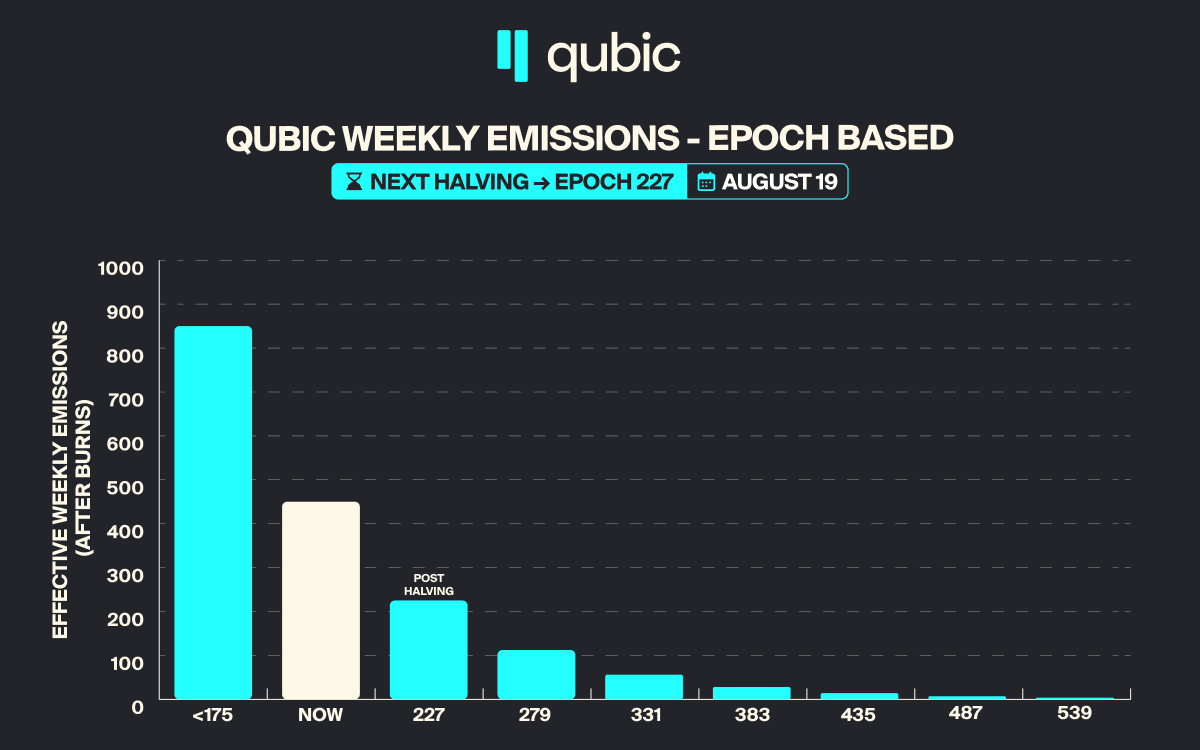
The chart above shows why this matters beyond a single event. Each halving lands every 52 epochs, and each one cuts the effective emission again. The path from today out to Epoch 539 is not a cliff, it is a staircase, and the upcoming Epoch 227 halving is the next step.
Why the Qubic halving matters
There are three reasons this event is worth paying attention to, whether you hold QUBIC, mine it, or build on it.
It keeps the QUBIC supply on schedule
This is the most concrete reason. Without the halving, the network could reach its 200 trillion maximum supply within the next 50 to 70 weeks, which puts us roughly at some point in 2027. Hitting the cap that early would shorten the runway for miners, Computors, and every ecosystem project that depends on emissions. The halving stretches that timeline out and gives the network room to grow into its design rather than hitting a hard ceiling.
It is worth remembering that tokens locked in QEarn count toward circulating supply, and they can return to the market at any time. Slowing net emissions is what keeps the approach to the cap gradual instead of sudden.
It reinforces scarcity by design
QUBIC is built to behave like energy rather than money. It gets consumed when smart contracts execute and when network operations run, and those amounts are burned rather than paid out. The halving accelerates this. By raising the burn rate, a larger portion of every week's emission are removed permanently, which steadily tightens the QUBIC supply over time. To date the network has already burned more than 45 trillion tokens through its combined burn mechanisms.
It protects the ecosystem's longevity
Mining and Computor rewards come out of effective emissions. If emissions ran out too quickly, those rewards would dry up with them. By cutting the net emissions, rather than the raw one, the halving extends how long those rewards last while keeping the network's useful work, including the AI training behind Aigarth, running on schedule.
The Supply Watcher keeps it balanced
One detail that often gets lost: 77.5% is a maximum burn rate, not a rigid one.
The Supply Watcher is a smart contract that monitors real-time supply data and adjusts the burn within that ceiling. Its job is to prevent the network from over-correcting, or burning so aggressively that it destabilizes incentives and starves the system of liquidity. Think of it as a thermostat rather than a fixed switch. The halving raises the ceiling, and the Supply Watcher decides how close to that ceiling the network actually runs at any given moment.
This is why every figure in this post is an approximation. The Qubic emission schedule sets the direction, and the Supply Watcher manages the pace.
What comes next for Qubic
The Epoch 227 halving is not the last halving, it is the second in a recurring cycle. The next one is projected for around Epoch 279 in August 2027, and the pattern continues every 52 epochs after that. With each cut, the effective emission shrinks further while the burn rate climbs.
Over the long run, the design points toward a turning point where burns outpace emissions entirely. At that stage the total supply is projected to peak near 196.8 trillion QUBIC and then begins to decline, settling below the 200 trillion cap the network is built to never touch.
The Epoch 227 halving is one step on that path, but it is a meaningful one. It cuts net new supply in half, holds the long-term schedule together, and moves Qubic further into the deflationary model it was designed around from the start.
Want to watch the burns happen live? Track the NULL_ID address on the Qubic Explorer, follow @Qubic for weekly epoch updates, and join the conversation on Discord and Telegram.
Note: All figures are approximations, subject to Supply Watcher adjustments, Arbitrator fees, and QEarn burns included in the calculations.