
QUBIC BLOG POST
What is AGI? Artificial General Intelligence Explained (2026 Guide)
Written by
Content
Published:
Listen to this blog post
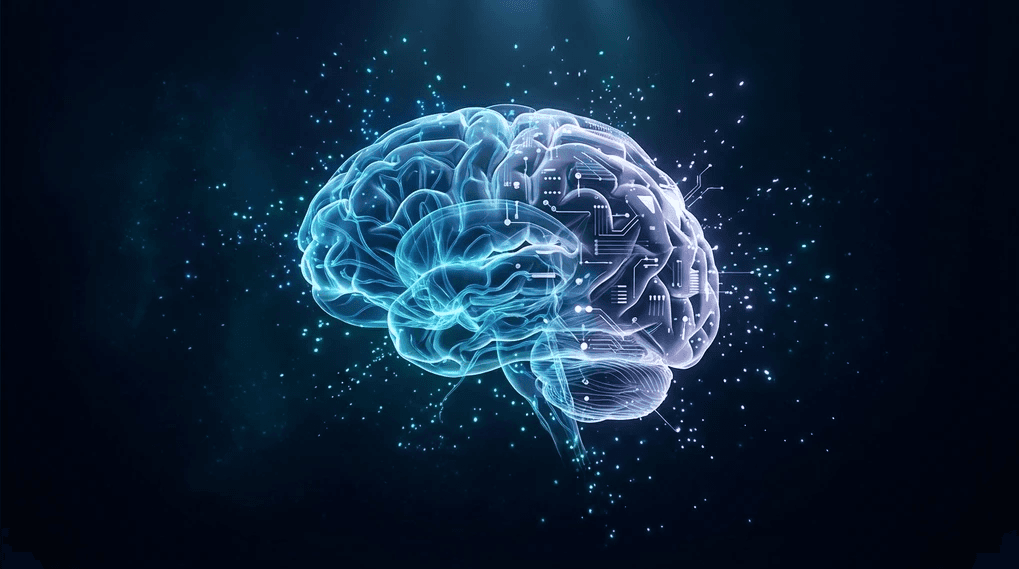
Imagine a system smarter than every tool you use today, not by doing one thing well, but by grasping nearly any challenge thrown its way. That’s the promise behind artificial general intelligence (AGI). Unlike the narrow AI tools we rely on now, like chatbots, recommendation engines, and image classifiers, AGI would learn fast, reason across domains, and adapt when circumstances change. Humans do this naturally. Machines haven’t come close. Yet.
So, what is AGI, really? How close are we to building it? And why does it matter whether it’s developed in closed labs or through open, decentralized systems?
This guide breaks it all down: from the definition of artificial general intelligence to how AGI differs from current AI, the ethical stakes involved, and why platforms like Qubic, a decentralized blockchain purpose-built for AI training, are rethinking the path to AGI from the ground up.
What is Artificial General Intelligence (AGI)?
Artificial general intelligence refers to a machine capable of performing any intellectual task a human can: understanding language, solving novel problems, learning from experience, and transferring insights across completely unrelated domains. It also involves abstract reasoning and the ability to adapt strategies when conditions shift. This stands in stark contrast to today’s AI tools, which need task-specific training and constant updates to remain useful.
In simple terms:
Narrow AI (ANI) excels at a single, predefined job, like playing chess, classifying images, or predicting protein structures.
AGI handles most cognitive tasks flexibly, adapting to new problems without being reprogrammed.
Today’s best AI systems, from GPT-4 to Google’s Gemini, beat humans at specific benchmarks. Yet these systems only perform within the bounds of their training data. True AGI, often called strong AI or human-level AI, would see connections others miss, shift perspective smoothly, and apply understanding wherever it’s needed, without being rewritten from scratch.
Many researchers view AGI not as an incremental upgrade but as a paradigm shift, a bridge between today’s narrow AI and the hypothetical artificial superintelligence (ASI) that could eventually surpass human cognition across every measurable domain.
Narrow AI vs AGI vs ASI: Understanding the Key Differences
Before diving deeper into AGI, it helps to see where it fits in the broader landscape of AI classifications. Each category represents a fundamentally different level of machine capability.
Feature | Narrow AI (ANI) | AGI | ASI |
Scope | Single task | All cognitive tasks | Beyond human cognition |
Examples | Siri, AlphaFold, GPT | Not yet achieved | Hypothetical |
Learning | Task-specific training | Cross-domain transfer | Self-directed evolution |
Adaptability | Low: rigid parameters | High: flexible reasoning | Unlimited: recursive improvement |
Status | Widely deployed | Active R&D worldwide | Theoretical concept |

Current AI tools like GPT-4, Claude, and Gemini are impressive but remain narrow AI, they draw strength from massive training datasets rather than genuine understanding. They cycle through patterns without ever truly learning on their own. The leap from narrow AI to AGI represents something qualitative, not just quantitative.
Is AGI Possible? The Scientific Case
The human brain itself serves as proof of concept. Biological neurons handle every type of thinking, from first principles reasoning and creative problem-solving to social intelligence and emotional regulation. The cerebral cortex alone orchestrates functions that no artificial system has replicated holistically.
Still, building equivalent capability in silicon runs into core engineering challenges:
Cross-domain reasoning: applying insights from one field to solve problems in another
Self-directed learning: improving without human-supervised retraining
Goal formation and adaptation: setting and pursuing objectives autonomously
Value alignment: ensuring machine goals remain tied to human wellbeing
The growing consensus among AI researchers: simply scaling up existing models won’t produce AGI. What’s needed are fundamentally new architectures, novel training paradigms, and purpose-built hardware. This view is supported by recent work from Google DeepMind’s AGI classification framework.
Current State of AGI Research (2026)
AGI research is now advancing across university labs, private research organizations, startup ventures, and government agencies. While no system yet demonstrates broad general intelligence, several converging trends signal rapid progress.
1. Foundation Models
Large language models and multimodal platforms now handle tasks spanning vision, code generation, reasoning, and natural , a marked shift from single-task systems. Still, these models primarily recognize patterns from training data rather than engaging in genuine self-directed learning. For a technical overview, see Stanford’s AI Index Report 2024.
2. Multimodal Intelligence
Models that integrate text, audio, vision, and even tactile data are emerging. These systems develop a richer understanding of their environment, bringing AI closer to the kind of sensory integration humans take for granted.
3. Tool Use and Reasoning
AI systems now connect with external tools, APIs, and , enabling structured reasoning, memory retrieval, and actions beyond the core model. This marks a step toward the kind of agentic behavior AGI would require.
4. Autonomous Agents
AI agents that decompose goals into subtasks, execute multi-step plans, and operate with minimal supervision are becoming more common. However, these agents still lack the persistent motivation and independent judgment that characterize genuine autonomy.
5. World Modeling
Simulated environments and embodied AI projects aim to give systems a continuous, grounded understanding of physical and social , a prerequisite for any machine that claims to think generally.
Despite this progress, leading AI researchers agree that current systems are nowhere near true AGI. They lack persistent long-term goals, intrinsic motivation, and the ability to reason clearly under genuine , hallmarks of human-level artificial intelligence.
How AGI Differs from Large Language Models
LLMs can produce impressively fluent text, but fluency isn’t the same as understanding. Several critical gaps separate today’s most capable models from what AGI would require:
Capability | LLMs (Current) | AGI (Theoretical) | Status |
Cross-domain learning | Pattern-matching within training data | Genuine transfer across novel domains | LLMs lead; AGI unrealized |
Persistent memory | Fixed context windows | Continuous identity and history | Experimental |
Autonomous goals | Follows prompts and instructions | Forms and pursues own objectives | Unrealized |
Real-time world model | Static training snapshots | Dynamic environmental awareness | Early-stage research |
Self-improvement | Requires manual retraining | Rewrites own learning processes | Hypothetical |
LLMs operate through unsupervised pattern recognition across vast text corpora. They never develop lasting internal goals or self-directed growth. AGI, by contrast, would function less like a statistical engine and more like an entity that understands the act of thinking itself.
AGI vs Human Intelligence: What Sets Them Apart?
Matching human cognitive ability doesn’t mean replicating how humans think. AGI could reach or exceed our problem-solving capacity while using fundamentally different internal processes. Human intelligence grows from biology, emotion, culture, and evolutionary , none of which an artificial system would share.
This distinction carries real weight for AI safety and alignment research. A system that solves problems brilliantly but lacks any framework for values, empathy, or social understanding could produce outcomes no one intended. Capability without alignment remains one of the field’s central risks.
Ethical and Safety Considerations Around AGI
As AGI research accelerates, the ethical stakes grow sharper. The conversation extends well beyond technical feasibility into questions of power, accountability, and social impact. According to a Nature study on AGI pathways, responsible AGI development must address five interlocking dimensions: societal integration, technological scalability, explainability, cognitive ethics, and brain-inspired design.
Alignment
How do we build AGI that reliably pursues what humans actually care about? Misaligned AI, where systems optimize for goals subtly different from our intentions, represents one of the most discussed existential risks in the field.
Control
Who maintains oversight when systems grow too complex for any single person or team to fully understand? The question of control becomes critical as AI capabilities approach human-level performance.
Concentration of Power
If AGI emerges under the control of a handful of corporations or governments, the resulting power imbalances could reshape global politics and economics in ways that are difficult to reverse.
Economic Disruption
AGI capable of performing cognitive labor could transform employment landscapes, displacing knowledge workers and restructuring entire industries.
Security Risks
Misuse of AGI could amplify cybersecurity threats, accelerate disinformation campaigns, and destabilize international trust. Open, transparent development frameworks offer the clearest path toward mitigating these dangers.
Centralized vs Decentralized AGI Development
Most AGI research today happens inside closed laboratories, relying on proprietary algorithms and exclusive computing infrastructure. This concentration creates significant problems: opaque decision-making, limited public oversight, and restricted access to intelligence systems.
Dimension | Centralized AGI | Decentralized AGI |
Control | Corporate or government ownership | Community-governed networks |
Transparency | Proprietary, closed-source models | Open-source, auditable development |
Accountability | Internal audits only | On-chain verification, public records |
Access | API keys, subscriptions, gatekeeping | Permissionless, global participation |
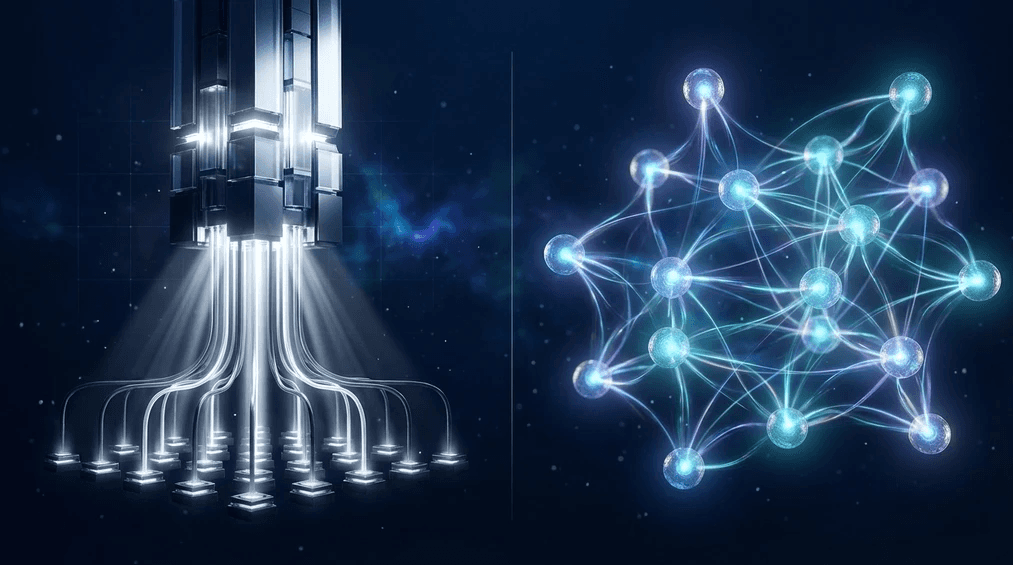
Decentralized AGI development aims to distribute responsibility so no single entity holds disproportionate power. Instead of one company making critical decisions, many participants act , sharing oversight, contributing compute, and ensuring progress serves people more equitably. This is where AI and blockchain technology converge to create new possibilities.
Why Compute Infrastructure Matters for AGI
Building AGI faces fundamental resource constraints: raw compute capacity, energy efficiency, training architecture design, data access, and scalability. Training frontier AI models now costs tens or hundreds of millions of dollars in computing resources alone. As models grow more complex, relying on centralized data centers to scale introduces rising costs and energy inefficiency.
AGI will likely demand continuous learning beyond single training runs, massive distributed compute resources, adaptive architectures, persistent world modeling, and multi-agent intelligence. These requirements build a strong case for decentralized computing platforms that harness collective effort across global networks.
The Case for Distributed Intelligence Systems
The human brain itself operates as a distributed system. Billions of neurons work in parallel with no central . Thought emerges from countless simultaneous processes. Several emerging AI blockchain projects now mirror this architecture, distributing compute across many nodes, enabling parallel learning, supporting modular cognitive designs, and eliminating single points of failure.
These principles align naturally with blockchain-based architectures, where security, coordination, and resource allocation are handled through decentralized protocols. This convergence of AI and blockchain technology represents one of the most promising frontiers in the path to AGI.
Qubic’s Vision for Artificial General Intelligence
Qubic takes an engineering-first approach to , not stacking AI models onto blockchains as an afterthought, but weaving intelligence directly into its consensus mechanism. The core idea is elegantly simple: the same computation that secures the network also trains its AI.
This design creates structural alignment between network security, energy expenditure, AI development, and long-term intelligence growth. Instead of burning compute on abstract cryptographic puzzles, Qubic channels processing power toward real cognitive tasks that generate lasting value.
Useful Proof of Work (UPoW)
Traditional proof-of-work blockchains require miners to solve arbitrary mathematical puzzles, computationally expensive but practically useless. Qubic’s Useful Proof of Work replaces these with actual neural network training tasks. Every mining operation contributes directly to AI development:
Every mining operation contributes to AI training
Network growth directly accelerates intelligence development
Security and utility become structurally aligned
Through this framework, Qubic transforms blockchain infrastructure into a decentralized AI supercomputer, making CPU mining meaningful rather than wasteful.

Aigarth: Qubic’s AGI-Oriented AI Model
At the core of Qubic’s artificial intelligence effort sits Aigarth, a continuously learning AI model designed to evolve toward artificial general intelligence over time. Unlike conventional AI systems trained on centralized databases, Aigarth builds knowledge by harnessing distributed compute power contributed by users across the Qubic network.
Key characteristics of Aigarth include continuous learning beyond formal training endpoints, compute distributed across many nodes rather than controlled by a single authority, transparent model development, open participation, and objectives aligned with ethical and peaceful use principles.
As fresh users join the Qubic ecosystem, they add processing capacity that feeds Aigarth’s training. This creates a virtuous cycle: larger networks produce sharper intelligence, which in turn attracts more participants.
Why Qubic’s Infrastructure is Built for AGI
AGI demands infrastructure capable of massive parallel processing, ultra-low latency communication, high-throughput data handling, persistent memory architectures, and autonomous execution environments. Qubic’s Layer 1 blockchain was designed specifically around these requirements:
High-performance Layer 1: Millions of transfers per second, enabling real-time AI coordination
Feeless transactions: Micropayments and frequent state updates without gas overhead
Instant finality: Deterministic computations with synchronized node states
Scalable smart contracts: Tens of millions of operations per second for complex AI workflows
What sets Qubic apart is that it doesn’t just record data, it executes intelligence across networks. Its design enables real-time processing by multiple nodes, transforming the platform from a simple ledger into a living computational substrate. Learn more about how it works on the Qubic technology overview page.
Ethical AGI Development at Qubic
Building AGI means handling extraordinary power. Qubic addresses this through an anti-military license that prohibits its technology from supporting weapons or warfare. Additional safeguards include open-source development, transparent governance, community participation in decision-making, decentralized oversight mechanisms, and human-aligned objectives at every development stage.
Rather than concentrating AGI research inside closed corporate labs, Qubic distributes the tools for understanding and building intelligence across diverse users and communities worldwide.
AGI Timelines: When Will Artificial General Intelligence Arrive?
Expert predictions vary widely. Some researchers see AGI emerging by the early 2030s; others believe it won’t appear until mid-century. The path forward might build incrementally on today’s systems, or it could require entirely new theoretical breakthroughs. For a detailed analysis of prediction patterns, see the Machine Intelligence Research Institute’s survey data covering 60 years of AGI forecasts.
Qubic’s ambitious target: AGI by 2027. The project relies on decentralized continuous learning and novel architecture development to accelerate progress. While exact dates may shift, the broader trend is clear: the path to AGI is moving faster than most observers expected even two years ago.
Whenever AGI arrives, whether in 2027 or 2035, the question that matters most is who builds it and under what conditions. That’s what will determine what will happen when AGI is achieved.
How to Participate in AGI Development
AGI development extends far beyond research labs. With Qubic, participation happens through multiple pathways:
Become a Computor
Contribute computing resources through Useful Proof of Work and directly support decentralized AI training efforts. Whether through CPU mining or more advanced setups, every contributor strengthens the network’s intelligence capacity.
Join the Community
Engage with Qubic’s open communities to participate in governance discussions, research collaboration, and development efforts. Your voice helps shape the direction of decentralized AGI.
Learn Through Qubic Academy
Explore the Qubic Academy for learning resources on decentralized compute, blockchain architecture, and artificial general intelligence concepts.
Build Applications
Develop decentralized applications that leverage Qubic’s AI-native infrastructure. Check the developer documentation to get started building on a platform designed for intelligence from the ground up.
The Future of AGI: What Comes Next

Artificial general intelligence represents more than a technological . It marks a fundamental shift in the relationship between humans and intelligent systems. Should AGI development go well, the potential applications are transformative:
Accelerating scientific discovery across medicine, materials science, and climate research
Improving healthcare outcomes through personalized treatment and early diagnosis
Optimizing energy systems and climate change mitigation strategies
Expanding global access to high-quality education
Enabling entirely new forms of creativity and human expression
Qubic’s approach, embedding intelligence directly into distributed systems, suggests a model where AGI serves humanity broadly, rather than concentrating power in a few corporate or governmental centers. The platform stands as one of the most ambitious AI blockchain projects currently in active development.
Frequently Asked Questions About AGI
What does AGI stand for?
AGI stands for artificial general , a hypothetical AI system capable of performing any intellectual task humans can, including reasoning, learning, problem-solving, language understanding, and adapting to new situations. Unlike narrow AI, which excels within a single domain, AGI would tackle any type of cognitive work flexibly.
How is AGI different from current AI systems?
Today’s AI is task- specific. Each system is trained for a particular job and struggles outside its domain. AGI would transfer knowledge between areas, teach itself new skills, and adapt its behavior when circumstances change. The gap between narrow AI and AGI is qualitative, not just a matter of scale.
Is AGI currently achievable?
Not yet. While AI capabilities are advancing rapidly, most experts agree that current systems remain far from genuine general intelligence. Achieving AGI will likely require new architectures and training paradigms beyond what exists today.
What risks does AGI pose?
Key risks include misalignment with human values, concentration of power in narrow hands, economic disruption across cognitive-labor industries, and security threats from misuse. Open-source, transparent development frameworks, like those Qubic advocates, offer clearer accountability and public oversight.
How is Qubic contributing to AGI?
Qubic integrates AI training directly into its blockchain consensus via Useful Proof of Work. The network harnesses distributed compute power to continuously train Aigarth, its AGI-oriented AI model, shaping it toward broader intelligence through open-source, community-driven development.
When does Qubic aim to achieve AGI?
Qubic has publicly stated its target of reaching AGI by 2027, leveraging continuous decentralized learning and ongoing infrastructure improvements. While exact timelines remain uncertain, the project represents one of the most ambitious decentralized AGI initiatives underway.
What will happen when AGI is achieved?
If developed responsibly, AGI could accelerate scientific progress, improve healthcare, optimize energy systems, expand education access, and enhance human creativity. However, its impact depends entirely on governance structures, alignment research, and whether development happens transparently or behind closed doors.
Can I participate in AGI development?
Yes. Through Qubic, anyone can contribute computing power via Useful Proof of Work, join governance discussions in the community, learn through the Qubic Academy, or build decentralized applications on AGI-native infrastructure.
Final Thoughts: Why the Path to AGI Matters Now
What is AGI? It’s not just an academic question. It points toward a technological shift that could reshape civilization. Building a machine that thinks like humans, learns fast, and works across every domain of knowledge won’t happen by scaling existing algorithms alone. It demands new approaches to computing infrastructure, training methodology, and governance.
Projects like Qubic represent a fundamentally different route: intelligence growing without central control, progress visible through openness, and development shaped by shared effort rather than corporate secrecy. As the path to AGI accelerates, the choices being made right now, about who builds these systems and under what conditions, will determine what artificial general intelligence ultimately becomes.
AGI is stepping out of theory and becoming real. The decisions we make today set the course for what comes next. Explore Qubic’s approach to decentralized AGI
Qubic is a decentralized, open-source network for experimental technology. Nothing on this site should be construed as investment, legal, or financial advice. Qubic does not offer securities, and participation in the network may involve risks. Users are responsible for complying with local regulations. Please consult legal and financial professionals before engaging with the platform.