
QUBIC BLOG POST
Qubic Network Guardians: A New Incentive System for Decentralized Node Operation
Written by

The Qubic Team
Published:
Listen to this blog post
Strengthening the Qubic network through lightweight node rewards
Introduction
The Qubic network has built its reputation on speed, achieving 15.5 million transactions per second verified by CertiK. Behind this performance sits a network of high-powered machines running the protocol directly on bare metal hardware. While effective, this architecture presents a challenge: the hardware requirements have limited who can participate in supporting the network.
Qubic Network Guardians is designed to change that. By introducing lightweight node options with lower hardware requirements, the initiative removes barriers to entry and makes network participation accessible to everyone. More participants means a stronger, more decentralized network.
The Problem: High Barriers to Network Participation
Running a full Qubic node currently demands significant resources. The official requirements include bare metal servers with at least 8 high frequency CPU cores (>3.5Ghz) featuring AVX2 support (with AVX-512 recommended, will be mandatory latest 2027), 2TB RAM, and dedicated hardware setups. These specifications ensure the network maintains its exceptional throughput, but they also create practical barriers.
Fewer operators mean reduced redundancy. When nodes are concentrated among a smaller group of participants, the network becomes more vulnerable to outages and potential centralization. This is a recognized tension in blockchain design: performance requirements can work against the decentralization that makes distributed networks valuable.
The hardware requirements for Computors exist for good reason. These machines must process transactions, execute smart contracts, and reach consensus at speeds that justify Qubic's performance claims. Lowering those specifications would compromise the network's throughput. The solution isn't reducing Computor requirements. It's creating additional ways to contribute.
The Solution: Incentivizing Lightweight Nodes
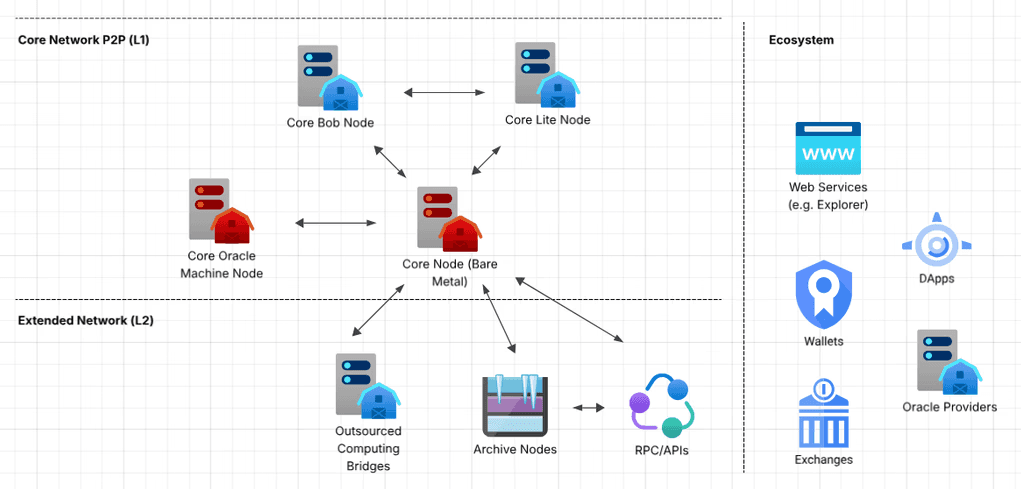
Network Guardians introduces economic rewards for running bob nodes and core lite nodes. These lighter alternatives provide meaningful network benefits without requiring the extreme hardware of a full Computor setup.
What Are Bob and Core Lite Nodes?
Bob Node: A high-performance indexer for the Qubic blockchain that provides a JSON-RPC 2.0 API (similar to Ethereum's) and WebSocket subscriptions for real-time data streaming. It's designed for exchange integration and dApp development, offering features like balance queries, transaction tracking, log filtering, and smart contract queries. Bob nodes are customizable for unique applications and serve as builder-centric infrastructure
Core Lite Node: A lightweight node that connects to the Qubic core network to receive and verify blockchain data (ticks, transactions, logs) without participating in the consensus process as a computor. Unlike full computor nodes that perform heavy computation and voting, a lite node focuses on indexing and serving chain data, making it ideal for running APIs, wallets, and exchange integrations.
Both node types contribute to network health by improving data availability, increasing redundancy, and providing additional access points for network queries.
How Network Guardians Works
The program operates through a straightforward cycle of monitoring, scoring, and rewarding.
Step 1: Node Registration and Discovery
Operators configure their bob or core lite node with an operator identity and optional display name. The system automatically discovers participating nodes through network crawling and node announcements. No manual registration process is required beyond proper node configuration.
Step 2: Continuous Monitoring
Once discovered, nodes enter continuous monitoring. The system evaluates performance across multiple dimensions to ensure operators are genuinely contributing to network health rather than simply running idle software.
Step 3: Scoring System
Points accumulate based on weighted criteria that reflect actual network value:
Metric | Weight | What It Measures |
Uptime | 50% | Consistent availability and reliability |
Synchronization Status | 30% | Keeping pace with current network state |
Data Correctness | 20% | Accuracy of served data and responses |
This weighting emphasizes reliability above all. A node that stays online and synchronized provides more value than one with perfect data accuracy but sporadic availability.
Note: The scoring framework is currently under development. The values provided above are illustrative and subject to change. Finalized values will be communicated later.
Step 4: Public Leaderboard
All participating operators appear on a transparent leaderboard ranked by their cumulative score. Anyone can verify who contributes and how much. This visibility creates accountability and allows the community to recognize top performers.
Step 5: Epoch-Based Rewards
QU rewards are distributed at the end of each epoch (Qubic's weekly cycle) proportional to operator scores. Higher-ranked operators receive larger shares of the reward pool. This aligns with how Computor rewards already function in the main network, extending a familiar model to lightweight node operators.
Technical Requirements
The hardware specifications for Network Guardians participation sit well below full node requirements while still demanding capable machines.
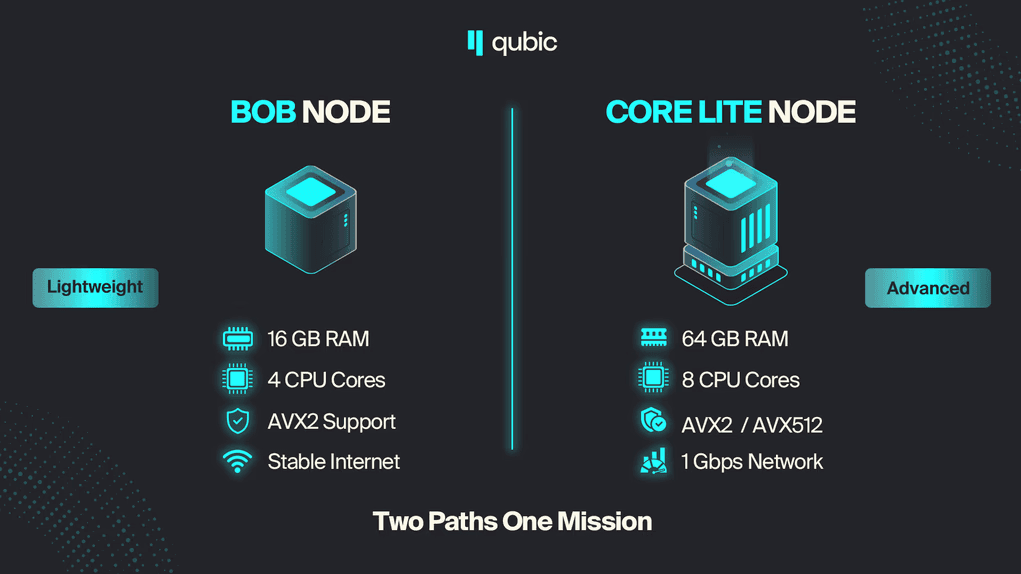
Bob Node Requirements
Component | Specification |
RAM | Minimum 16 GB |
CPU | 4 cores with AVX2 support |
Network | Stable internet connection |
Operating System | Linux |
Core Lite Node Requirements
Component | Specification |
RAM | Minimum 64 GB |
CPU | 8 cores with AVX2 or AVX512 |
Network | 1 Gbps recommended |
Operating System | Linux |
For comparison, running a full Qubic node requires bare metal hardware with 8+ cores, AVX-512 support (mandatory by 2027 latest), 2TB RAM, and dedicated server infrastructure. The lightweight alternatives reduce the entry point considerably.
Preventing Abuse
Any reward system faces gaming attempts. Network Guardians plans several countermeasures:
Relay and Proxy Detection: Mechanisms to identify nodes that appear to be running but are actually routing requests through other infrastructure rather than providing genuine service.
Identity Limitations: Restrictions on how many nodes a single operator identity can register, preventing one participant from claiming disproportionate rewards by spinning up numerous low-effort instances.
The specific implementation details for these measures will develop alongside the program as real-world patterns emerge.
Long-Term Vision: Moving On-Chain
The initial Network Guardians phase operates without a smart contract. Reward calculations happen through existing infrastructure, and distributions follow established processes.
The roadmap targets full on-chain operation through several planned developments:
Smart Contract Deployment: A dedicated contract managing the reward pool and distribution logic.
Oracle Machine Integration: Network statistics delivered through Qubic's Oracle Machines, which connect smart contracts to real-world data through the Qubic Protocol Interface.
Automated Distribution: Reward calculations and payments handled entirely by contract logic, removing manual processes and increasing transparency.
This transition would align Network Guardians with Qubic's broader smart contract architecture, where contracts operate through community governance and provide shareholders with passive income from fees.
Why Decentralization Matters
The 676 Computors that validate the Qubic network must reach quorum (451+ agreement) to finalize transactions. This Byzantine Fault Tolerant design ensures the network can function even if some validators fail or act maliciously.
Lightweight nodes don't participate in consensus directly, but they strengthen the network in other ways:
Data Redundancy: More nodes storing and serving network data means better availability during outages or attacks.
Geographic Distribution: Lower hardware requirements enable operators in more locations to participate, reducing reliance on data center concentrations.
Query Load Distribution: Additional nodes handling API requests and data queries reduce strain on Computors, letting them focus on consensus operations.
Attack Resistance: A larger node population makes targeted attacks more difficult and expensive to execute.
These benefits compound as participation grows. Each additional node makes the network incrementally more resilient.
Getting Started
Network Guardians is designed for simplicity. Both bob and core lite nodes will be available as Docker images, enabling near one-click deployment.
Why Docker?
Bob and core lite nodes aren't single executables. They're coordinated systems composed of multiple services (core node, Redis, kvrocks) that must run together and communicate reliably. Docker packages this entire stack into a single, reproducible unit.
Consistent environment: Every user runs the exact same versions with no configuration drift
Zero dependency management: No manual installation of Redis, kvrocks, or version matching
Simple operation: Start and stop the entire stack as one unit with Docker Compose
Safe upgrades: Switch image versions without affecting your host system
Clean isolation: Node runs separately from your OS with explicit data persistence
To Prepare
Check Hardware: Confirm your machine meets bob node (16 GB RAM, 4 cores) or core lite (64 GB RAM, 8 cores) requirements.
Install Docker: Ensure Docker and Docker Compose are installed on your Linux system with AVX2 CPU support.
Follow Announcements: Monitor official Qubic channels for launch details and deployment guides.
Configure Identity: Once live, set up your operator identity and optional display name through the provided configuration.
Roadmap: Building Together
Phase | Target |
Closed Beta | End of January |
Public Launch | Mid to Late February |
The journey itself is part of the campaign. Feedback from early participants will shape the final implementation, scoring weights, and reward mechanics. This isn't a system being handed down. It's infrastructure being built together.
Join the Discussion
Have questions about Network Guardians or want to connect with other node operators? The Qubic community is active across several platforms:
Discord - The main hub for technical discussions, announcements, and support
X (Twitter) - Follow for updates and ecosystem news
Telegram - Community chat and discussions