
QUBIC BLOG POST
QBridge: Qubic Opens a Direct Line to Ethereum
Written by

The Qubic Team
Published:
Listen to this blog post
For all its speed, for all its ambition, Qubic has operated in its own lane by design. A feeless Layer 1 capable of 15.5 million transactions per second, verified on mainnet by CertiK, running bare-metal C++ smart contracts at tick speeds most chains can only theorize about. And yet, every token locked inside the Qubic ecosystem has been, until now, exactly that. Locked inside. Cut off from the deepest liquidity pools in crypto. Invisible to the wallets, DEXs, and lending protocols where the majority of on-chain capital still lives.
QBridge changes that equation. Moving to IPO in Epoch 205, QBridge is a non-custodial cross-chain bridge connecting Qubic directly to Ethereum, and with it, to the single largest concentration of DeFi infrastructure in existence.
What Is QBridge? The Qubic-Ethereum Cross-Chain Bridge
At its core, QBridge allows anyone to transfer QUBIC tokens between the Qubic and Ethereum networks in seconds. Built by Vottun and architected as a native Qubic smart contract, it creates a seamless corridor between two fundamentally different blockchain architectures: Qubic’s tick-based quorum consensus and Ethereum’s EVM execution layer.
The bridge doesn’t require trust in a single operator or centralized custodian. It runs on a 2-of-3 multisig governance model, meaning every critical administrative action (changing admins, adjusting fee parameters, withdrawing accumulated fees) requires agreement from at least two of three independent signers. No single party holds the keys. No single point of failure exists.
How It Works: Lock, Mint, Burn, Unlock
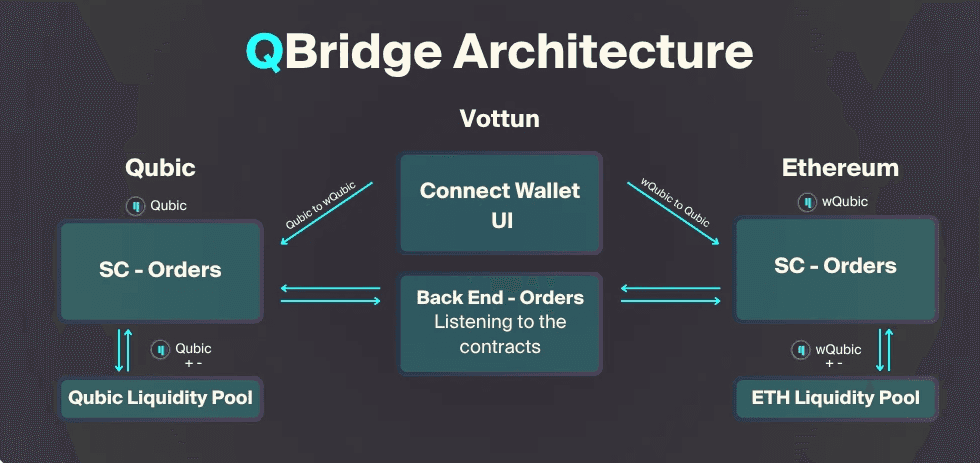
QBridge uses a lock-and-mint architecture, the same proven pattern that underpins the most reliable cross-chain bridges in the industry, but implemented natively within Qubic’s smart contract framework.
When a user bridges QUBIC to Ethereum, the process works as follows: the original tokens are locked inside the QBridge smart contract on Qubic, and an equivalent amount of wQUBIC, a fully backed ERC-20 token, is minted on Ethereum. The ratio is always 1:1. No fractional reserve. No synthetic exposure. Every wQUBIC in circulation on Ethereum is backed by a native QUBIC token held in the bridge contract.
Going the other direction, the wQUBIC is burned on Ethereum, and the corresponding native QUBIC is unlocked and returned to the user on Qubic. This two-phase commit pattern, where tokens are received first and only marked as locked upon successful completion, ensures that assets are never lost, even if a transaction fails mid-process. Every error path triggers a full refund of both tokens and fees.
The bridge charges a flat 1% total fee per order, split evenly: 0.5% goes to the bridge operator (Vottun), and 0.5% flows back to the network as dividends distributed to computor shareholders. A minimum order of 200 QU prevents dust spam. Importantly, fees are reserved at the time an order is created but only released for distribution once the order successfully completes. If something goes wrong, the user gets everything back.
Bridge Security: Audited, Multisig-Governed, and Refund-Protected
Bridge exploits have cost the crypto industry billions. The QBridge team clearly took that history seriously. The contract has undergone a full security audit, and every finding has been addressed in the current implementation.
The fixes are specific and substantive. Single-pass slot allocation eliminates redundant loops. Transfer operations follow a transfer-first pattern, where state is only updated after a successful transfer, closing a class of reentrancy-style vulnerabilities. The contract validates Ethereum addresses against zero values and checks proposal addresses against null IDs. Invocation rewards are captured immediately and excess payments are refunded. The nextOrderId counter increments only on successful order creation, preventing ID collisions from failed attempts.
Beyond the audit, the multisig governance layer adds structural protection. All admin proposals follow a create-approve-execute flow. A proposal auto-counts as the first approval from its creator, then requires a second admin to sign before execution. If the underlying action fails, the proposal deactivates cleanly. Creators can cancel pending proposals at any time. The threshold can be adjusted, but never below two approvals, through the same proposal mechanism.
Why the Qubic-Ethereum Bridge Matters for Interoperability
Qubic’s architecture is unlike anything else in crypto. Written in C++, executing directly on bare metal without a virtual machine layer, processing transactions with instant finality and zero fees, it’s a chain built for raw performance. But that distinctiveness has come with a cost: EVM incompatibility has been a recurring friction point for partnerships, exchange integrations, and wallet support.
QBridge doesn’t just move tokens. It moves Qubic into the orbit of Ethereum’s massive ecosystem. With wQUBIC as an ERC-20 token, QUBIC becomes accessible to every Ethereum wallet, every DEX aggregator, every lending protocol, and every portfolio tracker that supports the standard. Liquidity that was previously siloed inside Qubic can now flow into Ethereum’s DeFi stack, and capital from Ethereum can flow back.
The bridge also carries a cross-chain message communication layer capable of transmitting arbitrary payloads beyond simple token transfers: governance votes, oracle data, contract calls. This positions QBridge not just as a token ferry but as infrastructure for multi-chain applications that span Qubic’s compute layer and Ethereum’s financial layer. For users who need immediate settlement, LP-backed instant liquidity pools provide liquidity vouchers so assets arrive without waiting for full finality, with liquidity providers earning a small fee for the service.
Strategic Infrastructure: QBridge in Qubic’s Expansion Roadmap
It’s worth stepping back to see the larger picture. Qubic is building outward. The Solana bridge, developed by Avicenne Studio, is progressing through QA. Oracle Machine subscriptions are entering testnet, enabling smart contracts to react to real-world data feeds. The Network Guardians program is expanding decentralization. Neuraxon’s AI research has been accepted for IEEE publication. Moreover, the second token halving approaches in August 2026, tightening supply further against an already deflationary backdrop. Over 67 trillion tokens have been removed from circulation through burns and QEarn locks.
QBridge is the Ethereum piece of this expansion. It’s the infrastructure that makes Qubic legible to the EVM world, the world where the majority of on-chain liquidity, developer tooling, and institutional attention still concentrates. When builders on Ethereum can interact with QUBIC through familiar interfaces, when Qubic-native applications can leverage Ethereum’s DeFi primitives, the ecosystem surface area grows in ways that compound.
This is not a feature. It’s a foundation.
QBridge IPO: Epoch 205 Smart Contract Launch
The QBridge IPO is open now through next Wednesday’s epoch change. Bids go directly through the Qubic wallet. On April 2nd, the team expects to launch on open mainnet, execute the first transaction, and open Uniswap liquidity pools.
Under Qubic’s smart contract model, shares undergo an IPO via Dutch auction, a mechanism where the market itself determines the price. Smart contracts on Qubic are self-financing through their IPO, and the network fee share from bridge operations flows directly to shareholders as dividends.
For those paying attention to where Qubic’s infrastructure is heading, Epoch 205 represents a meaningful moment to participate early in what may become one of the most-used contracts on the network.
What Comes Next for Qubic Cross-Chain Connectivity
Qubic has spent its first two hundred epochs proving that a feeless, high-throughput blockchain can work at scale. The speed records are verified. The architecture is battle-tested. The ecosystem is growing.
Now the walls come down. QBridge connects Qubic’s compute power to Ethereum’s capital markets, its developer community, and its deep pool of financial primitives. It’s the first permanent, non-custodial corridor between these two networks, and it’s built to carry far more than tokens.
Epoch 205. The bridge is open.