
QUBIC BLOG POST
Strike the Match: My Last Match Approaches Closed Beta
Written by

The Qubic Team
Published:
Listen to this blog post
A match strikes. For half a second there is warmth, a small circle of orange light against a silence that has no edges. Then the flame dies, and the dark folds back in. Somewhere close, something breathes that used to be a person. Somewhere far, a safehouse door opens, and a stranger decides whether you are worth saving or worth robbing.
This is My Last Match. And its closed beta is approaching.
My Last Match (MLM) is a post-apocalyptic survival MMORPG built natively on Qubic and developed in Unreal Engine by the team behind The Wicked Days (2021) and Post Scriptum CTG, both shipped by Alien Tech Limited. The game is led by Come-from-Beyond (CFB), Qubic's founder.
The project has already drawn serious capital. MLM's IPO closed with 473.876 billion $QUBIC bid and burned, removing that supply permanently from circulation. The target is a single interconnected world supporting up to 50,000 concurrent players at 50ms latency. Whether the final build reaches that ceiling remains to be seen, but the ambition reveals where the project is headed: a social survival system with a real, functioning on-chain economy.
The Anti-Game: Why My Last Match Breaks Every Survival Game Rule
Most survival games hand you a world, let you break it, then reset it. MLM refuses. There are no server wipes. Every safehouse captured, every alliance betrayed, every road controlled stays in the world's history permanently. Your decisions do not dissolve at the end of a season. They calcify.
There are no pre-set teams or sides. Clans form because people choose each other, and territory is held because someone fought for it and someone else decided not to challenge them yet. Resources are finite with no respawn. Bullets hoarded today are bullets unavailable tomorrow. A medkit used carelessly, is a medkit no one else will ever find.
Combat runs on stats, equipment, and strategy. You will not out-click a prepared opponent. You will out-think them, or you will die and pay the resurrection cost to try again.
A Post-Apocalyptic 1990s Europe You Can Actually Survive In
MLM takes place in a 1990s European landscape, decayed and running out of everything. Gasoline has degraded beyond use, making only diesel vehicles viable. Over 100 vehicles exist in the game world (cars, vans, trucks, tractors, buses), all limited in number. The map spans city centres, villages, forests, and coastlines, each with distinct survival challenges.
Crafting relies on salvaged materials: scrap metal, ash, sand, and spare parts. Progression follows the Knowledge system, where players learn by studying manuals, experimenting with materials, and discovering whiteprints (rare crafting blueprints earned through gameplay). What you know determines what you can build, trade, and survive.
The game also tracks a deep set of player metrics: sanity, hygiene, temperature, consciousness, hydration, oxygen, nutrients, and pain. These interact with each other and with the environment. Ignore your hygiene and your scent draws threats. Let your sanity drop and the world shifts around you. The game treats the human body as a full system, and survival means managing all of it.
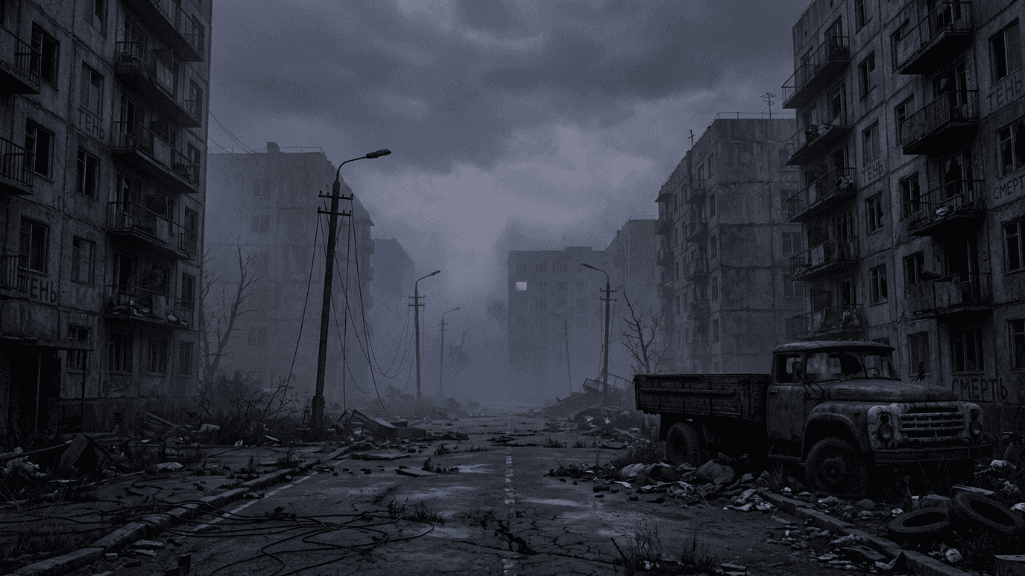
Concept art generated with AI. This does not represent actual in-game graphics. MLM's visual style is still evolving as development progresses.
Light vs. Dark: The Survival Mechanic That Defines My Last Match
The most distinctive survival loop in this blockchain MMORPG revolves around darkness and what lives in it.
Mares are non-physical entities that haunt the perpetual night. They are not visible by default, but as a player's sanity deteriorates, they begin to appear, a sign that your mind is already slipping. Their proximity drains sanity further, creating a feedback loop: the worse your mental state, the more you see, and the more you see, the faster you fall. Light keeps them at bay. A torch, a lamp, a safehouse with working electricity. But light attracts dementals: humans driven to madness by fear and the influence of mares. They retain rudimentary intelligence. They use doors. They remember patterns. And they are drawn to any light source in the darkness.
Stay in the dark and your mind frays. Light a fire and you announce your position to everything that hunts. Every decision about visibility is a decision about which danger you accept. This tension never fully resolves, and it sits at the psychological core of the entire game.
Note: mares and other advanced features will be deployed incrementally during the beta as the team tests and stabilizes each system. Game features are being deployed incrementally by necessity. What enters the world, stays, so every mechanic must hold up under real conditions before going live.
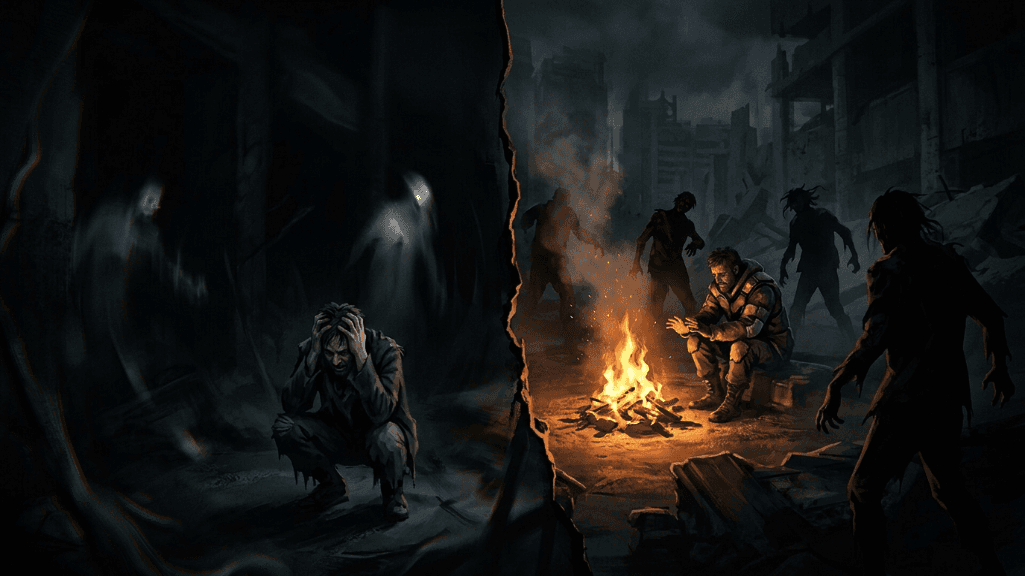
AI-generated concept art illustrating the light and darkness survival mechanic.
Safehouses: The Player-Driven Economy Backbone of MLM
The original game world contained 676 safehouses, a number mirroring Qubic's own Computor count. Many have since been converted into vehicles, pets, or bonus upgrade points, leaving about 300 unique structures. These range from dugout shelters and public restrooms to strip clubs, gyms, hunting mansions, churches, cranes, and floating aerostats.
Each safehouse has a unique function: some specialize in crafting, others in storage, trade, or medical services. All serve as respawn points and income sources. Owners can charge reincarnation fees every time another player respawns there, and levy storage and trade taxes. Production is fully player-driven, meaning players must cooperate for resources by trading through live trading routes across the map. There is no global marketplace UI. Trading requires physical proximity inside safehouses, which means a safehouse's location on the map directly determines its commercial and strategic value.
This economy started forming well before the beta. In the Qubic Discord, a church safehouse sold for 7.5 billion QUBIC. The mayor's car fetched 6.1 billion QUBIC. Players are already pricing future use, prestige, and strategic advantage in a world that has not fully launched.
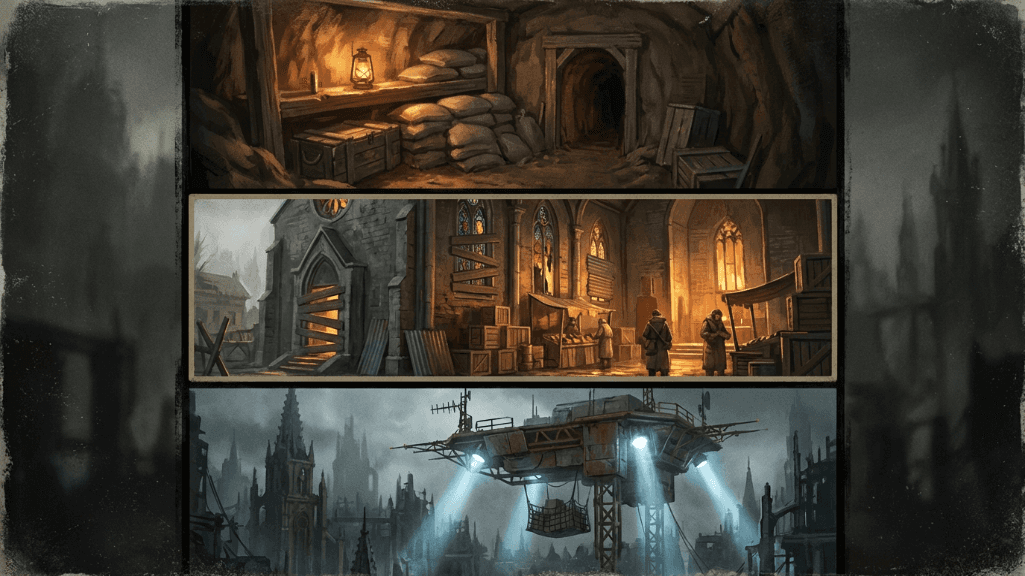
AI-generated concept art depicting safehouse variety. These visuals are illustrative and do not represent current in-game graphics.
How Qubic Powers My Last Match
Every transaction in MLM happens in QU, Qubic's native currency. Every asset (safehouse, vehicle, pet, weapon) is owned on-chain and stored in the player's individual Qubic wallet. You can trade, sell, or transfer anything you own. Ownership is validated by the network itself.
The game also introduces its own in-game currency: matches. During the beta, matches will be distributed as loot throughout the game world. At full release, each match will be redeemable at a fixed rate of 1 Match = 1,000 QU. This creates an earning layer from the very first day of beta, where active players can accumulate real value simply by playing.
For those already in the Qubic ecosystem: MLM is deeply integrated into the network's economic logic. The IPO alone burned 473.876 billion $QUBIC from supply. On top of that, every in-game transaction and smart contract execution carries a fee that is permanently removed from circulation. As the game scales, so does the burn. MLM is already one of the most significant contributors to Qubic's deflationary mechanics.
For everyone else: the blockchain layer runs underneath. You do not need to understand tokenomics to play. You just need to know that what you earn, you actually own.
Built With the Community: How MLM Players Shape the Game
CFB engages directly with players in the Qubic Discord through one-on-one conversations about mechanics, balance, and feasibility. Player suggestions have already been integrated into the game. The crafting system is designed to include community-contributed recipes, covering everything from survival tools to portable shelters.
Community-organised structures are already taking shape around the game. The Wolf Pack, MLM's largest player-formed clan, has built a meritocratic organisation around a shared safehouse portfolio (including an aerostat, grassship, crane, strip club, gym, and hunting mansion), on-chain governance weighted by their $WP token, and coordinated military and commercial operations. Their $WP public sale sold out in 30 minutes, moving 250 billion QU worth of tokens. That kind of capital commitment to a clan structure, before the game's beta has even launched, says something about the level of conviction in the community.
Other clans and economic alliances are forming across the Discord. The political and economic landscape of MLM is already being shaped by real players with real assets, and the game world has not even fully opened yet.
My Last Match Closed Beta: What to Expect and How to Join
The closed beta is approaching soon. All existing MLM asset owners (safehouses, vehicles, pets) will have access automatically. For those without assets, Survival Packs are available for 70 million QU through the MLM website. Only 300 packs exist. Each pack contains 9 essential early-game items: the bare minimum to face the dark. All proceeds from survival pack sales will go directly into purchasing matches from the MLM contract, which are then distributed as loot inside the game world.
Features will roll out incrementally during the beta. The development approach is deliberately inside-out: core mechanics and systems first, visual polish later. The game is currently in a placeholder graphics state. Think of it as comparable in spirit to Project Zomboid: deep systems, evolving visuals. Graphical improvements are planned, but the team's priority right now is getting the survival loop, economy, and multiplayer infrastructure right.
The key detail: nothing wipes. Loot collected during beta carries into the full release. Progress is permanent. Decisions made now will still matter when the world is complete.
The beta will already present a meaningful earning opportunity for active players. During prior playtests, top-performing players earned whiteprints, valuable crafting blueprints that can be broken into grayprints and traded on the open market. Combined with matches distributed as loot (redeemable at 1 Match = 1,000 QU at full release), the beta seeds the first layer of a real player-driven economy from day one.
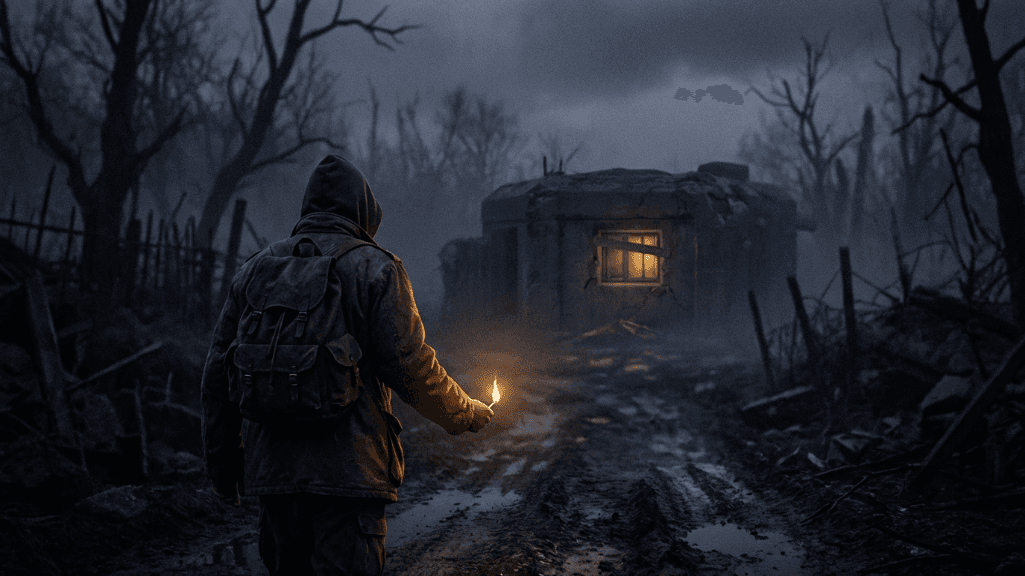
Concept art created with AI for illustrative purposes. Actual in-game visuals are under active development and will differ.
Step Into the Dark
My Last Match is a game built on permanence, scarcity, and the belief that ownership only matters when the world around it gives you something worth fighting for. The beta is the beginning of a persistent world where every action echoes forward and nothing resets.
As RokS, MLM Board Director and Wolf Pack Project Lead, puts it:
"No game has been built quite like this. CfB's approach is to test with consequences, which means every feature goes live in the actual game, not a sandbox. There are no server wipes, so every mechanic must hold up under real conditions. If Dementals become too strong, there may be no stopping them. The game has a life of its own. You can't reset it. You can only build on it, feed it, shape it."
The MLM website is live. Survival Packs are limited. The darkness is not waiting for you to be ready.
The only question is whether you will strike the match.
Join the beta list before it closes. Only 300 Survival Packs will be available, and they won't last.