
QUBIC BLOG POST
Neuraxon at AMLDS Osaka and AGI-26 San Francisco
Written by

Qubic Scientific Team
Published:

Listen to this blog post
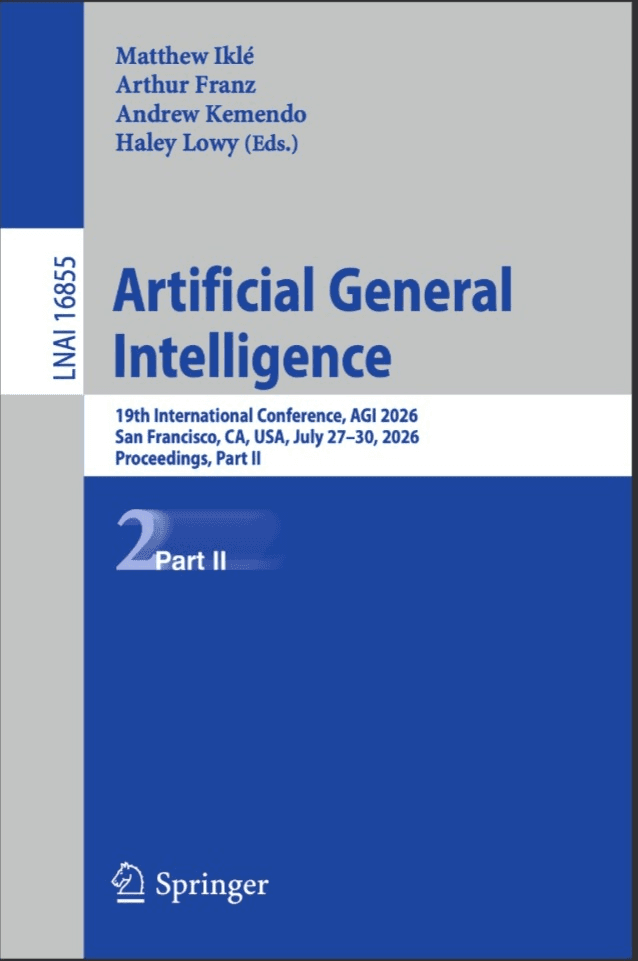
The AGI 2026 (AGI-26) proceedings from Springer. Qubic's Multi-Neuraxon paper joined the peer-reviewed record of the 19th International Conference on Artificial General Intelligence
Two Conferences, Two Neuraxon Papers
First of all, special thanks to CfB and to all Qubic members for their support.
We had the opportunity to present the Neuraxon papers at two conferences.
Trinary Neurons and Self-Organized Criticality: The Neuraxon Paper at AMLDS Osaka
We took the trinary paper to AMLDS in Osaka. Trinary means a neuron whose output can be excitatory, inhibitory, or neutral, not just on or off. Almost everyone in the room had seen ternary before, but as a way of compressing weights to save memory. Our claim was different: the neutral state isn't a compression trick, it's a dynamical element that changes how the network regulates itself. To test it we built two networks that were identical in every respect (same wiring, same synapses, same plasticity rules, same inputs) and changed one thing only: whether the neuron had two output states or three. Then we let them run in an artificial-life world with no resets, no normalisation layers, and nothing telling them what to learn, and we watched how activity propagated over long horizons. What we found is that the trinary networks sit at criticality about two and a half times more often than the binary ones, and they get there on their own and stay there. The binary networks drift subcritical and never really recover. The result we care about most, though, is the one about robustness: the trinary networks hold criticality across the whole range of LTP/LTD imbalance we observed, while the binary ones only get close when plasticity happens to be finely balanced. In other words, the neutral state decouples critical dynamics from having to tune your plasticity correctly. Our reading is that it works as a buffer, a soft landing between silence and firing that absorbs fluctuations instead of amplifying them, which is exactly what subthreshold biology does with silent synapses and dendritic plateaus. For neuromorphic hardware that's an attractive trade: a third state costs you well under a bit per neuron and may let you drop the stabilisation circuitry you'd otherwise need. Where it's honestly weak is that all of this happened with no supervised objective, so we can't yet say criticality buys you accuracy on a benchmark
We got awarded with best evening presentation in our section.
Multi-Neuraxon at AGI-26: Modular, Frequency-Gated Spiking Neural Networks
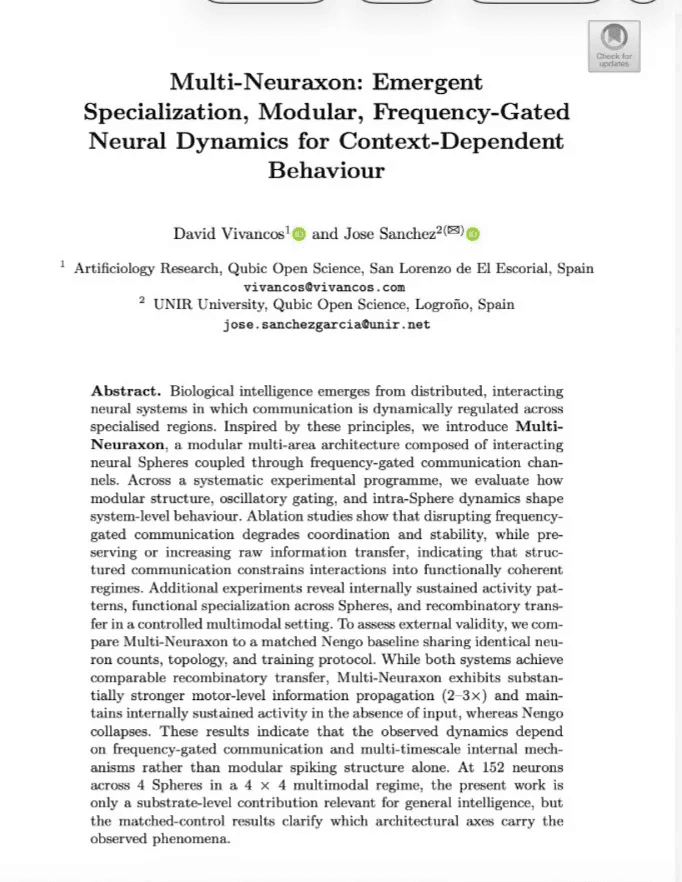
The Multi-Neuraxon paper — "Emergent Specialization, Modular, Frequency-Gated Neural Dynamics for Context-Dependent Behaviour" — by David Vivancos and Jose Sánchez, Qubic Open Science.
At AGI 26 in San Francisco we presented Multi-Neuraxon, which is what happens when you stop treating Neuraxon as one network and start treating it as several. The architecture has four Spheres --- visual, auditory, association, motor --- each a complete Neuraxon in its own right, and the interesting part is how they talk to each other. Instead of fixed wiring, projections between Spheres are gated by oscillatory coherence: gamma carries feedforward, beta carries feedback, theta links the two sensory Spheres laterally. Similar to the brain mechanisms of active inference and predicting coding. When the phases align the channel opens; when they don't, it closes. We didn't design the configuration by hand --- an evolutionary architecture search found it --- and then we lesioned and probed that one healthy brain fourteen different ways. The result that surprised us most is what happens when you switch the gating off: information doesn't drop, it goes up, and yet coordination and motor stability fall apart. So the gating isn't a bandwidth mechanism, it's a constraint mechanism --- it keeps interactions inside a coherent regime rather than making them stronger. Alongside that, three internal mechanisms turned out to be co-essential: remove ChronoPlastic dynamics, complementary coding, or trinary logic and the system loses half its information each time. The behavioural side is where the talk got interesting: the Spheres specialise on their own, with visual and auditory becoming modality-selective and the association Sphere staying genuinely multimodal, without us ever assigning those roles. The system also recombines learned components it was never trained to combine, forgets gracefully rather than catastrophically across sequential tasks, and keeps working after losing three quarters of its neurons. To show none of this was just "modular spiking networks do that," we built a matched Nengo baseline with the same neuron count, topology and protocol, and the two are equivalent on recombination but diverge sharply on internal activity, where Nengo collapses without input and Multi-Neuraxon keeps going.
Honest Limitations of a Substrate-Level AGI Contribution
The limitations we put on the slide ourselves: this is a hundred and fifty neurons, so it's a substrate-level contribution and to be clear: nothing about scaling is demonstrated; everything comes from one architecture-search configuration. Perhaps the co-essential triad may be a co-adapted optimum rather than a principle. In fact, all three of those mechanisms are ours, which means cross-framework replication is the obvious next step. We also still owe the field a transformer baseline and a standard neuromorphic benchmark.
Deep Learning Highlights from AMLDS Osaka
In Osaka, there were some astonishing presentations on deep learning applications. Although we don't believe intelligence can emerge from language alone, LLMs deliver better results month after month. A strong keynote by Giuseppe Di Fatta covered multi-task deep learning. Drawing on Stein's paradox in statistics, his group used a shrinkage factor for multi-task regularisation. They set out to improve on Google DeepMind's Gato, a generalist agent trained to handle 604 distinct tasks.
AGI-26 Keynotes: Predictive Coding, Active Inference, and Embodied Intelligence
The next conference was AGI 26, in San Francisco --- the one devoted specifically to general intelligence. Its keynotes were reserved for genuine giants of neuroscience, psychology, computing and artificial intelligence. Karl Friston, the father of predictive coding, opened proceedings with a morning keynote. David Eagleman set out his vision of a future AI society and the signs by which we might recognise general intelligence.
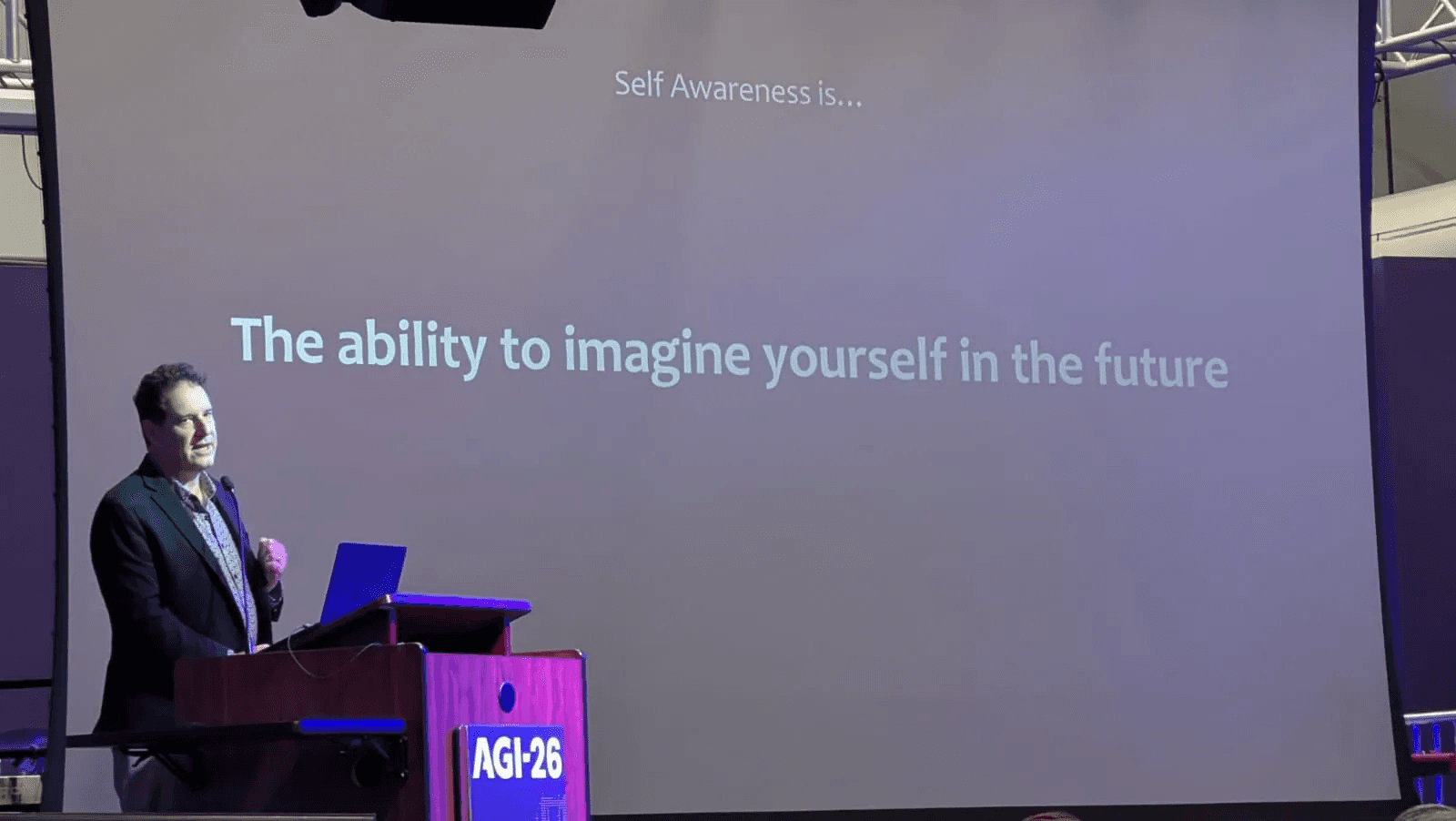
Hod Lipson at the AGI-26 podium: "Self-awareness is the ability to imagine yourself in the future."
Hod Lipson presented superb work on robotics and human--machine interaction; his model of self-representation in robots is genuinely remarkable. Anil Seth argued that intelligence is an emergent property of biological, embodied, conscious organisms --- as a fellow meditation practitioner, I found myself very much in tune with that view. Other speakers took a more functionalist line, or, as someone quipped from the stage, a "com-functionalist" one.
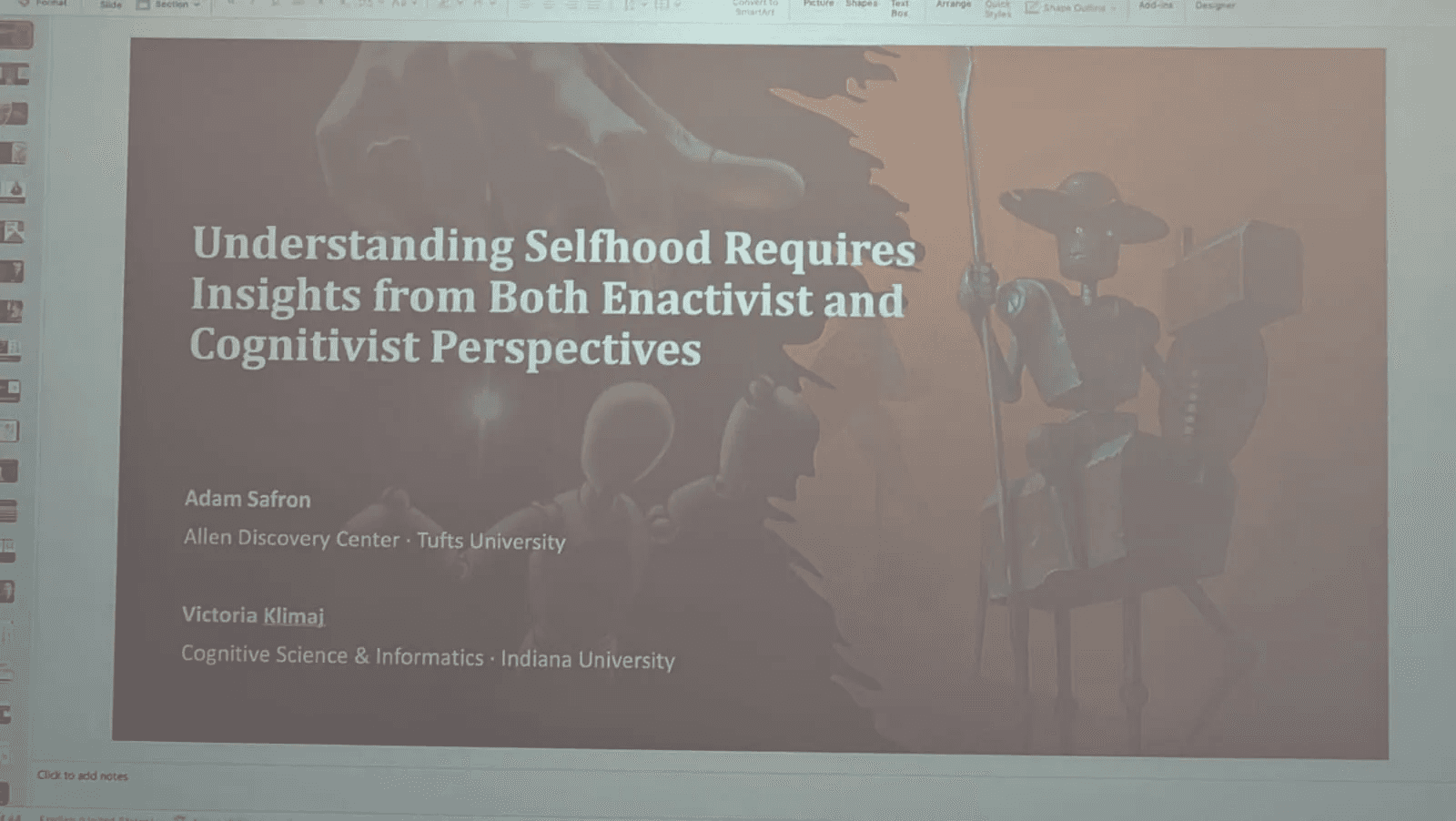
The debate between embodied and functionalist views of mind ran through AGI-26 — here, Adam Safron and Victoria Klimaj on selfhood across enactivist and cognitivist perspectives.
Alison Gopnik made the case that it is children's intelligence, not adults', that we should be studying and modelling. Michael Levin, a synthetic biologist, presented a lifetime of extraordinary discoveries in non-human animals and in cells, showing that intelligence is bound up with structures far beyond complex nervous systems.
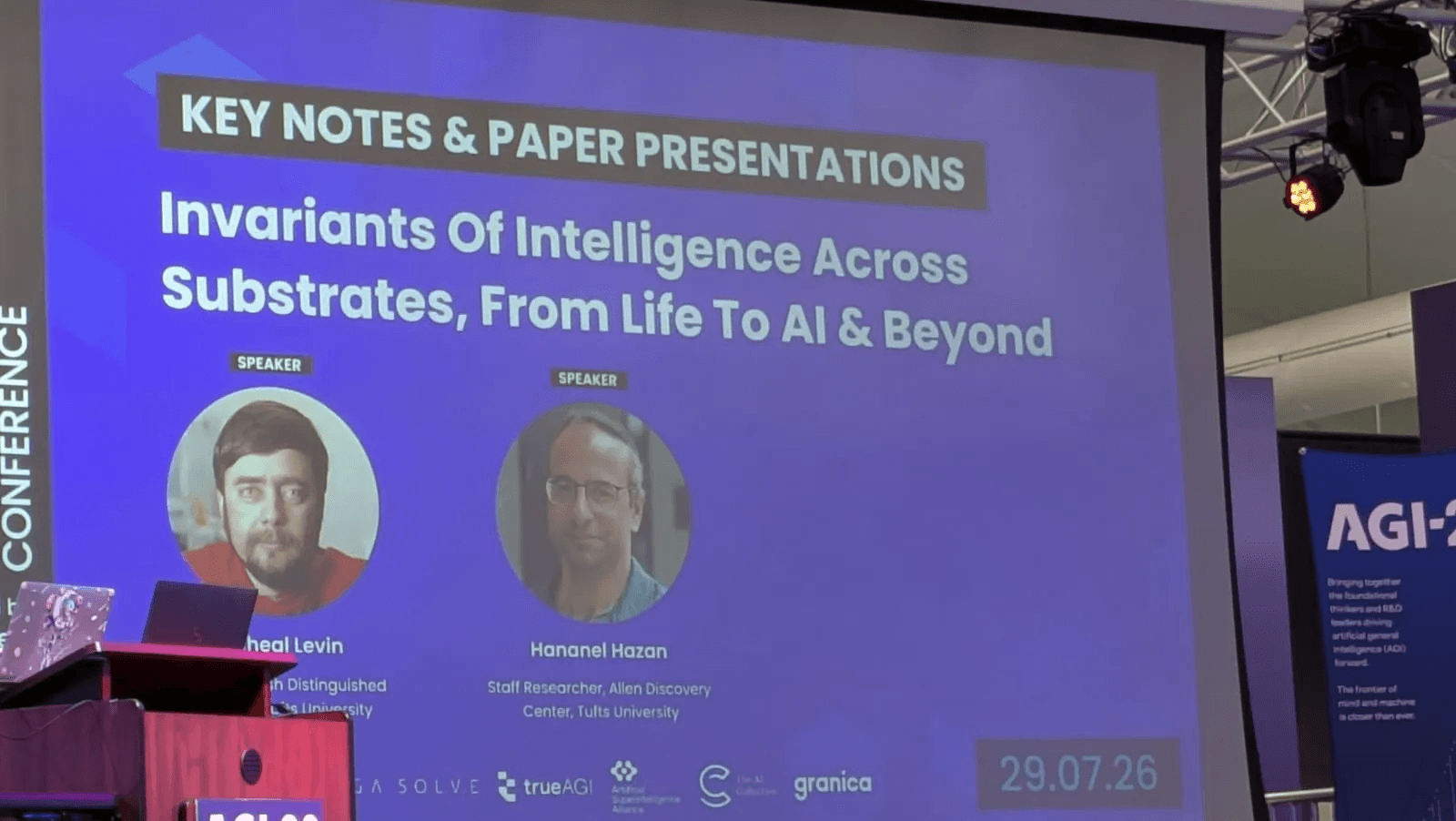
Michael Levin and Hananel Hazan (Allen Discovery Center, Tufts) on the invariants of intelligence across substrates — from living cells to AI and beyond.
We also had time to visit Google's headquarters, home to several Nobel laureates, Demis Hassabis among them. Organiser Ben Goertzel spoke at length about his own AGI project, Hyperon, and about Claw, his agent-communication layer for AGI.
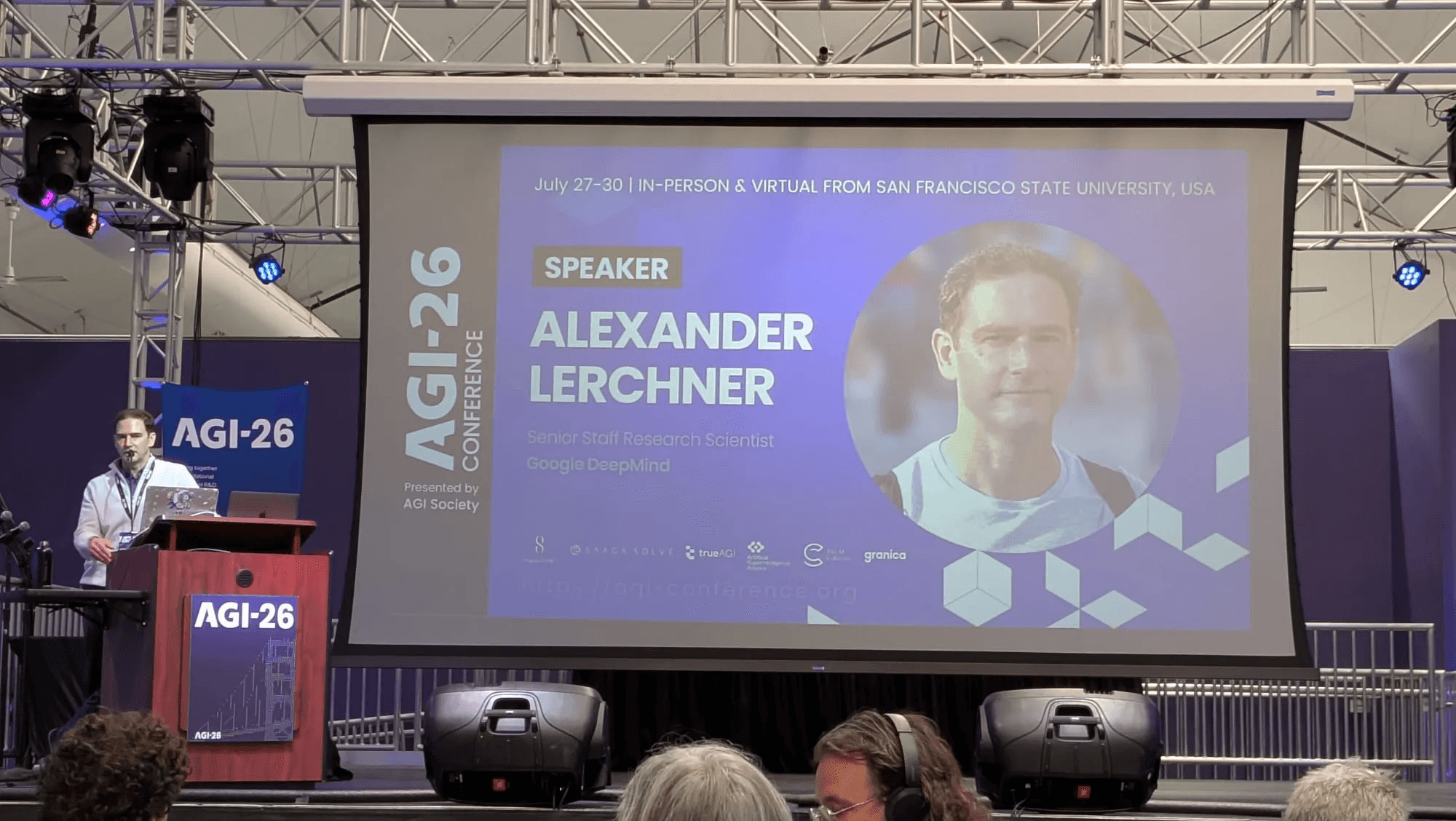
Industry meets academia at AGI-26 — Google DeepMind's Alexander Lerchner on the main stage in San Francisco.
Are We Close to Artificial General Intelligence?
Great speakers --- but, honestly, it seems we are still a long way from AGI. There were remarkable papers and projects on predictive coding and active inference, alongside thoughtful reflections on AI safety, regulation, futures, pitfalls, dangers and purpose. Yet as things stand there is no demonstrated system capable of learning genuinely new tasks without explicit training. For me that is not a bad thing at all. It simply confirms that the goal is a genuinely demanding one. Being part of the Artificial General Intelligence community, with a paper published for Qubic, feels like a real achievement --- and the more papers we publish, the better for the project. So if you ever feel we aren't yet reaching what you imagine, keep it in perspective: nobody has more than a glimpse of it right now.
Onward with Qubic's Open Science Research
Let's keep going with the research.
Thank you to the Qubic community and to CfB for your support. Jet lag, long flights, great effort, but truly rewarding.
Dr. Jose Sánchez. PhD. Neuroscientist.
Qubic Scientific Team
PD: contact me if you wish photos or links of the presenters at info@josesanchezgarcia.com